-
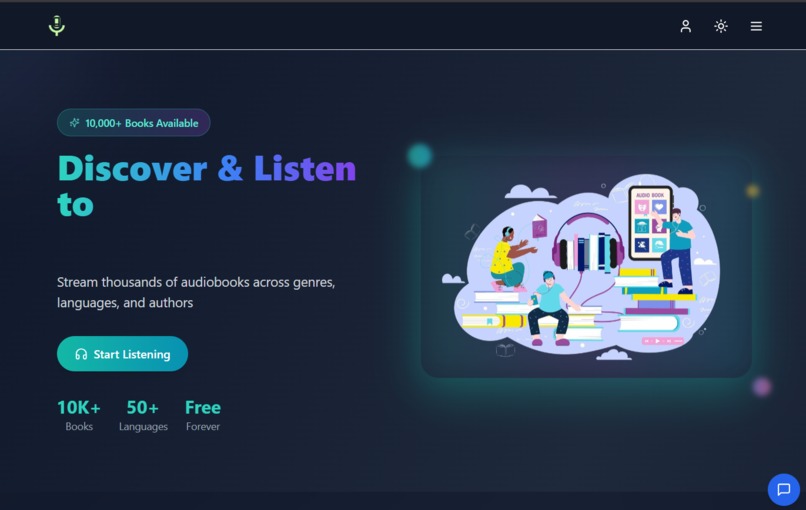
Home page

"From Music to Audiobooks — The Idea Behind BookRadio" I have created a perfect way to listen to books — not just modern ones, but timeless classics from the late 18th, 19th, and 20th centuries. Welcome to BookRadio — a platform with over 10,000 audiobooks, spanning diverse genres, languages, and legendary authors from history.
But how did this idea come to life?
Well, I’m not exactly a bookworm — but I do love a good story. Whether it’s music or spine-chilling fiction, I enjoy listening during my free time. One day, I thought: what if we could listen to classic books — old fiction, detective tales, and timeless adventures — just like we listen to songs? And that’s how BookRadio was born.
So… how did I actually build it?
I wanted to create a user-friendly, interactive, and animated website that not only looks good but also helps users find and enjoy stories effortlessly. So I started exploring — searching for resources that could bring this idea to life. That’s when I discovered LibriVox, a public domain audiobook platform. It turned out to be the perfect match! I used their API to extract rich book metadata — including titles, authors, genres, and languages — and seeded it into my own database. This became the foundation of BookRadio.
I Started seeding the data into my mongoDB through Web Scrapping
MVC helped me separate logic and routes for better maintainability.
My backend was structured using the Model-Controller-Router (MVC/MVR) pattern to ensure scalability, modularity, and maintainability.
Model — Defines the Data Structure
I created Mongoose models for Book and User. These define how data is stored, validated, and indexed in MongoDB.
Controller — Business Logic
Each controller contains the logic for handling specific routes.
Router — Route Handling
My bookRoutes.js file defines the endpoints and connects them to their corresponding controllers.
Middleware- The Middleman
Middlewares played a central role in my backend. They handle: *JWT authentication
Building the frontend part
With the backend logic in place, I shifted focus to building the frontend — where functionality meets design and user experience. Designing the frontend wasn't just about putting components together. It required: 🎯 A strong design system 📱 Responsive layouts ✨ Smooth animations 🧠 Component reusability 🌙 Theme integration “React.js, a widely-used frontend library, was my choice to build a fast, component-driven UI.” To design an interactive and responsive UI, I used Tailwind CSS and Framer Motion for styling and smooth animations.
Challenges which I faced during making of this projects were:
- Making it responsive for all size screens.
- Fetching and Handling Complete Book Metadata.
- Web Scraping for Enhanced Information.
- Designing a Genre Detection Algorithm.
- JWT Authentication and Secure Routing.
Features of BookRadio
- Listen to public domain audiobooks from LibriVox.
- Play individual episodes via inline audio players.
- Full-text search across title, author, genre, description, tags.
- Authentication & Profile
- Feedback form
- User Interface & Experience
How is BookRadio Unique?
- User-First Audio Experience
Built With
- axios
- css
- express.js
- git
- html
- javascript
- jwt
- librivox-api
- mongodb
- node.js
- nodemailer
- react.js
- tailwind-css


Log in or sign up for Devpost to join the conversation.