-
-
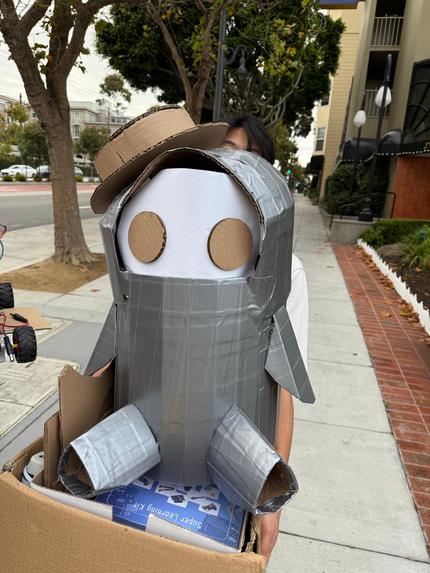
Buns' Avatar.

Inspiration
The inspiration came from wanting to give AR experiences tangible, real-world presence. While AR is immersive, it's still confined to the digital realm - we wanted to break that barrier and let users interact with physical objects through their Spectacles, creating a true bridge between the virtual and physical worlds.
What it does
Buns is an AR-controlled hardware assistant powered by Snap Spectacles. Users can pinch ground positions in AR space, and Buns autonomously navigates to that location in the real world. The system uses:
- Ground plane detection to set navigation targets
- Pathfinding algorithms that calculate angles and distances
- BLE communication between Spectacles and ESP32-controlled stepper motors
- Autonomous navigation with turn-and-move logic to reach the target position
How we built it
Hardware Stack:
- Snap Spectacles
- ESP32 microcontroller as BLE bridge
- 2 Arduino Unos controlling 4 stepper motors (28BYJ-48 with ULN2003 drivers)
- 4-wheel differential drive robot platform
Software Stack:
- TypeScript in Lens Studio for Spectacles AR interface
- BLE GATT protocol for wireless communication (custom service/characteristic UUIDs)
- Arduino C++ for motor control logic
- Ground plane interaction using Spectacles' spatial mapping
- Custom pathfinding algorithm with angle calculation (atan2), turn alignment (5° threshold), and distance tracking
Development Process: Built iteratively from gesture control → motor control → ground interaction → autonomous navigation.
Challenges we ran into
- Motor direction debugging - Stepper motors had inverted directions that required extensive testing and flipping of individual motor polarities across multiple Arduinos
- Touch/tap detection - Initial gesture detection methods failed; had to experiment with InteractionComponent, TapGestureModule, and ultimately ground plane pinching
- BLE communication reliability - Managing string-based command protocol and ensuring consistent data transmission
- Coordinate system mapping - Translating AR space coordinates to robot movement commands while accounting for relative positioning
- Pathfinding calibration - Tuning turn angles (degrees per command) and distance per step for accurate navigation
Accomplishments that we're proud of
- Seamless AR-to-hardware pipeline - Successfully bridged Spectacles AR input to physical robot movement via BLE
- Autonomous ground-target navigation - Robot can pathfind to user-selected positions without manual control
- Multi-Arduino coordination - Orchestrated 4 stepper motors across 2 Arduinos with synchronized commands
- Intuitive gesture interface - Natural pinch-on-ground interaction feels magical and requires no learning curve
- Working prototype from scratch - Built entire system from concept to functional demo using official Snapchat samples as foundation
What we learned
- BLE protocol implementation and GATT services for IoT communication
- Stepper motor control patterns and timing considerations
- Spectacles Lens Studio development and spatial computing APIs
- Coordinate system transformations between AR and physical space
- Pathfinding algorithms (angle calculation with atan2, turn-align-move logic)
- Hardware debugging techniques for motor polarity and direction issues
- The importance of iterative testing when bridging digital and physical systems
What's next for Buns
- Obstacle avoidance using ultrasonic sensors
- Voice commands for more complex interactions ("Buns, go to the kitchen")
- Object manipulation - Add a gripper arm for pick-and-place tasks
- Multi-robot coordination - Control multiple Buns units simultaneously
- Visual feedback - LED indicators on the robot showing status
- Improved pathfinding - A* algorithm for complex route planning around obstacles
- Persistent memory - Save favorite locations and patrol routes
- Computer vision integration - Let Buns recognize and respond to objects/people in its environment
Built With
- arduino
- c++
- snap
- spectacles
- typescript




Log in or sign up for Devpost to join the conversation.