-
-

Care4You Logo
-
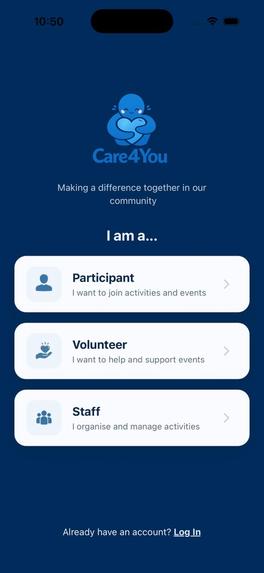
Onboarding page


Care4You
Inspiration
Social care organisations often run multiple programmes and activities at the same time, supported by staff, volunteers, caregivers, and participants. However, activity coordination is commonly handled through fragmented tools such as Google Forms, spreadsheets, chat messages, and manually designed posters.
From our observations, this fragmentation leads to duplicated registrations, unclear schedules, missed updates, and significant administrative burden on staff. Participants and volunteers often lack clarity on whether they have successfully registered, while staff spend many hours each week manually coordinating attendance and communications.
This inspired us to build Care4You — a single platform that simplifies activity coordination for everyone involved.
What it does
Care4You is an all-in-one activity management platform for participants, volunteers, and staff.
It allows:
- Staff to create and publish activities in one place
- Participants and volunteers to browse and register for activities through a unified calendar, with receive of instant confirmation upon successful registration -Guest users to register for activities without creating an account, while still retaining their registrations if they choose to sign up later
- Organisations to broadcast announcements and updates to all users
- Exportable participation and attendance records in CSV format, enabling easy reporting and integration with existing workflows
By centralising these processes, Care4You reduces confusion, prevents double bookings, and significantly cuts down manual administrative work.
How we built it
We designed Care4You with a role-based architecture, ensuring that each user type — participant, volunteer, or staff — only sees features relevant to them.
We began the project by focusing on deployment and infrastructure setup. As a team more familiar with local Node.js development, we invested time early on to research and configure Google Cloud hosting, ensuring the platform could run in a production-like environment from the start.
To parallelise development, the team split responsibilities:
Yi Jie focused on UI/UX design using Figma, prioritising clarity and accessibility for social care contexts
Jay member handled the Expo and Github setup
Yee Siang set up Google Cloud services and deployment, including CI/CD integration
Feature development was then divided across the team:
- Authentication flows (login, sign-up, profile management)
- A unified calendar view with activity cards and announcement visibility
- A “My Events” section to retrieve registered activities and generate CSV exports
Midway through development, we decided to introduce guest mode to improve accessibility. This required learning how to securely store data on the local device, persist registrations across sessions, and ensure a smooth transition if a guest later chose to create an account.
Throughout the build, we prioritised simplicity, reliability, and real-world usability, ensuring the platform could be adopted without extensive training.
Challenges we ran into
One of our main challenges was deployment and infrastructure setup. Our team was more familiar with developing applications locally using Node.js, but less experienced with deploying services on Google Cloud. A significant amount of time was spent researching cloud hosting, configuring services, and understanding how to securely deploy and run the application in a production-like environment.
Another technical challenge was implementing guest mode. We had to learn how to reliably store user data on the local device, ensure registrations persisted across sessions, and design a smooth transition so that guest data could be retained if users later decided to create an account.
Balancing these technical challenges with limited hackathon time required careful prioritisation and constant iteration.
Accomplishments that we're proud of
- Successfully building a working end-to-end platform within a limited timeframe
- Designing a system that supports multiple user roles without increasing complexity
- Creating a unified calendar experience that replaces fragmented sign-up tools
- Implementing a guest mode that allows users to register event and track activities without an account, while retaining their data if they sign up later
- Building an announcement system that notifies users when new activities are created or updated
- Delivering accurate, exportable CSV records without forcing organisations to change existing reporting processes
What we learned
Through this project, we learned that simplicity is often more impactful than automation. In social care settings, reducing cognitive load and administrative friction can make a bigger difference than adding advanced features.
By speaking directly with elderly users, we discovered that many do not have or regularly use email accounts, making traditional sign-up flows a significant barrier. Requiring account creation upfront would unintentionally exclude the very users the platform aims to support.
This insight led us to design a guest login flow, where registration data is saved locally on the user’s device. Guest users can still track their registered activities, and if they choose to create an account later, their existing data is retained seamlessly.
We also gained valuable experience in:
- Designing role-based systems
- Translating real-world operational pain points into technical solutions
- Building products that prioritise trust, clarity, and accessibility
What's next
NFC Check-in Instant tap-to-verify participation at activity locations, further reducing manual verification and staff workload.
AI Recommendations Personalised activity suggestions based on user participation history and engagement patterns.
In-App Messaging Direct messaging between staff, participants, and volunteers to handle questions, reminders, and follow-ups without relying on external chat apps.
Singpass Integration Secure identity verification for high-trust volunteer roles and streamlined authentication for caregivers and seniors.


Log in or sign up for Devpost to join the conversation.