-
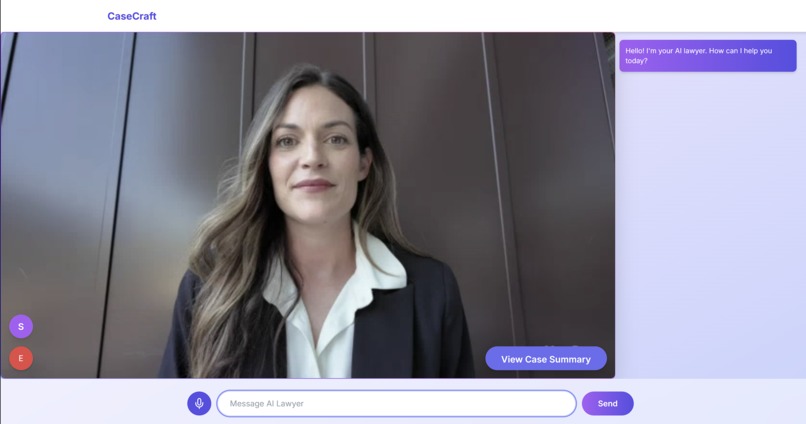
AI Lawyer that Talks and Moves
-
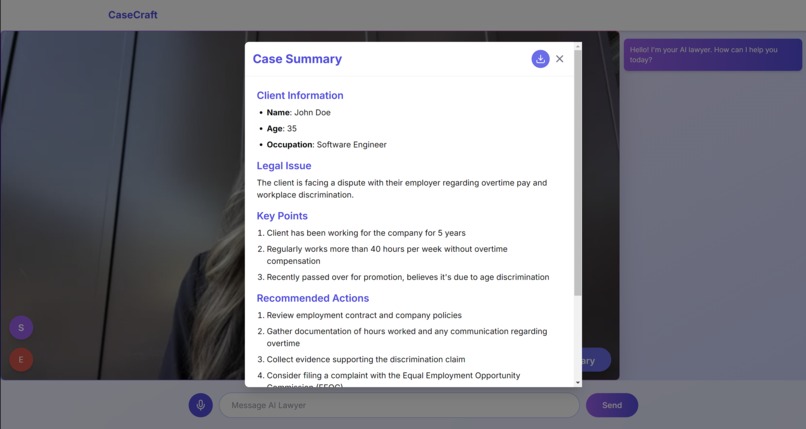
Case study generation
-
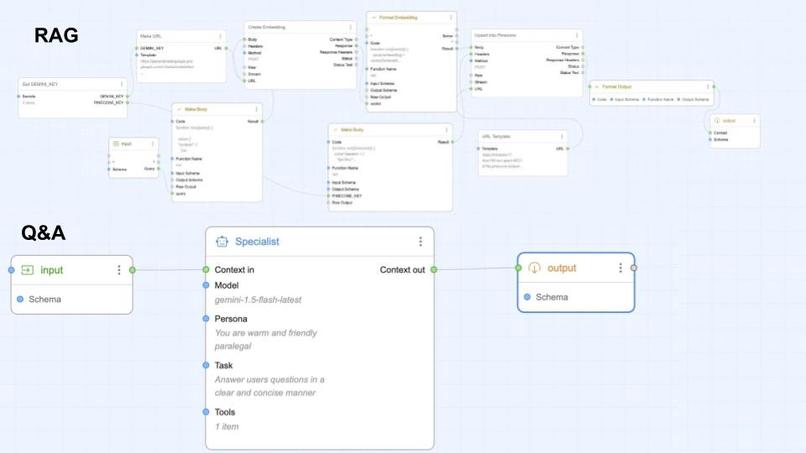
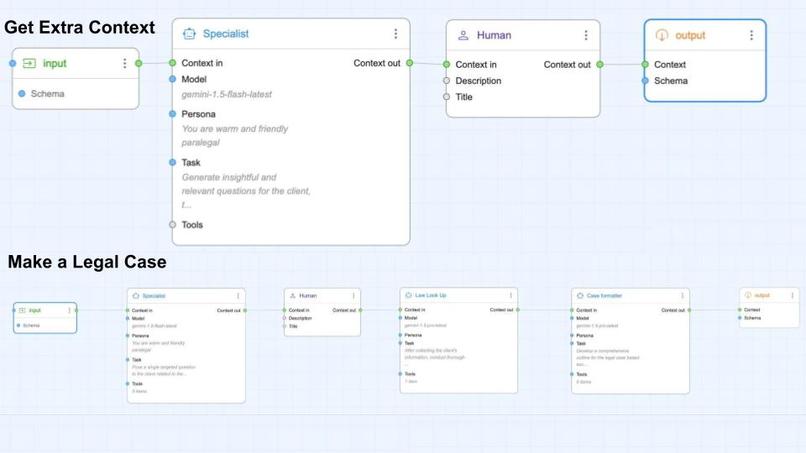
Google Breadboard implementation
-


Inspiration
92% of significant civil legal issues faced by low-income Americans go unanswered. With legal fees climbing higher and higher, countless people are deprived of the support they desperately need in moments of profound vulnerability. Behind each percentage lies a story of someone lost in the labyrinth of our legal system, abandoned when they needed guidance the most. A staggering 86% of civil legal problems reported by low-income individuals are either inadequately addressed or, worse, completely ignored. This isn't just a statistic—it’s a call to action.
What it does
Our platform is on a mission to revolutionize access to justice, offering free legal advice and services to everyone—no matter their financial situation, background, or circumstance. We believe that no one should be denied the right to expert legal support. Our goal is to level the playing field, empowering individuals to build strong cases and make meaningful appeals without the burden of cost.
How we built it
We developed our front-end using the Next.js framework with React, integrating Tailwind CSS for streamlined styling and a responsive UI. On the back end, we leveraged Google's AI Breadboards with Gemini to construct complex LLM agent swarms and task chains, enabling powerful AI-driven functionalities. For voice interaction, we employed Cartesia's Sonic for text-to-speech conversion and Groq for speech-to-text processing. We used Pinecone for our vectorstore. Our solution was containerized using Flask, providing a lightweight, scalable environment for deployment.
Challenges we ran into
One of the key challenges we faced was setting up seamless lip sync between the AI-generated voice and the video to create a more human-like experience.
Integrating the speech-to-text API and leveraging Groq for efficient processing also posed difficulties.
On top of that, we encountered several roadblocks when connecting the backend to the frontend, particularly with API endpoints and CORS errors. However, after some troubleshooting and problem-solving, we were able to resolve these issues successfully.
Lastly, we faced challenges with the final breadboard setup. It was initially difficult to configure, but after exploring and fine-tuning the model, we were able to make it work effectively.
Accomplishments that we're proud of
Our UI Assistant is unlike anything we have personally encountered. If we didn’t build it, we could have mistaken it for a real human both in look and sound. We are also proud of backend agent swarm that can break down legal questions and create legal cases.
What we learned
We learned how to make AI UIs that can adapt to each user while also making low latency text-to-speach and speech-to-text. This hack particularly required us to connect a lot of components building a strong understanding of WebSockets and API creation.
What's next for CaseCraft
To elevate our pro-bono marketplace and enhance its impact in the legal industry, we will conduct research to identify the specific legal needs of underserved communities and develop a user-friendly platform that connects individuals with legal consultants. By implementing a review system for consultants and partnering with law schools and legal aid organizations, we can create trust and build a network of qualified professionals. On the technical side, we will focus on integrating an API to facilitate seamless communication between users and consultants, utilizing machine learning algorithms to improve the matching process, and ensuring data security measures to protect user information. Regularly monitoring metrics to assess effectiveness and expanding outreach efforts will further ensure that our marketplace effectively supports those in need of legal assistance.


Log in or sign up for Devpost to join the conversation.