-
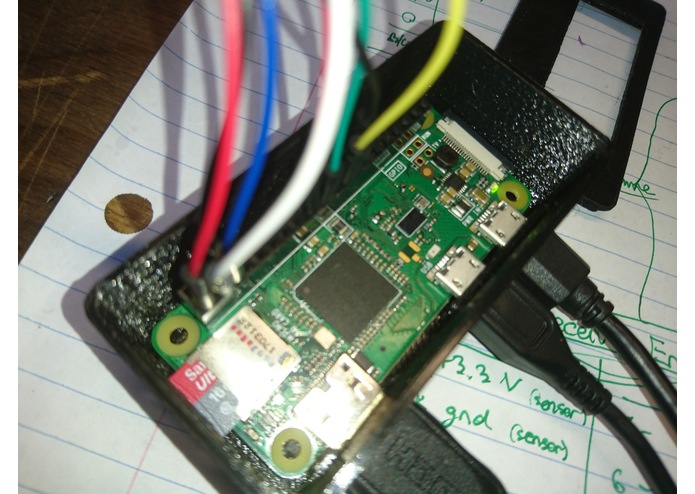
Raspberry Pi Zero W
-
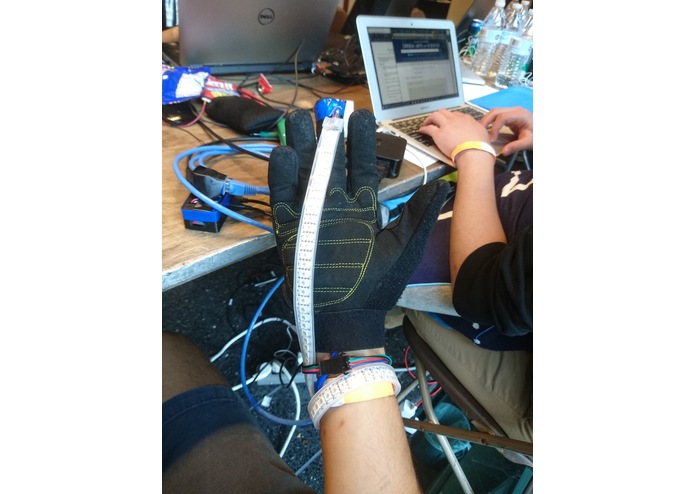
The completed glove
-
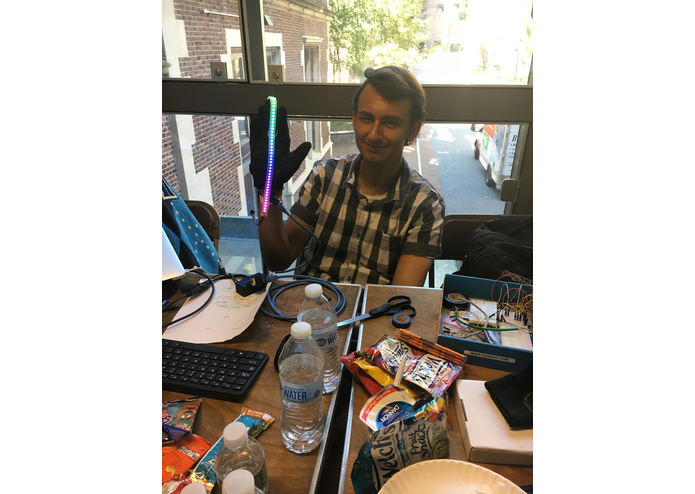
Cameras don't capture the effect very well so come to our demo!


Inspiration
In 2016, MIT Media Lab created a project called Fluxa, a new means to communicate by using a customized Arduino circuit with an LED strip to display text. Users could pre-program or use an app to load an image into the device, and the LED would light up intermittently to construct the image once the users waved their hands. Inspired by this project, we attempted to recreate the project and explore further applications of human-computer interaction.
For the paper on the MIT Media Lab project: http://fluid.media.mit.edu/sites/default/files/Fluxa-UIST-CR.pdf
The two phenomena that makes the project work is the Persistence of Vision and the Phi Phenomenon. The POV effect prevents instant blindness whenever we blink: "Whenever light strikes the retina, the brain retains the impression of that light for about a tenth of a second - depending on the brightness of the image - after the source of that light is removed from the eye...As a result, the eye cannot clearly distinguish fast changes in light that occur faster than this retention period." We can process up to 10-15 images per second.
For more information about POV: http://www.foundationsmag.com/persistence_of_vision.html
What it does
FlashDance reads information onto a display generated by hand motions. It applies the Persistence of Vision effect to a wearable device.
How we built it
Our project was built using a Raspberry Pi Zero W and a DeWalt work glove. The Adafruit LSMD9S0 peripheral to detects and measures hand motions. Mokungit RGB LED strip contains individually addressable LEDs over APA102 protocol. The Elechous PN532 is an embedded RFID reader and writer. The peripherals are enclosed in a 3D-printed case within the glove.
Challenges we ran into
On the first night, our PCB board broke. We had to remap the wires connecting the Raspberry Pi to the peripherals. Even after we thought we had finished the prototype, the wires broke within the tape, resulting in numerous Remote I/O errors. We also struggled to control the Raspberry Pi over WiFi.
Publicly available information on Fluxa was very limited. We had to re-engineer the project using Python on Raspberry Pi instead of Arduino C.
We sought to understand Madgwick’s IMU and AHRS sensor fusion algorithms for tilt orientation, but had a lot of difficulty implementing them. We ultimately found that the z-axis of the gyroscope reading was all that was necessary for displaying text.
Recreating the project required more time than expected. We ran out of time to create a web/mobile app user interface for the gloves, where the user would choose the color and text for the display. Flashdance cannot display very long messages. We were unable to fully realize our intended applications of this wearable technology.
Accomplishments that we're proud of
Ultimately, we successfully replicated the effects of the MIT Media Lab project. We wired the peripherals through the Raspberry Pi.
The display detects whether the wearer of the glove is moving. It is activated and deactivated by the wearer’s motion. We created an alphabetic/emoji dictionary to write messages. The text of the messages can be easily read.
We minimized cost, time, and power consumption in this project. We had so much fun learning more about new technology!
What we learned
We learned to stabilize wiring connections, how to interface an accelerometer, gyroscope, and magnetometer with the Raspberry Pi, and how to control the LED light strips.
We learned more about the science behind retinal afterimages, why the project worked.
We learned that waving one's arms is a very fun workout.
What's next for FlashDance
- Create mobile user interface to create custom messages and images
- Integrate RFID into function
- More text capability
- Images (e.g. weather data)
- Another glove
- Potential Bluetooth capabilities
Applications
- Communication: make messages more complex, add more emojis
- Fashion: add more patterns, integrate lights with other types of clothing
- Security: tapping the glove to an object will process the input
- Gaming: use glove to play simple games
- Fitness: track and display progress, create fun and artistic workouts
- Art: performance art, concerts
Built With
- lsm9d50
- mokungit
- pn532
- python
- raspberry-pi


Log in or sign up for Devpost to join the conversation.