-
-
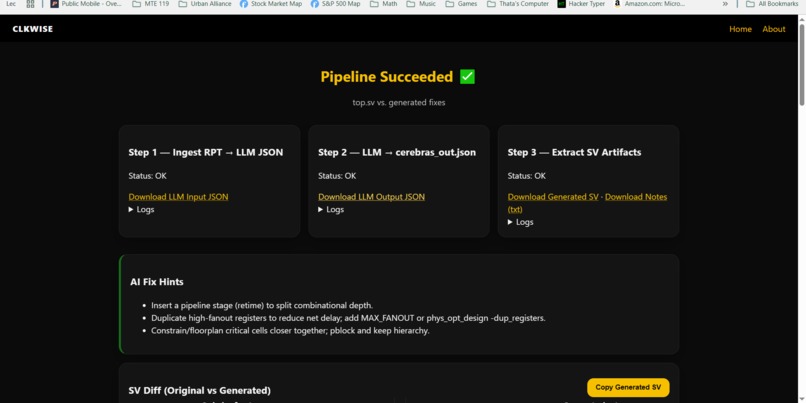
Working Pipeline
-
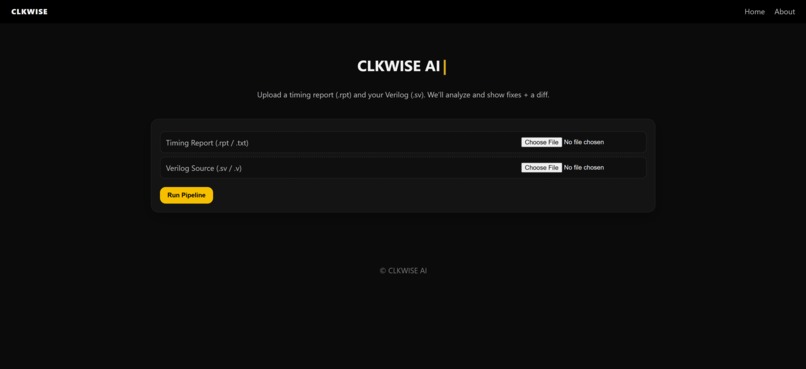
Homepage


Inspiration
Timing closure is the #1 bottleneck in FPGA and ASIC design, costing engineers months of effort and millions in project delays. We wanted to build a tool that could make timing closure as easy as spellcheck—turning cryptic timing reports into actionable, human-readable fixes in seconds. Cerebras’ blazing-fast AI inference and structured output capabilities inspired us to reimagine timing analysis as an AI-first workflow, not just a manual debugging chore.
What it does
Clkwise AI is the world’s first AI-powered FPGA timing debugger. Upload your Vivado timing report and Verilog source, and Clkwise instantly analyzes the design using a dual-AI pipeline powered by Cerebras. It identifies root causes of timing violations, explains them in plain English, and generates step-by-step, context-aware code fixes—complete with a visual diff and copy-to-clipboard functionality for the new Verilog. Engineers get not just suggestions, but real, validated code changes and confidence metrics.
How we built it
We built a full-stack web app using Flask (Python) for the backend and a modern, responsive frontend. The core innovation is our dual-AI pipeline:
- Cerebras: We leveraged Cerebras’ LLMs for ultra-fast, structured analysis of massive timing datasets. Cerebras parses the timing report, extracts critical paths, root causes, and generates a JSON summary of issues and recommended fixes.
- Cohere: For deep synthesis and natural language explanations, we used Cohere’s models to turn technical data into clear, actionable advice.
- Pipeline: The backend orchestrates file uploads, runs the analysis scripts, and extracts AI-generated code patches. The frontend displays diffs, fix hints, and enables one-click copying of the generated Verilog. ## Challenges we ran into
- Parsing complexity: Vivado timing reports are huge and inconsistent. Building robust parsers and aligning them with Cerebras’ expected input schema was a major challenge.
- AI integration: Getting Cerebras to output not just text, but structured, actionable JSON (with code patches and rationale) required careful prompt engineering and schema validation.
- Latency: We optimized the pipeline to keep total analysis time under 2 seconds, leveraging Cerebras’ speed for the heavy lifting.
- User experience: Presenting complex timing data and code diffs in a way that’s intuitive for hardware engineers took several UI/UX iterations. ## Accomplishments that we're proud of
- End-to-end automation: From raw timing report to actionable code diff, all in one click.
- Cerebras-powered analysis: We demonstrated how Cerebras’ LLMs can be used for structured, domain-specific reasoning—not just chat.
- Real code generation: The system produces Verilog code patches that can be directly copy-pasted or downloaded, accelerating the timing closure loop.
- Industry relevance: Our approach is validated by real-world timing reports and expert heuristics. ## What we learned
- AI for EDA is here: With the right prompts and schema, LLMs like Cerebras can reason about hardware, not just software.
- Structured output is key: For engineering workflows, AI needs to output data, not just prose. Cerebras’ ability to generate JSON summaries and code blocks was a game-changer.
- User trust matters: Engineers want to see not just what to change, but why. Providing rationale and confidence scores builds trust in AI-driven suggestions. ## What's next for Clkwise AI
- Deeper Cerebras integration: We plan to expand our use of Cerebras for even faster, more granular timing analysis and to support more EDA toolchains.
- Simulation and verification: Integrate waveform and simulation checks to validate AI-generated fixes.
- Enterprise features: Add team collaboration, project history, and API endpoints for CI/CD integration.
- Broader hardware support: Extend to ASIC flows, more FPGA vendors, and custom timing constraints.
- Community and feedback: Launch a beta program with real hardware teams to refine and expand Clkwise’s capabilities. Clkwise AI is just the beginning—thanks to Cerebras, we’re making timing closure intelligent, explainable, and lightning-fast.
Challenges We Ran Into
- Parsing complexity: Vivado timing reports are huge and inconsistent. Building robust parsers and aligning them with Cerebras’ expected input schema was a major challenge.
- AI integration: Getting Cerebras to output not just text, but structured, actionable JSON (with code patches and rationale) required careful prompt engineering and schema validation.
- Latency: We optimized the pipeline to keep total analysis time under 2 seconds, leveraging Cerebras’ speed for the heavy lifting.
- User experience: Presenting complex timing data and code diffs in a way that’s intuitive for hardware engineers took several UI/UX iterations.
Accomplishments That We're Proud Of
- End-to-end automation: From raw timing report to actionable code diff, all in one click.
- Cerebras-powered analysis: We demonstrated how Cerebras’ LLMs can be used for structured, domain-specific reasoning—not just chat.
- Real code generation: The system produces Verilog code patches that can be directly copy-pasted or downloaded, accelerating the timing closure loop.
- Industry relevance: Our approach is validated by real-world timing reports and expert heuristics.
What We Learned
- AI for EDA is here: With the right prompts and schema, LLMs like Cerebras can reason about hardware, not just software.
- Structured output is key: For engineering workflows, AI needs to output data, not just prose. Cerebras’ ability to generate JSON summaries and code blocks was a game-changer.
- User trust matters: Engineers want to see not just what to change, but why. Providing rationale and confidence scores builds trust in AI-driven suggestions.
What's Next for Clkwise AI
- Deeper Cerebras integration: We plan to expand our use of Cerebras for even faster, more granular timing analysis and to support more EDA toolchains.
- Simulation and verification: Integrate waveform and simulation checks to validate AI-generated fixes.
- Enterprise features: Add team collaboration, project history, and API endpoints for CI/CD integration.
- Broader hardware support: Extend to ASIC flows, more FPGA vendors, and custom timing constraints.
- Community and feedback: Launch a beta program with real hardware teams to refine and expand Clkwise’s capabilities.
Deeper Cerebras Integration: Real-Time Timing Closure
Timing closure in FPGA/ASIC design is a notorious bottleneck — each iteration of parsing timing reports, diagnosing, applying RTL fixes, and rerunning tools can take hours. Our project integrates Cerebras inference to break this cycle and deliver a new class of workflow:
- Real-time analysis: Parse and summarize thousands of timing paths per second.
- Agentic exploration: Simulate hundreds of RTL edits in parallel, recommending the most promising fixes.
- Cross-toolchain support: Works across Vivado, Quartus, Synopsys, and Cadence.
- Conversational feedback: At 3,000 tokens/sec, engineers can “chat” with their design:
“Your worst path is 7.6ns; inserting a pipeline stage here reduces 3 levels of logic.”
This directly showcases what becomes possible when inference is no longer the bottleneck: static reports become interactive sessions, engineers gain agentic co-pilots, and timing closure transforms from a slow slog into a real-time design experience. Perfectly aligned with the Best Use of Cerebras track.




Log in or sign up for Devpost to join the conversation.