-
-
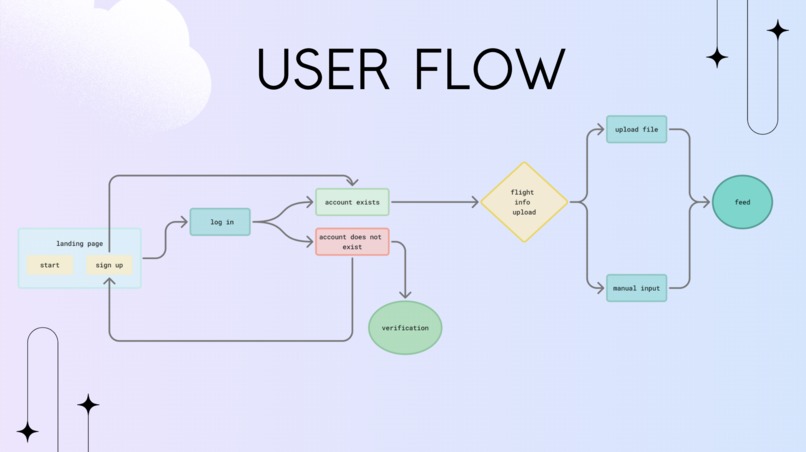
Overview of how users move through the platform from start to finish.
-
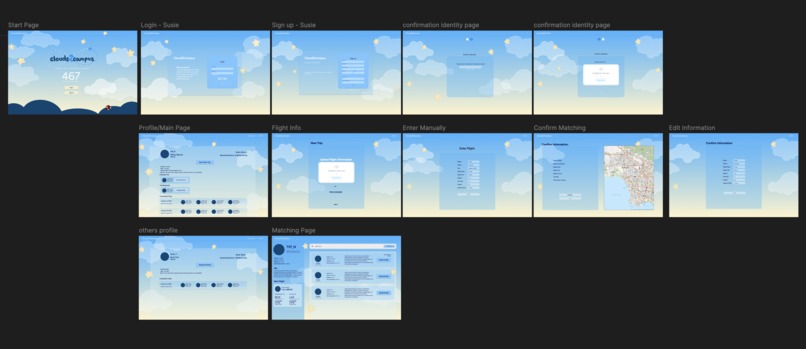
Our Figma prototype for all UI pages
-
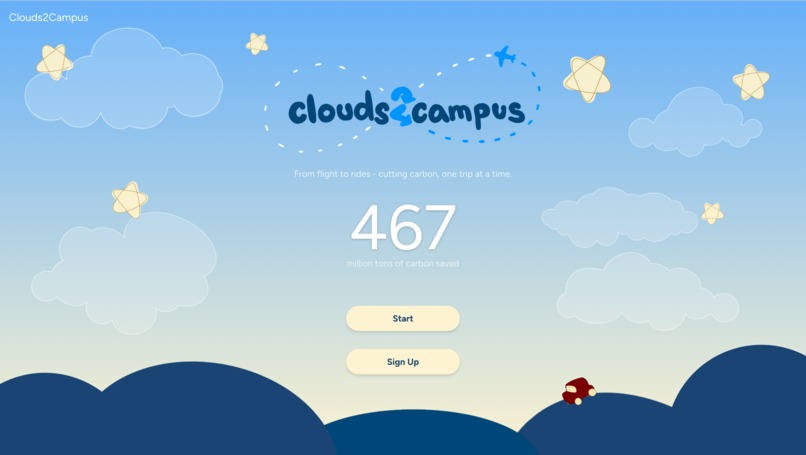
Landing page
-
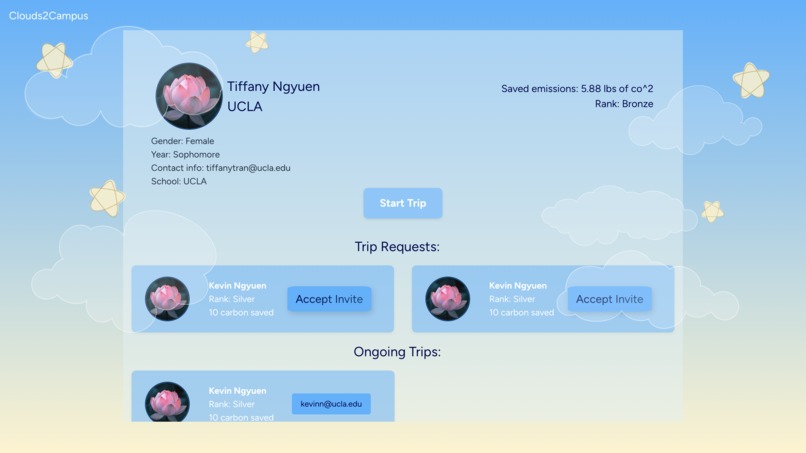
User profile, data saved and retrieved through MongoDB
-
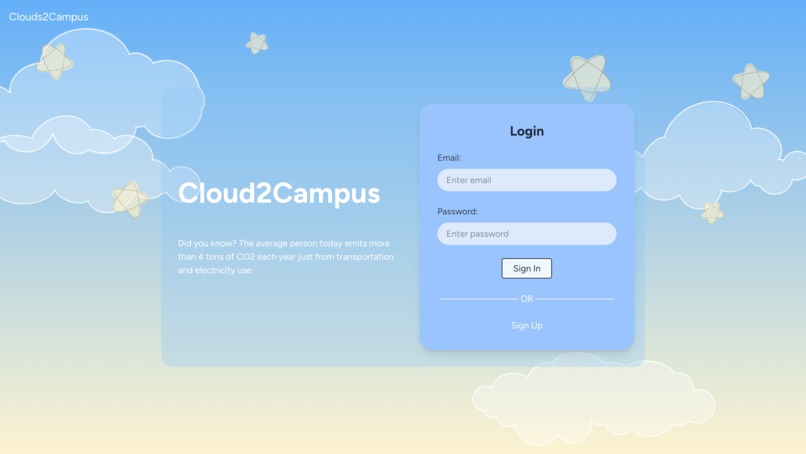
Log in page
-
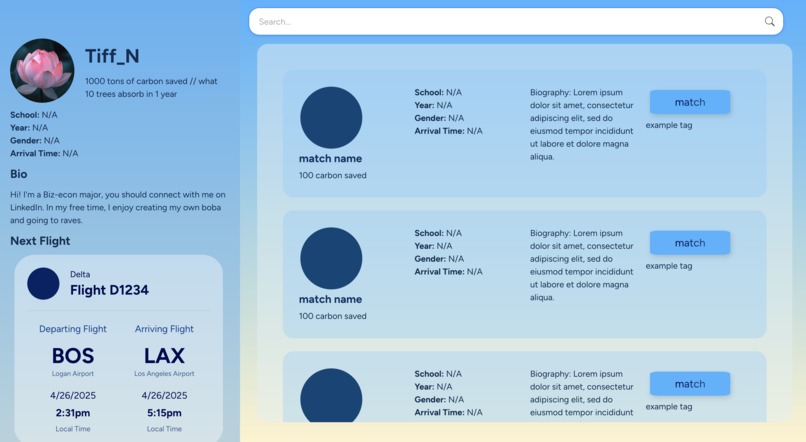
Matching feed to find other students with similar flight arrival time


Inspiration
The last thing anyone wants to do is take a flight just to endure three hours of mixed-modal transport. For college students, the journey from the airport to campus can be a stressful, expensive, and time-consuming experience. Public transportation is unreliable and ridesharing is costly, leaving students with few choices for getting to campus efficiently.
Our platform aims to change that by offering a smarter, greener, and more cost-effective way to travel. Our approach not only helps students save money but also contributes to reducing carbon emissions through more sustainable ridesharing.
From clouds to campus, we’re cutting carbon, one trip at a time.
What it does
Our platform solves this by matching students based on flight arrival times and connecting them with peers. This allows students to plan rides back to campus ahead of time, reduces travel costs, and decreases carbon emissions. Each individuals' information is securely stored in a database and preserved with each log in, guaranteeing preserved progress even if you decide to come back at another time.
We also address safety concerns by verifying users through their school emails, ensuring only legitimate students are accessing the platform. Contact information is shared only after mutual approval. It’s not just a ridesharing solution; it’s a social networking opportunity for students to connect with peers. Our goal is simple: make travel more affordable, accessible, and eco-friendly for students, while creating a connected community. Whether you’re traveling back home for the holidays or returning to campus, this website is your perfect travel companion.
How we built it
We used React and Javascript to build the frontend of each page, while integrating the Gemini API to parse through PDF files and extract specific components of a flight itinerary. We also seamlessly integrated visual elements using Tailwind for our CSS. To manage the backend database, we used Node.js and Express.js with MongoDB to store user data, including their email, password, flight information and personal tags. The application also utilizes the nodemailer module to verify each new user.
Challenges we ran into
With only one developer on the team, it was difficult picking up pace with the development. As the team's developer focused on implementing the backend and Gemini API for the website, the three first-time hackers found themselves progressing with the frontend UI rather slowly. Nevertheless, we were able to collaborate with our different skillsets, discuss solutions, and compile a standard (for example, common GitHub commands for pushing and pulling) to avoid any conflicts that could lead to large scale damage in our application.
Accomplishments that we're proud of
This project has a tangible, positive impact on both the environment and students. By facilitating shared rides, it directly reduces carbon emissions. Beyond the environmental benefits, it builds a stronger student community, allowing users to connect with peers on the same journey, whether for a ride or a lasting friendship.
We are proud of using React, HTML, CSS, and JavaScript to create an aesthetic interface (thanks to our wonderful designer) that ensures an intuitive user experience. In addition, we’ve implemented a user-friendly sign-up/sign-in process, allowing users to upload their profile pictures and relevant documents for a more personalized experience.
What we learned
With three first-time hackers and one developer on the team, this experience was a large learning curve for all of us. From learning to push and pull from GitHub, resolving merge conflicts, to bringing our Figma prototype to code, our first-time hackers learned frontend development using JavaScript, along with CSS and Tailwind. Our developer learned to connect a backend to the frontend design while leveraging a database to store user information. She also learned to use Gemini for document understanding and retrieving specific information through effective prompt engineering.
What's next for Clouds2Campus
Our platform is currently only built for UCLA students in mind, however, it is designed to scale. With MongoDB for flexible data storage, we can easily handle increasing user data as we expand to more universities. We plan to add a tag for each student to indicate their university, making it easier to filter between all suggested matches. Although carbon footprint tracking is still in development, the core features—school verification and carpool coordination—can easily be adapted for large-scale deployment. As the platform grows, we can accommodate campuses nationwide, allowing students from various schools to connect and share rides seamlessly.
Built With
- css
- express.js
- figma
- html
- javascript
- mongodb
- node.js
- nodemailer
- react
- tailwind


Log in or sign up for Devpost to join the conversation.