-
-
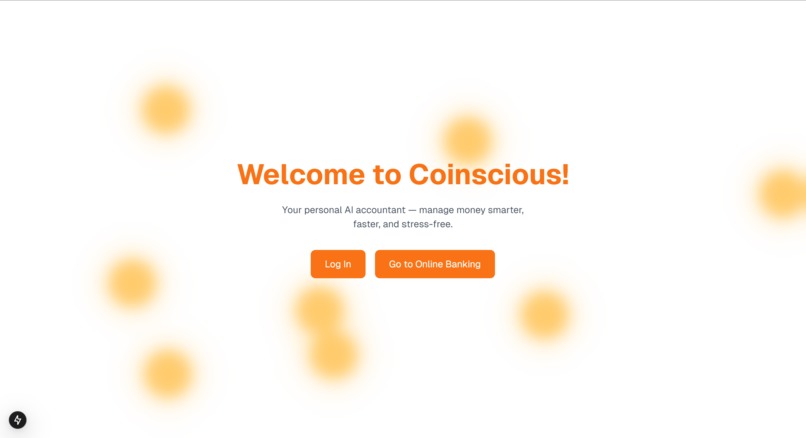
Landing Page
-
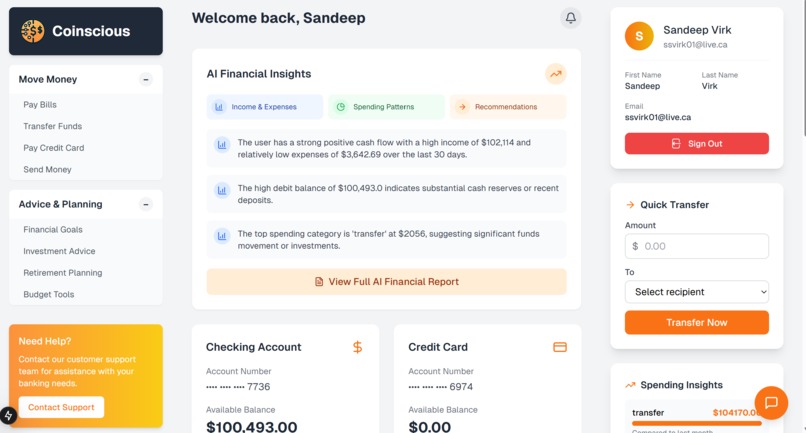
Bank Home
-
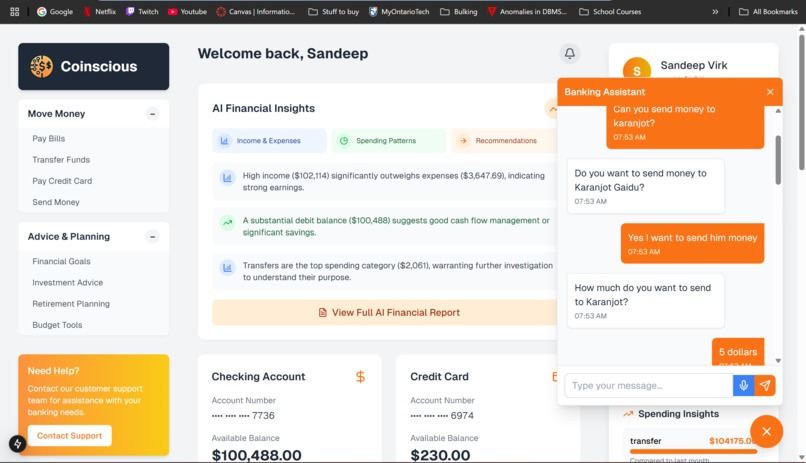
Chat
-
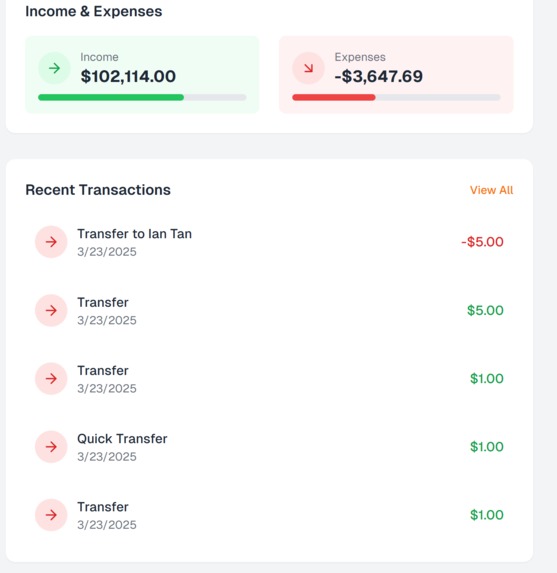
Transactions
-
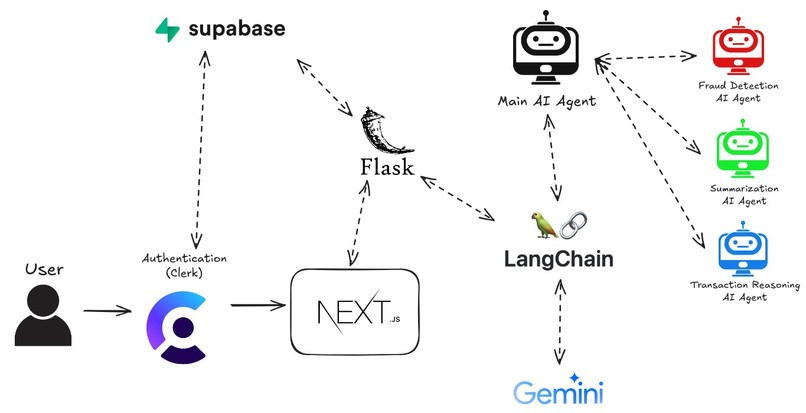
Diagram


Inspiration🚀🚀🚀
Our inspiration stemmed from a simple but powerful observation: financial illiteracy is alarmingly widespread, especially among youth. According to the National Financial Educators Council, the average U.S. adult lost $1,819 in 2022 due to a lack of personal finance knowledge. Similarly, a 2023 survey by FINRA revealed that nearly two-thirds of Americans are unable to pass a basic financial literacy test.
What’s more concerning is that most youth do not receive adequate financial education until they are already adults, often left to figure out how to budget, invest, file taxes, or build credit on their own. In schools, finance is rarely prioritized, and many young adults feel overwhelmed and underprepared when they start earning.
To make matters worse, hiring professional accountants or financial advisors is a luxury that many can’t afford. The average hourly rate for an accountant is $150–$400, making these services inaccessible to a huge portion of the population, especially students or low-income individuals.
What it does 🪙🪙
We wanted to build an intelligent, accessible, and always-available alternative—something that could provide smart financial advice, help with budgeting, analyze transactions, and even simulate sending money.
Our web app serves as a personal AI-powered accountant and financial advisor that travels with you wherever you go. Once signed in, users have access to a chat-based AI agent that can intelligently analyze past spending, simulate transactions, check for fraudulent activity, and offer personalized financial advice based on age and interests. It can also retrieve up-to-date financial trends using Retrieval-Augmented Generation (RAG). Whether you're asking "Can I afford this?", "Where did I spend most last month?", or "Is this transaction suspicious?", the AI agent selects the right tool on its own and gives meaningful, actionable feedback in real time.
How we built it 🔨🔨
🧱 Tech Stack
- To bring this idea to life, we built a full-stack web application using:
- Next.js (Frontend): For a modern and responsive user interface
- Flask (Backend): To connect our app with data and AI processing
- Supabase: As our primary database for storing user profiles, transactions, and wallets
- LangChain: To create AI agents that can reason and select tools autonomously
- Google Gemini (2.0 Flash): The LLM behind our financial assistant
- Pinecone & RAG: Used for vector search to power Retrieval-Augmented Generation (RAG) to provide insights about financial trends by retrieving relevant context from recent data
Our AI agent can 💪💪:
- Analyze past transactions
- Simulate sending money
- Detect potential fraud
- Offer personalized financial insights based on user profile
- Retrieve recent financial news or spending trends using RAG
Challenges we ran into ❌ ❌
- This project was ambitious in scope—and as expected, came with its fair share of challenges:
- LangChain: This was our first time using LangChain. Understanding the architecture of agents, tools, memory, and chaining required time and trial-and-error.
- RAG Implementation: Retrieval-Augmented Generation was a completely new concept. Integrating -- - Pinecone with LangChain and understanding how to vectorize data for financial trends was difficult but ultimately rewarding.
- Pinecone Connection Issues: Getting the Pinecone index to initialize and retrieve properly through LangChain took troubleshooting and close reading of their docs.
- Framework Overload: Many of these tools (Supabase, LangChain, Pinecone, OpenAI Agents) were new to us, and balancing their configurations together added complexity.
- Tool Reasoning: Designing tools for the agent that interact with the real database (e.g. send money, create transactions) and ensuring the agent uses them correctly was a challenge in prompt design and system logic.
- Bank from Scratch: Since we do not have access to bank records or a bank system, we had to create one from scratch ourselves, to be able to deploy our agent and showcase what it is capable of.
Accomplishments that we're proud of 🏆🏆
- Built a fully functioning AI agent that can simulate a real accountant’s behavior.
- Successfully integrated LangChain tools with real-time database operations.
- Implemented RAG using Pinecone for the first time and retrieved relevant financial context.
- Designed a clean, functional chat interface with decision-making AI capabilities.
- Developed a robust backend that simulates sending money and tracking user balances.
What we learned 📖📖
- How to use LangChain to build multi-tool AI agents with memory and reasoning capabilities.
- The fundamentals of Retrieval-Augmented Generation and the value of vector databases like Pinecone.
- How to connect real-time database operations to AI tool outputs.
- Best practices in tool design and prompt engineering for agent-guided behavior.
- Improved our understanding of cross-platform integration in a full-stack AI web application.
What's next for Coinscious 🚧🚧
- Expand the toolset to include goal tracking, budget planning, and saving tips.
- Integrate more personalized user insights using calendar-based spending trends.
- Improve fraud detection using anomaly detection models trained on real-world financial data.
- Enhance the AI’s reasoning by incorporating longer-term memory and multi-turn context.
- Deploy the application and test with real users for feedback and iteration.




Log in or sign up for Devpost to join the conversation.