-
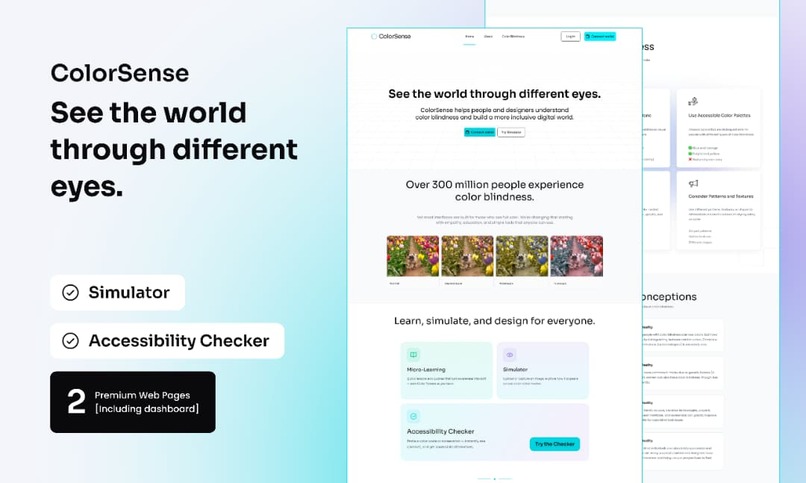
Color-Sense MVP

INSPIRATION Our World is made up of Colors, Approximately 300 million people (4.5% of total world population) live with color vision deficiency yet most interfaces are designed for standard vision. We were inspired by the desire to change this and make digital experiences more inclusive for people with color blindness. Many people struggle to perceive colors correctly, which can affect everything from browsing websites to using apps. We wanted to create a tool that educates, simulates, and empowers users to understand color vision differences while providing practical solutions. Additionally, we wanted to integrate a reward system that incentivizes learning and accessibility awareness, powered by Polkadot WalletConnect.
CORE FEATURES Our app allows users to:
Simulate how images and interfaces appear to people with different types of color blindness.
Test color combinations for accessibility and readability.
Learn about color blindness and its impact through interactive lessons.
Connect their Polkadot wallet for authentication and to earn color tokens, which reward engagement and reflect support for inclusive design.
It’s both an educational tool and a practical simulator that helps designers, students, and curious individuals experience the world through the lens of color blindness, while earning tokens that incentivize building accessible designs.
HOW WE BUILT COLORSENSE We built the app using modern web technologies with accessibility and responsiveness as core priorities. Key components include:
A simulation engine that accurately represents various types of color blindness.
An interactive educational module with clear explanations and visuals.
Polkadot WalletConnect integration for secure authentication and token rewards.
A user-friendly interface designed for intuitive navigation and accessibility.
Integration with a backend system to store user progress, wallet-linked tokens, and preferences.
We relied on a combination of research, open-source libraries, and careful testing to ensure accuracy, usability, and secure blockchain-based rewards.
CHALLENGES WE ENCOUNTERED Some of the main challenges included:
Accurately simulating color blindness in a way that felt realistic and educational.
Designing a UI that was visually appealing yet accessible to users with color vision deficiencies.
Integrating Polkadot WalletConnect for secure token management without complicating the user experience.
Optimizing performance so simulations and interactions were smooth across devices.
Each challenge taught us the importance of empathy, accessibility, and careful integration of blockchain technologies.
ACCOMPLISHMENTS WE ARE PROUD OF Successfully creating a simulator that visually represents multiple types of color blindness.
Developing an educational component that is engaging, informative, and easy to navigate.
Integrating Polkadot WalletConnect to enable token-based rewards for learning and engagement.
Launching a functional MVP tested across devices and user groups, receiving positive feedback from early users.
WHAT WE LEARNED Accessibility and inclusivity require both technical precision and human-centered design.
Blockchain integration can enhance engagement when implemented thoughtfully.
Testing with real users is invaluable for catching issues that simulations alone cannot reveal.
Collaboration and iterative design are essential for creating meaningful, rewarding experiences.
WHAT'S NEXT FOR COLORSENSE Our Vision
We envision a world where inclusive design is the global standard, not an optional feature. By integrating accessibility education with a blockchain-powered reward system, we aim to empower people to learn, create, and innovate with empathy. Through color tokens and Polkadot-enabled authentication, we’re building an ecosystem that rewards awareness, supports inclusive creativity, and inspires a new generation of designers and users committed to making digital experiences accessible for everyone.
Built With
- cursor
- llama
- next.js
- polkadot
- qroq
- shadcn




Log in or sign up for Devpost to join the conversation.