-
-
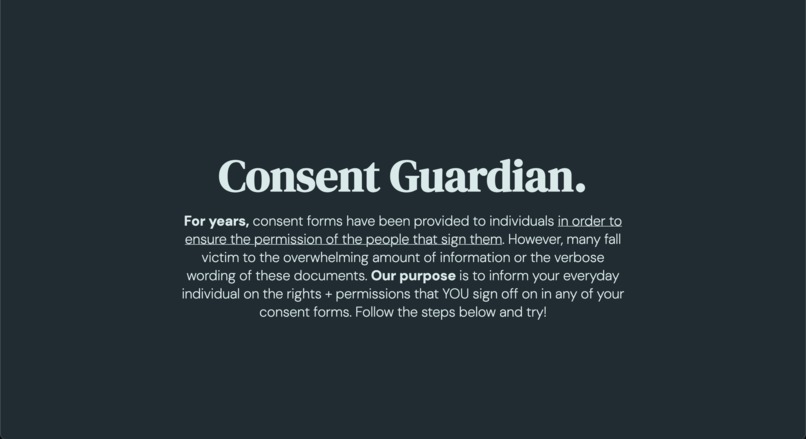
Front-end opening page for Consent Guardian
-
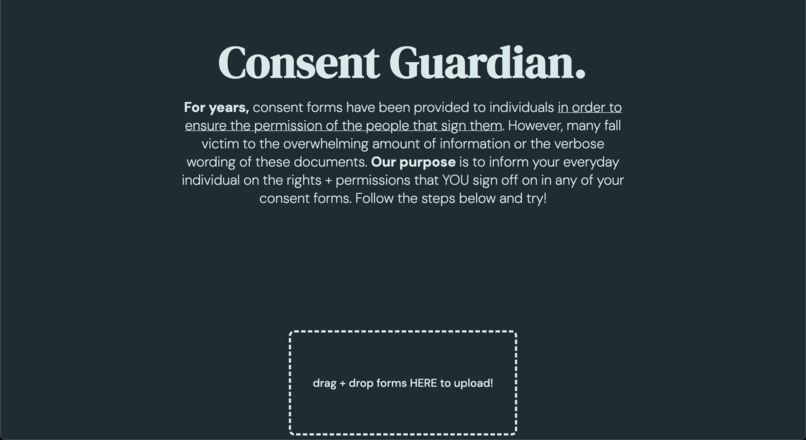
Opening page for Consent Guardian with file uploader


Inspiration
We believe that every patient should be aware of what they are getting into when they are handed consent forms. Being able to educate the everyday individual is what we strived to accomplish when we were developing this application, as well as making it as accessible and simplistic as possible.
What it does
This program utilizes a drag-and-drop file uploader, an extractor from images and PDFs using optical character recognition and attempts to summarize the text using Gemini AI.
How we built it
Our full-stack integration is built using ReactJS for the front-end, and Flask as the backend.
Challenges we ran into
The main challenges that we ran into came from implementing our full-stack with a framework and an API that we were not familiar with, despite our efforts. Our biggest challenge came from Gemini AI because of its difficulty to understand and implement into our code in a way that would process the information passed into the model we made.
Accomplishments that we're proud of
Our biggest accomplishment is making a full-stack application for the first time, and collaborating by splitting the task amongst every member of our team. Having everyone help craft a structure for the project and to communicate their processes was really beneficial to us as a team.
What we learned
We learned how to import an AI API--in this case Gemini--and how to link a frontend from React to a backend Flask in a team environment. It was treacherous, but we were grateful to truly put our brains together to figure this project out.
What's next for Consent Guardian
We would implement a way to accurately summarize the text data from the pdf, highlighting important permissions or points that the user would hypothetically sign off for, and allow the user to have a conversation with the bot, ensuring the patient's understanding of their consents.


Log in or sign up for Devpost to join the conversation.