-
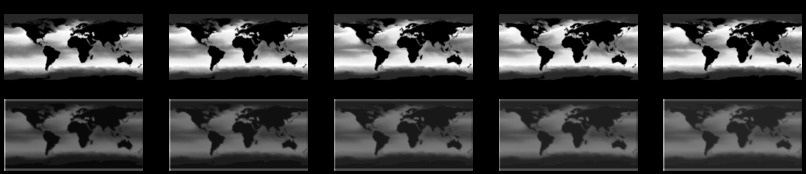
The model output on the bottom, compared to the ground truth data above it.

Inspiration
Coral reefs are fundamental to Earth. They are a beautiful part of our world, they are nature's gift to us humans. Because of our destructive touch, currently, more than 75% of the coral reefs in the Atlantic are threatened. By 2030, estimates predict more than 90% of the world’s reefs will be threatened by local human activities, warming, and acidification, with nearly 60% facing high, very high, or critical threat levels. link
We need to do better.
As four optimistic individuals, we are driven to bring awareness and inspire change. We only have one home, and we will do all in our power to foster a positive impact. We created CoralEye, a comprehensive website that informs and educates individuals about the impact of climate change on our coral reefs. Through these predictions, we aim to give CoralEye users the opportunity to gain a better understanding of how our past and present actions contribute to a warmer climate and thus the damage to our reefs. We hope that by providing users with an opportunity to “see into the future”, they feel encouraged to take action to protect our planet today. We hope to inspire others to start doing better.
What it does
Our mission is to create conversation surrounding the impact of climate change on our coral reefs by making predictions of the rising sea temperatures that are destroying them. Through these predictions, we aim to give CoralEye users the opportunity to gain a better understanding of how our past and present actions contribute to a warmer climate and thus the damage to our reefs. We hope that by providing users with an opportunity to “see into the future”, they feel encouraged to take action to protect our planet today.
Coral Bleaching occurs when corals are under stress. Their skeleton becomes exposed as they expel algae from their tissue. Possible stressors include changes in temperature, light, and nutrients. Coral bleaching does not mean death, however, bleached corals are at a higher risk of dying. The leading cause of coral bleaching is climate change; a temperature change as small as 2 degrees Fahrenheit can cause coral bleaching. This is what leads to the noticeable change in the satellite images/
The machine learning model that we designed uses computer vision and time series mapping to examine maps from NOAA that indicate sea surface temperature, as increasing temperatures in tropical waters is one of the main causes of coral bleaching.
How we built it
The website is built using HTML, CSS, and Javascript in Replit. We hyperlinked websites, added images, and linked between the pages.
We used a custom ConvLSTM neural network architected in Tensorflow to analyze a series of sea surface temperature (SST) images from NOAA, spanning each month from 1982 to 2023. The model attempts to predict the next image in the time-series sequence, taking into
Challenges we ran into
The primary challenge we experienced for the website creation portion of our project was our lack of familiarity with HTML. Three out of the four members of our team had never participated in a hackathon, so once we educated ourselves on HTML, we were able to successfully create our website.
One of the main challenges we ran into with the model was the lack of enough GPU and CPU RAM space. Despite shrinking our dataset to 10% of its original size, we still ran into errors that indicated that training crashed due to not enough room for a full batch, even with the batch_size set to 1. This hugely restrained the amount of work we were able to do on the model, as well as how accurate it was.
Even prior to this, there was a huge lack of research in generational prediction based on time series, and it was hard to figure out what might be the right model to use in our application. We also found that standardized satellite data for coral reefs was hard to come by — with most of the data we found, it was either not enough to train a model with, not clear enough, or too variated (e.g. there was no cloud removal, or the data would come in varying image patches instead of full images). Eventually, we settled on NOAA SST data, but our original goal was to use satellite images to predict coral reef size and/or health.
Accomplishments that we're proud of
We are proud to say that we have created an educational, comprehensive, and aesthetically pleasing website having had no prior experience with HTML. We are also extremely proud of the team effort that went into the creation of our project.
We are also very proud of the work we did on the model, and glad that our output was very similar despite compute and time constraints. We proved that we were able to ingest a lot of research material in a short time, as well as understand computer vision better than we had before. We had to pivot on the fly when something didn't work out, and we're proud of our agility in terms of determining a new goal by working off of what we had.
What we learned
Due to the fact that most of our group members had no experience with HTML, a large part of what we learned during this project was how to build a website using HTML and CSS. Over the course of our project completion, we also conducted extensive research on climate change with respect to coral reefs. We can also now confidently say that we could create a website using HTML in less than 24 hours, are more familiar with HTML in general, and are more well-versed in our ecosystem.
In working on the model, we also learned a lot of limitations that are placed on real-world computer vision problems. We looked through numerous research papers to determine the best approach to apply machine learning to coral reef health prediction and found many, many approaches, each of which had its own pros and cons. We also had to study time series prediction models such as ConvLSTM, as well as become more familiar with TensorFlow and Keras.
What's next for CoralEye
We hope to apply our model architecture to more useful images — while we had found an ideal API to access Sentinel-2 satellite data, the images themselves were too large, too complex, and not standardized enough to use for our model, but given more time and compute resources, we believe that we can do much better than many other coral reef prediction solutions in the future — many current solutions use limited image data and rely more on numeric data, which is difficult to describe benthic (coral) extent with. Even if we were to use SST data, we would use all 3 color channels than the 1 we were limited to because of computing restraints.
We also wished to add a better UI to interact with our algorithm, but we ran out of time to do so. It would also have been cool to utilize some of our team members' experience with 3D modeling to add some interactivity, creativity, and immersiveness to the website.
Built With
- colab
- conv-lstm
- keras
- python
- tensorflow


Log in or sign up for Devpost to join the conversation.