-
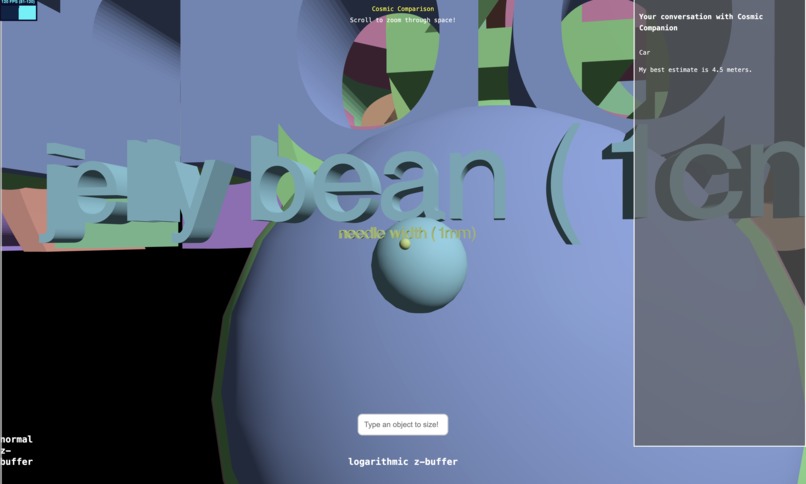
Jelly Bean!
-
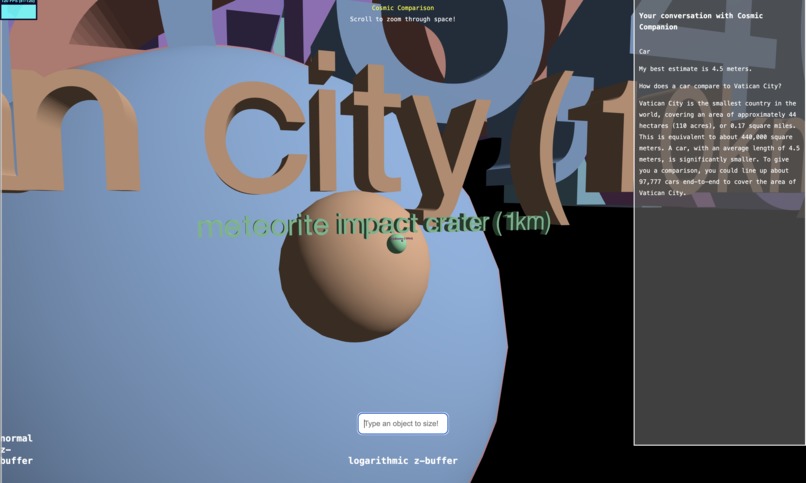
Vatican City Compared to a Car
-
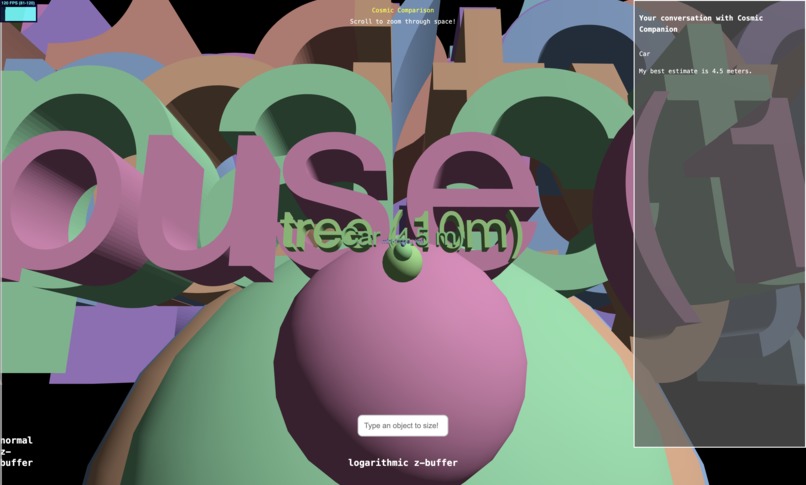
Seeing "Car" (the submitted object) in Space


Inspiration
A Few Core Tenets We Believe In:
- Learning is optimized when play and exploration is encouraged.
- Interactivity is a core principle supporting the joy of learning.
- Programs that look cool are memorable and meaningful!
Also, education in astronomy is undervalued and underdeveloped: we wanted to create a program that inspired a joy for learning that followed these core principles.
What it does
Cosmic Comparison, first and foremost, is a 3D-simulation to explore the size of objects in the universe. It also calls the OpenAI API, which takes in a user-inputted object (e.g., “Castle”) and asks GPT to return an estimated size for the object.
The API, which we affectionately call “Cosmic Companion,” then returns an estimated size for the object (e.g., 50m) that is used in creating a sphere that matches the size of the object relative to the reference spheres.
- "Infinite" Zoom: A unique way to display scale on an enormous level
- Interfacing with AI: Allows for an adaptive user experience
- Size Comparison: Putting objects seen in our nighttime sky in perspective
How we built it
- A base 10 logarithmic scaling enables easy traversal across magnitudes.
- Calling the OpenAI API to communicate with Chat GPT; then, using the measurement to create a sphere to add to our model.
- We used Three.js to render 3D models into the simulation.
Challenges we ran into
3D Modeling and working with Three.js, as well as integrating the OpenAI API.
Accomplishments that we're proud of
Everything! We worked very hard on this project and it came together in a satisfying way.
What we learned
A lot - for all of us, it was our first hackathon, so the entire experience was novel and educational.
What's next for Cosmic Comparison
The stars
Eligible for MLH!


Log in or sign up for Devpost to join the conversation.