-
-
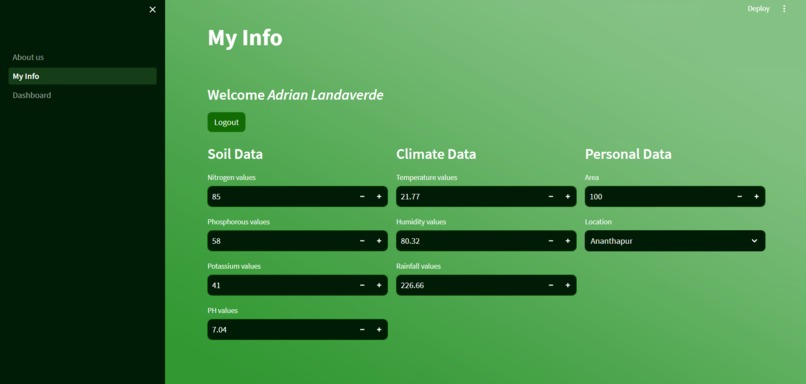
My info page
-
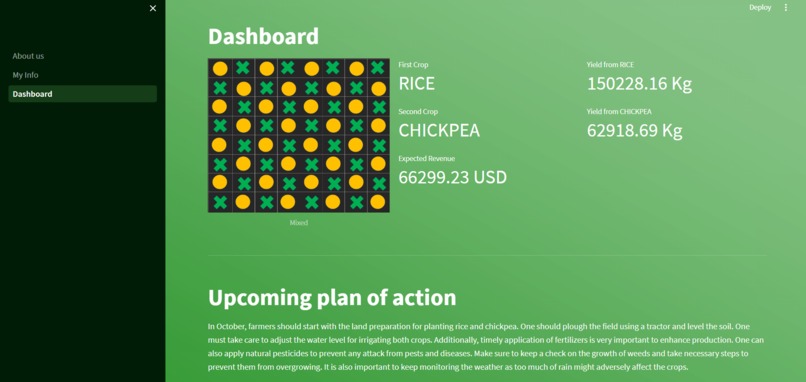
Dashboard of crops
-
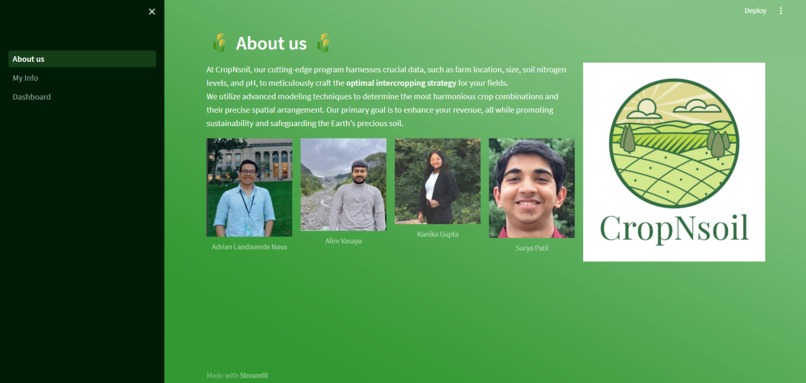
About us page


Inspiration
The alarming surge in suicide rates among farmers in developing countries begs the question: What is driving these individuals to such a desperate point? Their relentless pursuit of higher yields has led many to employ excessive quantities of fertilizers and pesticides, with the hope of boosting their crop output. However, instead of reaping financial benefits, these practices often result in mounting debts and profound despair, ultimately pushing some farmers to take their own lives. What's more, the overdose of fertilizers not only contributes to soil pollution but also leads to diminishing yields over time, creating a detrimental feedback loop. This perilous combination of financial strain, environmental degradation, and declining agricultural productivity underscores the urgent need for comprehensive solutions to safeguard farmer well-being, promote environmental sustainability, and ensure the long-term success of agriculture in these regions.
What it does
At CropNsoil, our cutting-edge program harnesses crucial data, such as farm location, size, soil nitrogen levels, and pH, to meticulously craft the optimal intercropping strategy for your fields. We utilize advanced modeling techniques to determine the most harmonious crop combinations and their precise spatial arrangement. Our primary goal is to enhance your revenue, all while promoting sustainability and safeguarding the Earth's precious soil.
By intelligently pairing crops that complement each other's growth, we create a synergy that significantly boosts overall efficiency by reducing the need of excess fertilizers and pesticides. This increases your income, reduces the risk factor associated with failure of one crop, but also plays a pivotal role in protecting our environment.
Furthermore, our custom intercropping patterns are tailored to harness the unique attributes of your specific location. This ensures that your agricultural practices are aligned with the environmental conditions of your farm. By making the most of what your land has to offer, we contribute to a sustainable farming future that safeguards our soil and protects our planet.
How we built it
The process began with a vast database containing valuable insights into soil conditions, weather patterns, and historical crop yields, specific to your region. These data formed the bedrock of our project.
We harnessed the power of machine learning, a cutting-edge technology, to make sense of this wealth of information. Our team diligently trained the models, using the historic data, to accurately classify crops based on weather and soil conditions.
This finely tuned machine learning model then goes a step further, recommending the ideal intercropping pattern. The primary objective is to maximize your revenue, all while promoting sustainability.
The final decision on the cropping pattern is made with precision, taking into account the compatibility of crops and their revenue potential. This process is a testament to the harmonious coexistence of data, technology, and agricultural wisdom, ensuring that your land thrives while benefiting both your financial well-being and the environment. The technologies we used were python, react, javascript, HTML, CSS, MongoDB, Node.JS, Tailwind CSS. Based on the crops and the spatial arrangement generated we explain the farmer on what is the logic behind choosing that arrangement. Also we provide a plan of action to the farmer specified for their crops according to the stage of crop growth they are in.
Challenges we ran into
Understanding the problem and the idea. Trying to minimize the scope and build this project in the given timeframe. Calling the machine learning model into the frontend.
Accomplishments that we're proud of
Coming up with a efficient, sustainable and effective solution to the problem. Creating a comprehensive model. Were a team of members from diverse backgrounds. Coming together and working as an efficient team.
Making a very good looking Github Repo which adds a unique personality to our project and showing all the main components of our project. Also, using commits related to hack for the future
What we learned
Learned about soils and the necessities of cropping system. Creating frontend models several tools.
What's next for CropNsoil
In the future we see the data collection that is done currently by asking the farmers to be done by the automated drones using sensors (winner HackHarvard 2022).


Log in or sign up for Devpost to join the conversation.