-
-
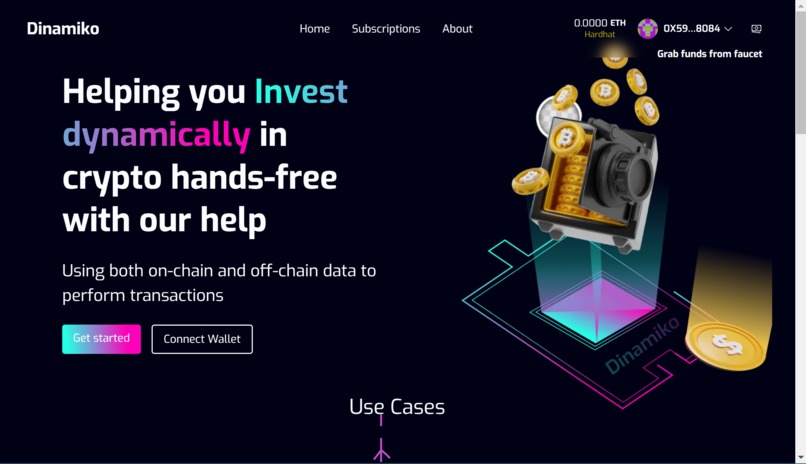
Home page
-
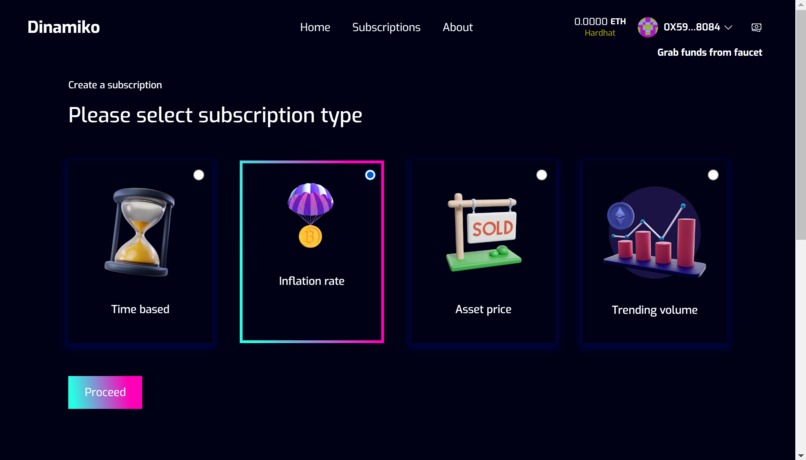
Subscription creation page
-
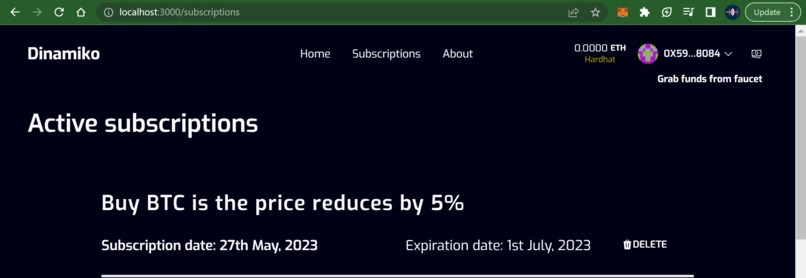
Subscriptions page


Inspiration
Dinamiko was an idea that came about as a result of the comparing the flexibility of centralized exchanges, where limit orders can be created and executed to perform trades. This limitation hinders users from making timely and optimized investment decisions, resulting in missed opportunities and inefficient trading strategies. Without a solution that addresses this issue, individuals navigating the world of cryptocurrencies face complexities and inefficiencies, hindering their ability to maximize returns and minimize risks. This sort of flexibility was something that was lacking from Web3 and DeFi, this is what Dinamiko aims to bring to DeFi. We recognized the need for a platform that streamlines investment trading decisions and empowers users to navigate the complex world of cryptocurrencies with ease and flexibility.
What it does
Dinamiko is a fully decentralized and fully autonomous on-chain trading solution for automating the process of trading and helps in implementing complex DeFi strategies. At its core Dinamiko is decentralized application, as such it carries out on-chain transactions/activities. The project is also is also directed towards but not limited to DeFi, as there are a lot of other areas decentralized on-chain automation can be applied. One of which is the automated settlement of payments when a specific condition is met like a a specific time period has elapsed.
The working model built for the hackathon though, contains features and innovations that allow users to create ‘subscriptions’(conditional executions) based on the following criteria
- Time
- Change in price of a token/coin
- Inflation rate
- trading volume
- Realized volatility
- APRs and interest rates
Given these conditions, users can form insightful and profitable subscriptions that carry out any of the following actions
- Buy a token/coin
- Sell a token/coin
- Add Liquidity to a pair pool
So users can easily create subscriptions that are triggered only when those specific conditions are met. The fun doesn’t have to end there as users will be able to combine conditions in order to create even more powerful subscriptions. The list below provides some insightful subscriptions that can be created with Dinamiko
- Buy 0.1 ETH every month
- If the trading volume of BNB/USDT pair exceeds $40,000,000 add liquidity to the BNB/USDT pool
- If the price of BTC stays above $28,000 for 3 days buy 1 BTC
- If the inflation rate goes above 3.5% buy 5 BNB
The above list shows but a few examples of the subscriptions Dinamiko can help users create.
How we built it
How it works
Dinamiko is a application that is easily understandable, and tailor made for a better user experience for people in DeFi. Here is step by step process of how Dinamiko works.
- User enters the app
- User connects their wallet
- User selects the condition type
- User selects the action/transaction type
- User selects the token/liquidity they want to interact with
- User approves the default transactions token (USDT) to be spent by Dinamiko smart contracts
- User selects or inputs the specific condition that has to be fulfilled for the transaction to be executed
Challenges we ran into
In as much as the Web3 has been around for quite some time now, it is still an emerging technology and as such there are always challenges associated with building projects for the decentralized web, and project Dinamiko was no different and it was definitely a learning curve for the team. Some of the challenges faced are listed below but not limited to:
- Idea conceptualization: Having a idea is one thing and knowing where to apply the idea is another, with Dinamiko it was no different as we faced the challenge of deciding how to properly structure the app and create a very good user experience. We also had to balance innovation and feasibility and narrow down the scope idea/app.
- Integration Complexity: Dinamiko is a very interesting project that combines quite a number of moving parts and thus we had to find way to combine all those parts and make sure that all they all worked well together. Some of those parts included interacting with a token using the approve and transferFrom functions, Chainlink Any API, price feeds and automation were used to implement the idea. We also utilized the Uniswap V3 contracts to perform transactions like buyToken and AddLiquidity. Truflation was also used to get inflation data. Given all these, we had to make a lot imports and work with multiple interfaces.
- Time constraint: This may sound contradictory given the 6 weeks period given for the hackathon to be developed but the team at Dinamiko was not formed until the 3rd week of the hackathon, This left us with not enough time to fully conceptualize the idea.
Accomplishments that we're proud of
- Getting a working MVP in less than 3 weeks: Developing a functional Minimum Viable Product (MVP) within the tight timeframe of less than three weeks was an exceptional achievement during the hackathon. The accelerated pace demanded meticulous planning, effective time management, and relentless dedication from our team. Through rigorous iteration and rapid prototyping, we swiftly transformed our initial idea into a working prototype that showcased the key value proposition of our solution. The ability to deliver a tangible MVP within such a limited timeframe demonstrated our team's resilience, adaptability, and proficiency in leveraging cutting-edge technologies. This accomplishment not only validated the viability of our concept but also provided a solid foundation for further development and refinement beyond the hackathon. We take immense pride in our ability to rapidly deliver a functional MVP, reflecting our commitment to innovation, teamwork, and agile development practices.
- Connecting all the moving parts: Connecting all the moving parts, including smart contracts, interfaces, and oracles, was a significant accomplishment during the hackathon. Assembling these components into a cohesive and functional system required meticulous planning, technical expertise, and relentless problem-solving. We successfully designed and implemented the smart contracts to handle various functionalities, ensuring their seamless integration with the user interfaces. Integrating Chainlink's oracles played a crucial role in bridging the gap between the blockchain and real-world data sources, enabling secure and reliable interactions. Through this achievement, we demonstrated our ability to synchronize complex systems, ensuring the smooth flow of information and transactions between different components.
- Learning a lot and working a as team: One of the most significant accomplishments we achieved during the hackathon was the immense amount of learning and growth we experienced as a team. Collaborating on a challenging project within a limited timeframe pushed us to expand our skills, explore new technologies, and delve into unfamiliar domains. The constant exchange of knowledge and ideas amongst team members fostered a dynamic and intellectually stimulating environment, enabling us to acquire a wide range of expertise. We embraced the opportunity to dive into the intricacies of Web3, smart contract development, and decentralized finance (DeFi), enhancing our understanding of these complex concepts. The experience of working together in such an intense and collaborative environment not only strengthened our technical abilities but also honed our teamwork, communication, and project management skills. We fostered a supportive atmosphere, leveraging each other's expertise to tackle challenges and deliver a polished final product. The accomplishment of learning and growing together as a team was invaluable, providing us with a solid foundation for future collaborations and instilling in us a sense of achievement and camaraderie.
What we learned
A core aim of every hackathon is to learn while building and for project Dinamiko it was no different, we had the opportunity to work with different technologies and learned a lot on the way. The items mentioned below are some of the things we learnt while building the project.
- Use of Chainlink services: Incorporating Chainlink services into our smart contracts was a transformative experience that brought numerous valuable lessons. Through our utilization of Chainlink's automation, Price Feeds, Data Feeds, and the flexibility to connect to any API, we gained profound insights into the power and potential of decentralized oracles. One key lesson we learned was the criticality of real-time and accurate data for reliable decision-making within our project. Chainlink's Price Feeds and Data Feeds provided us with a trustworthy source of information, enabling us to make informed investment choices and execute transactions with confidence. Additionally, we discovered the importance of secure and tamper-proof interactions between smart contracts and external data sources, which Chainlink's infrastructure facilitated flawlessly. The seamless integration of Chainlink's services taught us the significance of interoperability and the ability to connect with various external systems, expanding the possibilities for our project.
- best practices in the smart contract development: Given that we had to write quite a number of smart contracts, participating in the hackathon was an invaluable learning experience for us in the realm of Web3 and smart contract development. We gained a deep understanding of best practices and key principles that guide successful projects in this space. We learned the importance of security considerations. We also grasped the significance of thorough testing, both for functional correctness and edge cases, to ensure robust and reliable smart contracts.
- Use of Truflation to get inflation data: During the hackathon, I delved into the fascinating concept of Truflation and its application in obtaining inflation data. Truflation is a novel approach that leverages blockchain technology and decentralized finance (DeFi) to provide a transparent and verifiable source of inflation information. By utilizing on-chain data and smart contracts, Truflation ensures the integrity and accuracy of inflation data, eliminating potential manipulation or bias. It enables users to access real-time and trustworthy inflation rates, empowering them to make informed financial decisions.
What's next for Dinamiko
After the hackathon, Dinamiko is poised for an exciting journey, building upon the momentum gained during the event. Securing a substantial win from the hackathon would provide valuable resources and validation, further fueling our ambitions. With the aim of refining and expanding our project, our next step is to submit Dinamiko to the Chainlink Build program, where we can tap into a community of experienced developers and receive feedback to enhance our solution.
By joining this program, we will gain access to comprehensive technical support, allowing us to leverage the expertise of Chainlink's team to further strengthen our infrastructure, security, and reliability. The program will also grant us priority access to essential services, empowering us to focus on critical aspects such as concept development, market strategy, product development, and finding the ideal market fit.
Through continued collaboration with Chainlink and its ecosystem, Dinamiko aims to iterate and refine our solution based on real-world feedback and emerging market trends. We will continuously work towards enhancing the user experience, expanding the functionality of our platform, and solidifying our position within the DeFi landscape.
Built With
- chainlink
- chainlink-automation
- chainlink-pricefeeds
- javascript
- react
- scaffoldeth
- solidity
- truflation
- typescript


Log in or sign up for Devpost to join the conversation.