-
-
Thumbnail

Watch the longer video here! -> https://youtu.be/S3n6NrZFoGw
Inspiration
Our team member, Richard, lives in Kentucky. He grew up in Kentucky and met many individuals from rural parts of the state. In doing so, he noticed an important need in the community. In many parts of Appalachia, Kentucky - a beautiful, rural, and mountainous area - coal mines used to be the primary driver of career success. Now, these towns have become desolate, slowly collapsing economically and leaving residents isolated and limited.
Factors that limit the pathways to college-level STEM education and careers for rural students can include less diverse coursework opportunities at school, geographic isolation, limited local career options, and a lack of mentorship or role models in STEM.
Meanwhile, STEM jobs are projected to grow by more than 10% between 2023-2031. Research shows that students from rural communities are significantly less likely to enroll in postsecondary STEM degree programs. While rural students begin high school with the same levels of interest in STEM as students from suburban areas, they often face a lack of pathways to get involved in STEM.
What it does
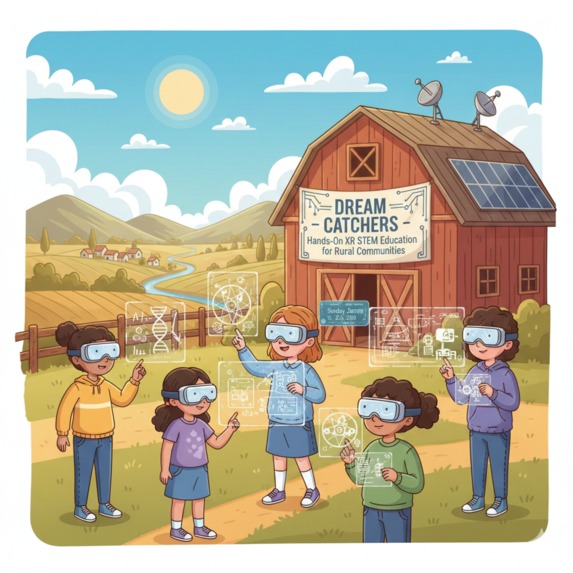
DreamCatcher is an interactive STEM learning platform that works without internet access. Using the most cutting-edge technologies of the future, it gives students of rural environments the rare opportunity to access a STEM education in an exciting, interactive kit.
With DreamCatcher, a student can open a kit they received from school or a local library. They can then learn about various topics using hands-on, gamified learning that has been researched to be most effective at captivating students’ attention.
Once the student enters the headset environment, they will be guided through a short tutorial on setting up an arduino. This will then lead them through a module on different STEM subjects. For our project, we focused on one module that teaches students about the Kinetic Molecular Theory (KMT) in chemistry. A student is able to take in temperature data using the arduino they set up and then process that data to show an interactive visualization in the MR headset.
How we built it
Tools:
- Unity
- Arduino Uno Q
- Meta Quest Headset
Challenges we ran into
Initially we tried using the Galaxy XR headset, however, we ran into build errors. Additionally, we struggled but finally succeeded at connecting the Arduino Uno Q to the headset.
Accomplishments that we're proud of
We created a single module showcasing how the headset can help with learning in rural communities.
What we learned
We learned about how to use the Arduino Uno Q and how to integrate assets into the Meta Quest headset. Additionally, we taught ourselves about chemistry concepts and Arduino uses to be able to teach others. We used particle systems in Unity and panels in Unity to create the teaching environment in the Quest headset.
What's next for Dream Catchers
Anything's possible! (with more time!)


Log in or sign up for Devpost to join the conversation.