-
-
-
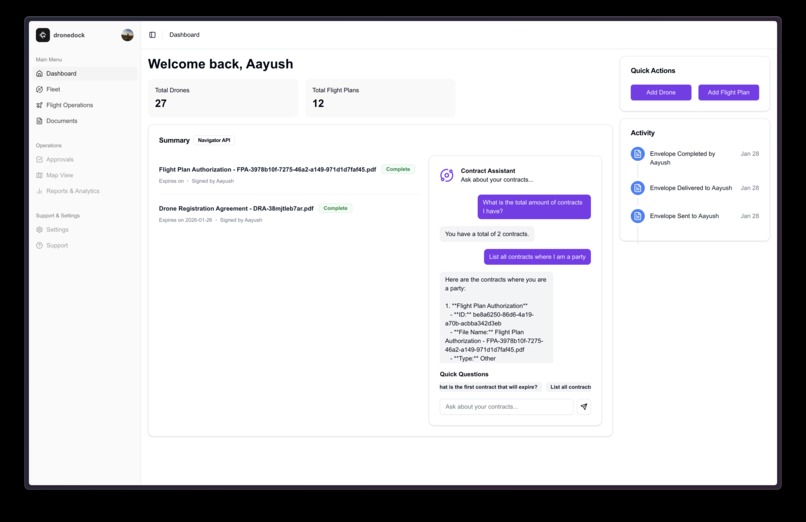
Dashboard
-
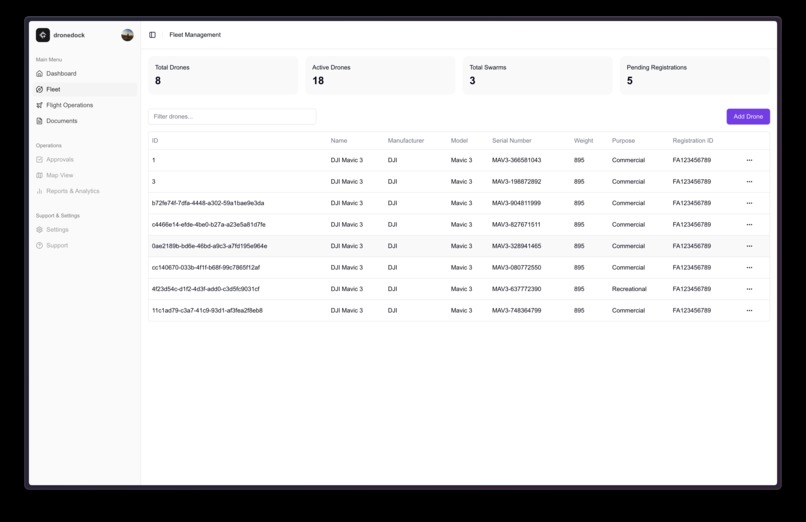
Fleet
-
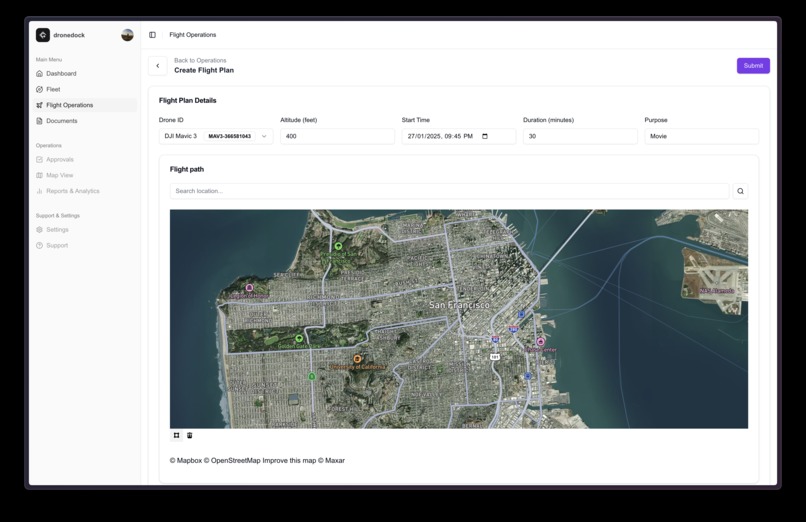
Flight Operations


Inspiration
Every day, drone operators face challenges with manual registration, flight approvals, and ensuring compliance with complex regulations. We wanted to simplify these processes by building an end-to-end platform that enables operators to register drones, plan flights, and stay compliant with regulations. By combining automation, real-time validation, and document generation, DroneDock ensures operators can focus on their missions without worrying about administrative overhead. 🚁
What it does
DroneDock is an all-in-one platform for managing drone operations. Here's what it offers:
- 🛩️ Drone Registration: Register drones, generate compliance documents, and sign agreements digitally.
- 🗺️ Flight Plan Management: Create, validate, and submit flight plans. Generate detailed flight authorization documents with a map of the planned route.
- 📄 Document Workflow Automation: Automatically generate and send registration certificates and flight plans using Docusign eSignatures API.
- ✅ Compliance Validation: Ensure flight paths adhere to altitude limits and avoid restricted zones.
- 🤖 Document Chatbot: Leverages Docusign Navigator API and OpenAI to create a chatbot that can intelligently answer queries about stored documents, helping users quickly understand document details and workflows.
- ✅ Real-Time Dashboards: Leverating Docusign Connect to show real time status of all documents and envelopes.
How we built it
- Frontend: Built using Next.js for a responsive and user-friendly interface.
- Backend: Node.js with Prisma for database management and seamless integration with Postgres.
- 🌍 Geospatial Processing: Leveraged Mapbox API for visualizing flight paths and static map generation.
- 📜 Document Workflow: Integrated with Docusign APIs to automate document generation, signing, and status tracking.
- 💬 Chatbot with Document Insights:
- Used Docusign Navigator API to retrieve agreement data and document details.
- Integrated OpenAI to build a conversational chatbot that answers questions about stored documents and agreements.
Challenges we ran into
- Geospatial Complexity: Handling no-fly zone overlays and validating flight paths against restricted areas was challenging due to the complexity of geospatial data.
- Docusign Integration: Automating the generation and signing of documents required a deep understanding of Docusign's APIs and workflows.
- Time Constraints: Balancing feature scope and implementation with a tight deadline pushed us to focus on core functionality first.
- Document Chatbot: Training the chatbot to intelligently interpret Navigator API data and provide accurate answers was a challenging but rewarding task.
Accomplishments that we're proud of
- End-to-End Functionality: Successfully implemented drone registration and flight plan workflows with automated document generation and eSignatures. Seamless User Experience: Built an intuitive dashboard streamlining drone and flight management.
- Compliance Validation: Added real-time validation to ensure flight plans meet regulatory requirements. Integration Mastery: Integrated multiple technologies, including Next.js, Prisma, Postgres, Redis, Trigger.dev, Mapbox, and Docusign, and OpenAI to deliver a cohesive platform.
- Smart Document Chatbot: Built a chatbot that leverages OpenAI and Docusign Navigator API to provide users with insights and details about their agreements, reducing time spent on document analysis.
What we learned
- The Importance of User-Centric Design: Simplifying complex workflows (like drone registration and flight planning) is critical for creating an intuitive user experience.
- Geospatial Data Handling: Working with flight paths, no-fly zones, and map overlays gave us a deeper understanding of geospatial technologies and APIs.
- API Mastery: Integrating Docusign and Mapbox taught us how to effectively use third-party APIs to automate workflows and enhance functionality.
- Time Management: Focus on delivering core features first, while ensuring scalability for future enhancements.
What's next for DroneDock
- No-Fly Zone Overlays: Integrate real-time restricted airspace data (e.g., FAA airport boundaries) to visually warn operators about compliance issues.
- Team Collaboration: Add multi-user workflows for collaborative drone operations.
- AI Compliance Checker: Implement AI-powered suggestions to optimize flight plans and ensure full compliance with regulations.
- Global Expansion: Extend the platform to support international drone regulations and multiple languages.
- Mobile App: Build a mobile app for on-the-go flight plan creation, approvals, and real-time tracking.
Built With
- docusign
- mapbox
- nextjs
- openai
- postgresql
- prisma
- redis
- trigger.dev


Log in or sign up for Devpost to join the conversation.