-
-
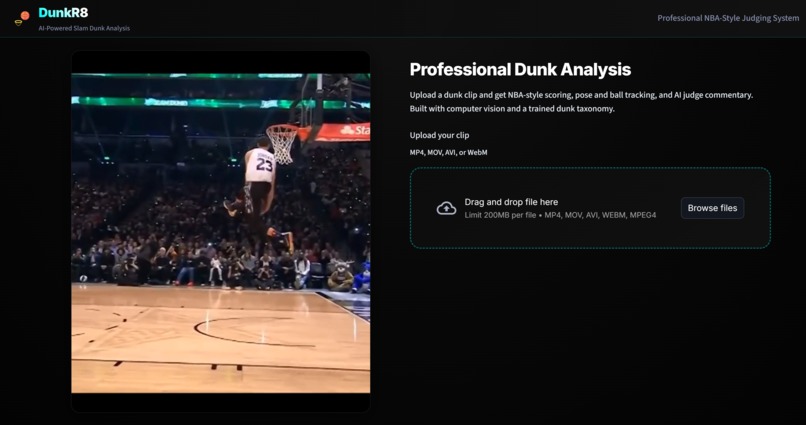
DunkR8 Lander
-
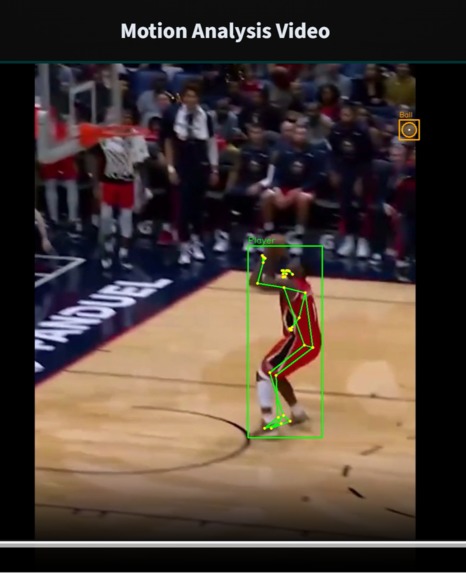
Computer Vision
-
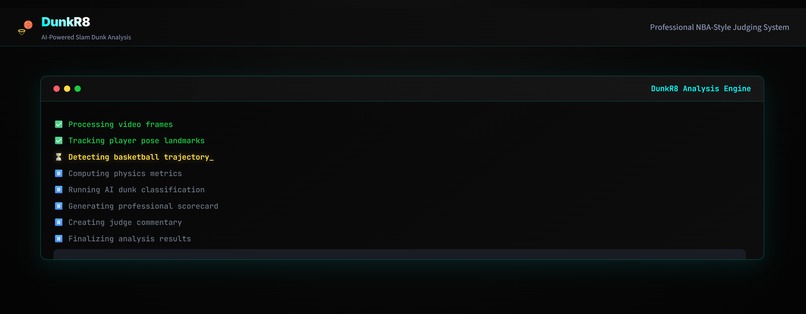
Processing Video Clip
-
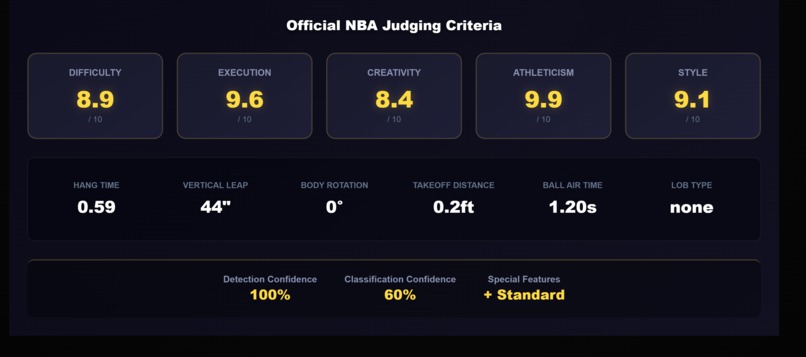
Judging Stats
-
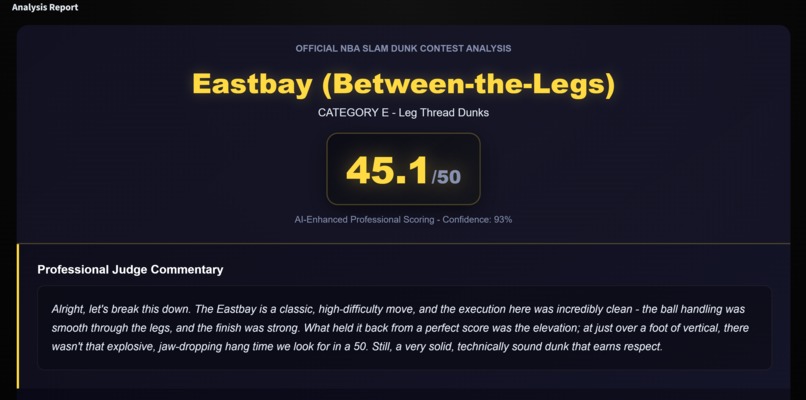
Judging Score and Reasoning
-
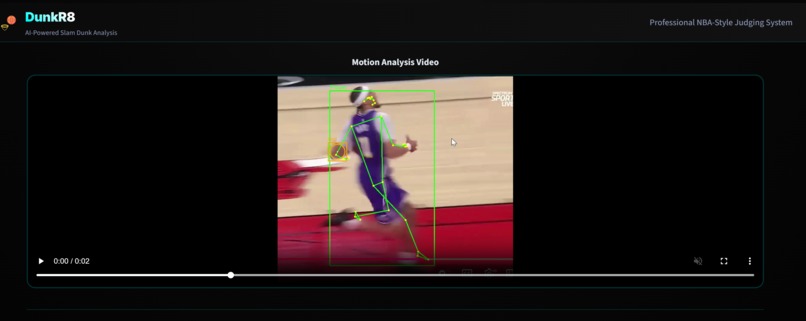
Computer Vision
-
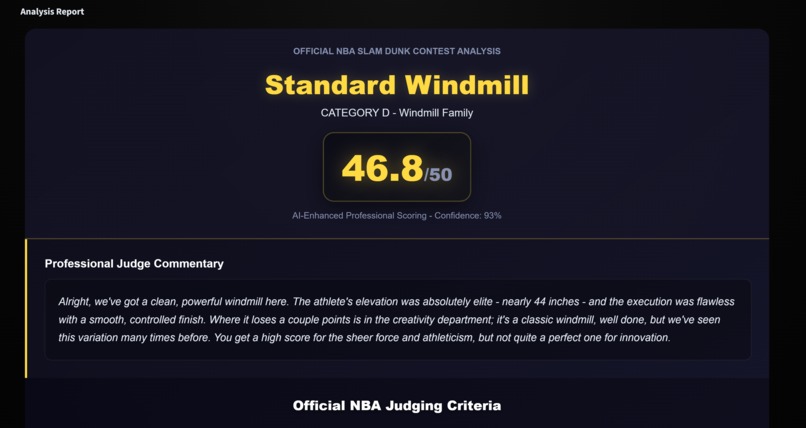
Judging Score and Reasoning
-
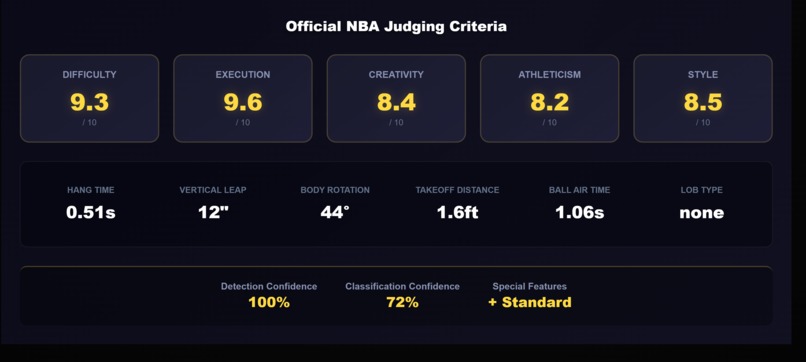
Judging Stats
-
(Zoomed Out) Evaluation


Inspiration
Dunk judging has always been subjective. A viral Instagram clip of a University of Miami ball boy throwing down an off-the-backboard dunk was captioned: “Would this get a 50?” That question sparked a bigger one. We wanted to explore how data and computer vision could bring objectivity to dunk evaluation and dunk identification. That idea led to DunkR8.
What it does
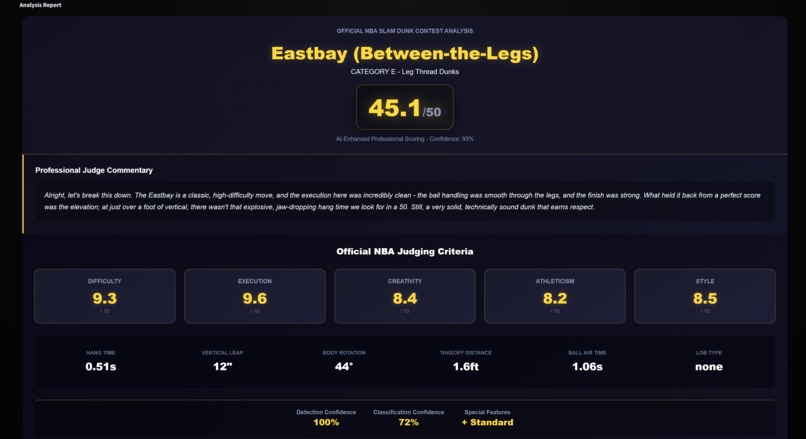
DunkR8 (Dunk Rate) objectively evaluates basketball dunks using computer vision and machine learning. The system first classifies the type of dunk (e.g., windmill, Eastbay, reverse), then analyzes measurable motion-based metrics such as hang time, body rotation, and additional kinematic features. These metrics are combined into a single, consistent evaluation based purely on performance in the air.
How we built it
DunkR8 is built as an end-to-end computer vision pipeline. Each uploaded video is processed using MediaPipe for pose estimation and OpenCV for video I/O and ball detection. MediaPipe extracts body keypoints (skeleton data) frame-by-frame, while OpenCV tracks the basketball’s position and handles frame processing.
From this visual data, we use a custom physics engine and dunk ontology to compute objective metrics such as hang time, vertical displacement, body rotation, and dunk type classification. The classification was done by taking many clips of labeled dunks in order to make an algorithm that classifies the user inputted clip. These measurements are then aggregated into a final performance score.
To enhance the experience, we integrate the DeepSeek API to generate NBA-style judge commentary and optionally refine score explanations or detection outputs. The entire system is wrapped in a Streamlit web app, allowing users to upload a dunk clip and receive an instant breakdown and score directly in the browser.
Challenges we ran into
One of our biggest challenges was defining objective metrics for a skill that is traditionally judged subjectively. Translating creativity and style into measurable physical features required multiple iterations and careful metric design.
We also faced limited and inconsistent dunk footage for training and validation. Variations in camera angles, lighting, and video quality introduced noise into pose and ball tracking, requiring additional preprocessing and robustness checks.
Finally, balancing technical rigor with intuitive results was difficult. We wanted the scores to be mathematically grounded while still aligning with how humans perceive dunk difficulty and execution.
Accomplishments that we're proud of
We built a complete end-to-end system that processes raw dunk footage and extracts meaningful motion-based features using computer vision. Within a hackathon timeframe, we successfully combined pose estimation, ball tracking, physics-based analysis, and dunk classification into a working prototype.
We’re especially proud of turning a subjective sports debate into a transparent, data-driven evaluation system. DunkR8 shows that even expressive, style-driven athletic moments can be analyzed systematically while remaining extensible for future improvements.
What we learned
Through building DunkR8, we gained hands-on experience with pose estimation and computer vision for analyzing human motion in real-world video. We learned how to extract and track keypoints over time, and how noisy inputs such as occlusions, motion blur, and varying camera angles affect pose accuracy.
We also learned how to transform pose and motion data into meaningful features, such as temporal dynamics and rotational movement, that can be used effectively in machine learning models. This project helped us understand the gap between theoretical computer vision techniques and their practical application in unconstrained, real-world footage.
What's next for DunkR8
We want to expand DunkR8 into a full training and analysis platform. Future plans include advanced dunk breakdowns, personalized feedback for athletes, expanded dunk categories, and tools designed specifically to help players train and improve their dunk performance. We hope to also use this program as a backbone for social media pages where viewers can send in dunks to be rated, posted, and monetized.


Log in or sign up for Devpost to join the conversation.