-
-
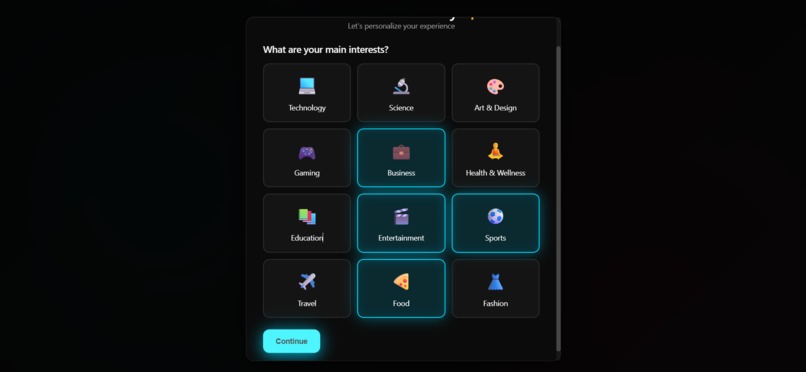
the web asks for user interests to use ai and track his interests and create a feed according to him
-
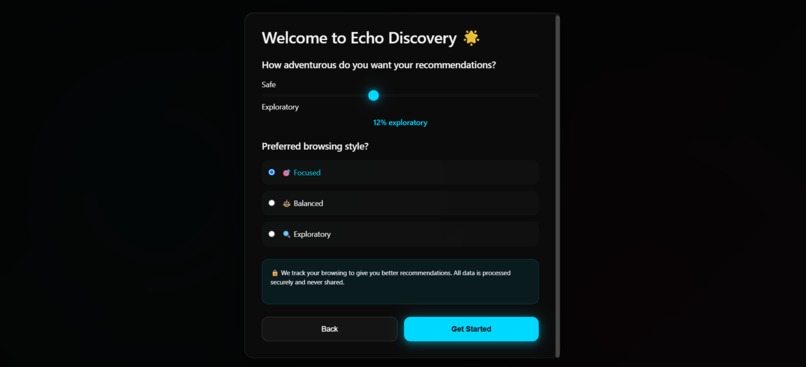
using this function we can ask how much the user wants to explore the webs according to his interests
-
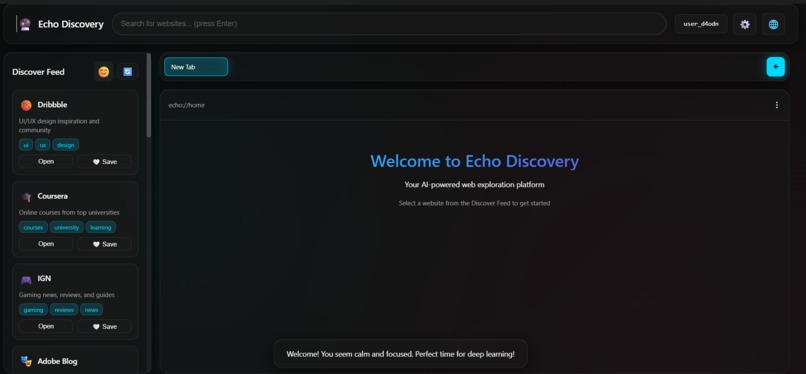
this is the interface where the user browses the webs, feeds and communities
-
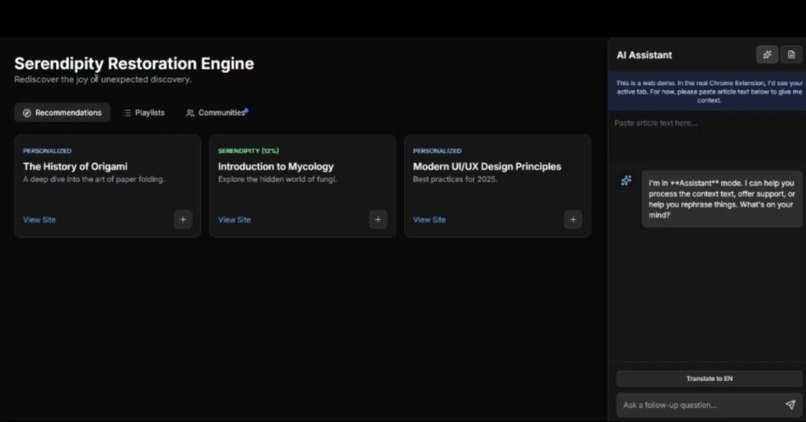
this is the web extenstion interface with same functions


Inspiration
The modern internet is broken. We are trapped in filter bubbles and echo chambers, algorithmically guided down the same narrow paths. The magic of the early web—the joy of "serendipity," of stumbling into a fascinating new topic or a hidden community you never knew existed—is gone.
Cloud-based AI, with its reliance on server-side tracking, only makes this problem worse. It analyzes our every click to build a profile, reinforcing our biases and walling us off from the new and unexpected.
Our inspiration was a single question: What if we could use the power of AI to break the filter bubble instead of building it?
This is a problem that only on-device AI can solve. We were inspired by the Google Chrome Built-in AI Challenge to create an engine that restores serendipity, using a powerful AI that is 100% private, instantaneous, and operates entirely on the user's device, proving that you don't need to sacrifice privacy for a truly personalized and expansive web experience.
What it does
The Echo Discovery Engine is a Chrome Extension that acts as an intelligent, privacy-first companion for web exploration. It has two main components:
The Dashboard Hub: This is the user's home base. It features a "serendipity feed" of recommended web content, with 88% of recommendations tailored to their interests and a crucial 12% dedicated to "exploratory" links—topics and sites they have not explored but which our AI has identified as tangentially fascinating. Users can also save any link to "Playlists" for later reading.
The Active AI Side Panel: This is the core of our project. As a user browses, our assistant is available in the side panel. It is fully "context-aware" of the page the user is on. Its features include:
Active, Empathetic Assistant: The user can chat with an AI that understands the content and emotional tone of the page they are reading. It can offer support, suggest more constructive phrasing for a comment, or help them process complex information.
On-Demand Summarizer with "Style": The user can instantly summarize any webpage with a single click. We use the Writer API to creatively style this summary as a "Meme," a "Story," or a "General" overview, making information consumption more engaging.
Contextual Q&A: After a summary, the user can ask deep, follow-up questions. Our AI answers based on the full original text of the article, not just the summary.
AI-Generated Communities: To solve the "community" aspect without a server, our dashboard features AI-generated content hubs. These are like serverless forums where our AI (using the Writer API) posts engaging discussion prompts, interesting links, and content summaries based on a central theme.
How we built it
We designed this project from the ground up to be a showcase for the Chrome Built-in AI APIs.
Architecture: We chose a 100% client-side Chrome Extension as our architecture. This was a deliberate choice, as it's the only way to ethically and securely access a user's active tab content. All processing, all chat history, and all context never leave the user's device.
The AI "Brain" (The Prompt API): The Prompt API is the heart of our entire system. We use advanced prompt engineering with systemInstruction to give our AI multiple "personalities" depending on the task:
The "Empathetic Assistant" for proactive chat.
The "Creative Summarizer" for the summarization task.
The "Curious Moderator" for generating our community content feeds.
Feature-to-API Mapping:
Active Assistant: Powered by the Prompt API and the Rewriter API. The Prompt API analyzes the page context and user's chat, while the Rewriter API is used to help the user refine their own writing (e.g., in emails or comments) to be more constructive.
Summarizer & Q&A: We use the Summarizer API for the initial text distillation. Then, we feed that summary to the Writer API to creatively restyle it. For the Q&A, we feed the full text of the article into the Prompt API's system context, allowing for deep, accurate follow-up questions.
AI-Generated Communities: The Writer API runs on a loop to generate a constant stream of high-quality, on-theme discussion prompts and content ideas for the dashboard hubs.
Challenges we ran into
Context-Awareness vs. Privacy: Our biggest challenge was the core premise: How do you make an AI "aware" of a user's browsing without violating their privacy? A cloud-based solution was unethical. The Chrome Extension API was the answer, but it required a secure architecture to ensure page content was handled only in the extension's sandboxed side panel and fed only to the on-device model.
AI State Management for Q&A: How do you make an AI answer questions about a 5,000-word article it just summarized into 50 words? We built a prompt-chaining system that "primes" the AI's chat history. When a user asks a follow-up, the AI's context includes the full original article, not just the last chat message, ensuring its answers are deeply informed.
Serverless "Communities": Building a real-time chat community requires a backend, which defeats the purpose of an on-device demo. We pivoted to "AI-Generated Content Hubs," which was a breakthrough. It uses the Writer API to simulate a lively community, which perfectly solves the user's need for discovery without the complexity of a server.
Accomplishments that we're proud of
The Proactive, Empathetic Assistant: We didn't just build another chatbot. We built an AI companion that demonstrates a new, "calm computing" paradigm. It's an assistant that doesn't just wait for a command but actively helps you process the web's emotional and intellectual load, all with zero latency.
The 100% Privacy Guarantee: This is our proudest achievement. Our project proves that a deeply personalized, context-aware AI is possible without a single byte of user browsing data ever being sent to a server. It's not a "feature"—it's the entire foundation of our app.
"Summarize with Style": We're proud of this small, creative feature. It shows that these AI APIs aren't just for utility; they can be used for delight, humor, and engagement, making the web more fun and accessible.
What we learned
On-Device AI is an Architectural Shift: The Chrome Built-in AI APIs aren't just "another API." They unlock entirely new categories of applications that were previously impossible due to privacy concerns or server costs. You can build "always-on" AI features that would be prohibitively expensive with a cloud model.
Prompt API is a Swiss Army Knife: We learned that by mastering prompt engineering and system instructions, the Prompt API can be shaped into any tool you need—an analyst, a therapist, a creative writer, or a Q&A expert. The model is just the engine; the prompt is the steering wheel.
What's next for Echo Discovery
This hackathon project is the foundation for a real, product-ready tool. Our next steps are:
Deeper Serendipity Graph: We will use the Prompt API to locally analyze the user's (privately stored) browsing history to create a "serendipity graph," finding non-obvious connections between their interests to fuel the 12% "exploratory" recommendations.
Hybrid AI Model (Firebase AI Logic): We will implement the "Hybrid AI strategy" as suggested in the challenge docs. For users who want to sync their "Playlists" across devices, we will offer an explicit opt-in to use Firebase AI Logic to securely manage that data, giving users the perfect balance of on-device privacy and cloud convenience.
Built With
- architecture
- bing-search-api
- chrome-built-in-ai-apis-(future-ready)
- client-side
- css3-(glassmorphism
- data
- github-pages-(https)
- google-custom-search-api
- html5
- javascript-(es6+)
- localstorage
- openweb-standards
- privacy-by-design
- react
- responsive-design)


Log in or sign up for Devpost to join the conversation.