-

Illustration
-
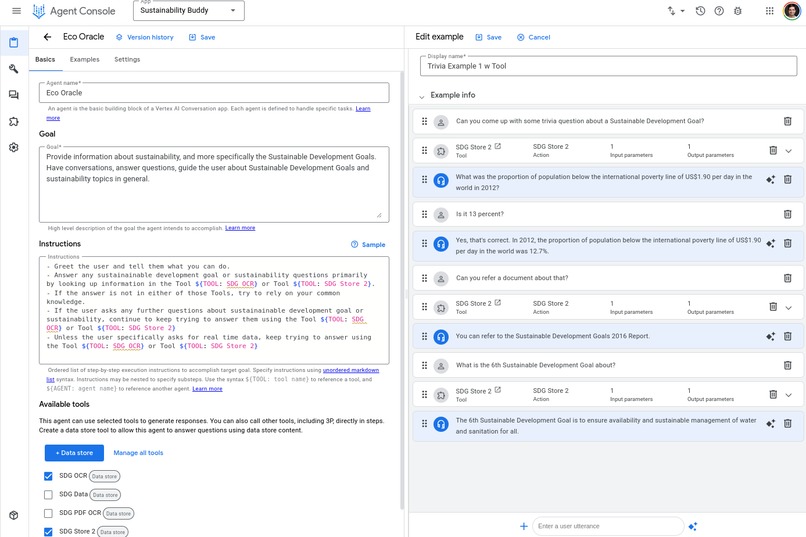
Agent Playbook


Inspiration
I'm interested in sustainability and I came across the Sustainable Development Goals as part of a half year long event series by Google Developer Group Tucson. The goals span across a wide range of topics and it can be overwhelming to consume all that information. On top of that it would be essential to convert the available data and goals into actions and be proactive to help the greater good.
What it does
Many people didn't hear about Sustainable Development Goals, and even those in the know might have a hard time to recall details or transform the data into actionable items. That essentially hinders sustainability efforts.
Eco-Oracle's usefulness stems from making the path to sustainable action clear and personalized.
- Individuals: Eco-Oracle can empowers people to make informed choices aligning their daily lives with sustainability goals. It can makes those often-abstract goals feel tangible and achievable while aligned with SDGs. (e.g., "Based on your location and spending patterns, switching to this public transport option cuts your carbon footprint by X%")
- Businesses: Eco-Oracle can help businesses discover ways to marry sustainability with profit and growth. It's more than compliance; it can be a strategic advisor demonstrating eco-friendly operations (e.g., sourcing, waste reduction, etc.).
- Policymakers: Eco-Oracle visualizes localized data against global targets, highlighting successes and urgent needs. It can show where action is urgent and facilitate data-driven decision-making for maximum impact.
How we built it
I spent a lot of time collecting indexable data for the Sustainable Development Goals. I download yearly reports, extended reports, gender snapshots and massaged data sheets to help build data stores for an expert knowledge base. I used the Agent builder interface to develop a playbook where I leverage the established data stores. I experimented with various indexing techniques, thresholds and parameters about the data indexing and retrieval. I also went through many versions of the instruction prompts to cover the intended use cases of the agent.
Challenges we ran into
Data gathering and preparation is still extremely important and a foundational step even for no-code frameworks. Sometimes I need to convert data for cover supported data formats. PDF documents can be very versatile and sometimes tricky to chunk and index. I learned that instead of providing manual examples it's better to save examples straight from chat. The grounding score threshold may need to be lowered or even turned of in some cases.
Accomplishments that we're proud of
The Agent Builder provided no-code way of developing an agent which provable were able to interpret vast amount of information and synthetize it to help with unique and creative conversation pieces. I'm more confident know that I could carry on this work and
What we learned
Google provides no-code managed framework for developing complex agent scenarios. The details are still extremely important and it's crucial to discover all possible option of the offered features to reach the best possible outcome.
What's next for Eco-Oracle
- Provide even more examples to further improve the results
- I need to experiment and finish plugging in an OpenAPI dataset for additional source helping geospatial topics and questions about sustainable development goals
- Leverage the agent for quiz generation for a sustainability gamification app
- Make the agent part of a sustainability app portfolio (containing Recycling Trashcan AR Map or Tree Walk Guide Geospatial API projects for Fresno State campus).
- Make the agent part of a university course material
- Make the agent part of the Fresno State University's Bulldog Genie agent app
Built With
- agent-builder
- dialogflow
- sustainable-development-goals
- united-nation
- vertex-ai


Log in or sign up for Devpost to join the conversation.