-
E-commerce Shipment

Inspiration
Climate change is an increasingly pressing issue in today's age, yet it's always daunting to address it at the scale that it is playing out and the timeframe needed to make a tangible change. But, without an active, collective drive to slow its effects, we understood that it would snowball until it is too late. Thus, we felt compelled to our best to create something that tackled this issue.
One thing we noticed was how fast same-day or two-day shipping had become ubiquitous in the online shopping industry, particularly with Amazon. We personally saw that with Amazon Prime, we had no option to choose otherwise, even though we didn't necessarily need packages within the next day. We later found out that the process of providing the service of same-day/two-day shipping is leading to large amounts of logistic inefficiency in the form of half-empty trucks, which means more trips and therefore higher carbon emissions. Freight vehicles, specifically medium- and heavy-duty trucks, are responsible for nearly one-quarter of the carbon footprint in the transportation category, which is the top producer of US carbon dioxide emissions. These short Amazon prime delivery times come at the expense of the environment. Research by Josué C. Velázquez-Martínez and Andrés Muñoz-Villamizar reflects this, showing that fast-shipping increased total costs up to 68%.
Ultimately, fast-shipping is very convenient for the consumer, but very expensive for the environment, especially when it isn't always necessary
What it does
E-commerce Shipment allows users to submit their online shipping orders (particularly Amazon) through a web interface, which groups packages together on common delivery dates to reduce the number of vehicles and back and forth routes to deliver packages. Users are able to track the carbon emissions they save by having their order as part of a particular shipment.
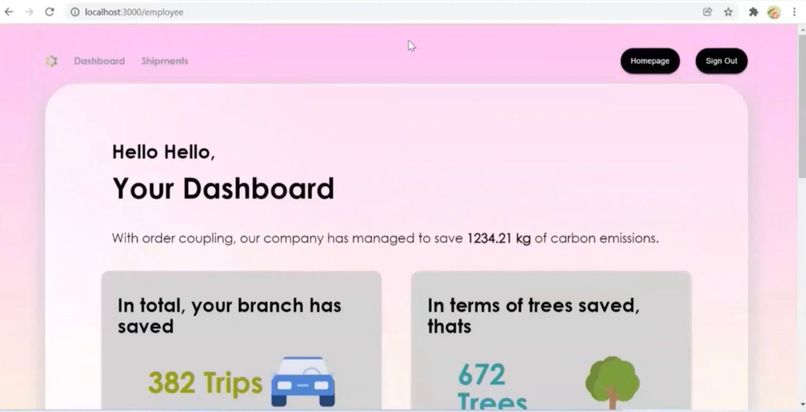
Delivery managers will have user orders grouped together into shipments through our platform, and will be able to distinctly see the emissions that will be saved when they do this haul instead of having separate hauls. The managers will be able to see the total amount of ecological savings their branch has through the app.
Ultimately, E-commerce Shipment serves to promote sustainable business practices and will inevitably lower carbon emissions from the climate conscious consumer and shipping marketplaces such as Amazon. These shipping marketplaces like Amazon will also benefit in business from making an eco-friendly choice and providing a green alternative to normal shipping for consumers.
How we built it
To make implementation easier, we employed a mix of the latest frontend and backend technologies such as MongoDB, Express, NodeJs, and React, as well as a variety of other front-end tools (eg. Material-UI). We utilized Passport.js with JWT authentication for user authentication. Bcrypt was used to hash passwords and save user sessions as cookies in the browser. We also used the Google Maps API to create a map that showed user locations. We additionally assessed the emissions we'd save by offering our service and combining consumer purchases together, using current predicted emission rates for rapid shipping and current expected emissions estimates for Amazon vehicles.
Challenges we ran into
Connections with MongoDB had errors, we also had a lot of challenges formatting the User Interface.
Accomplishments that we're proud of
We are proud to develop a project that can help reduce the carbon footprint of e-commerce websites by more than half. Bringing a reform in this polluted world to make it eco-friendly is what we love no matter how small our contribution is to the cause.
What we learned
We learned a lot about the details and scale of climate change issues while brainstorming ideas and we also developed a stronger grasp of modern frameworks like React and Express
What's next for E-commerce Shipment
We'd like to continue developing some of its features and improving it.
Currently, our algorithm for calculating ecological footprint only takes into account the weight of the order. If not for the 24 hour time constraints, we would like to leverage a geolocation distance calculating API and integrate a pathfinding algorithm for delivery routes. Our calculated delivery route could then be incorporated in the calculation of ecological footprint.
Furthermore, we believe that our online interface may be integrated into the Amazon website to provide a sustainable shipping option. Users would no longer need to navigate to our app to place orders; instead, the Amazon marketplace would be able to fetch order information immediately.
This integration is critical, as delaying deliveries will lower Amazon's expenses while also improving consumer satisfaction. Users may be compensated for how much carbon footprint they have reduced with a credit system.
Built With
- bcrypt
- express.js
- google-maps
- jwt
- material-ui
- mongodb
- node.js
- passport
- react


Log in or sign up for Devpost to join the conversation.