-
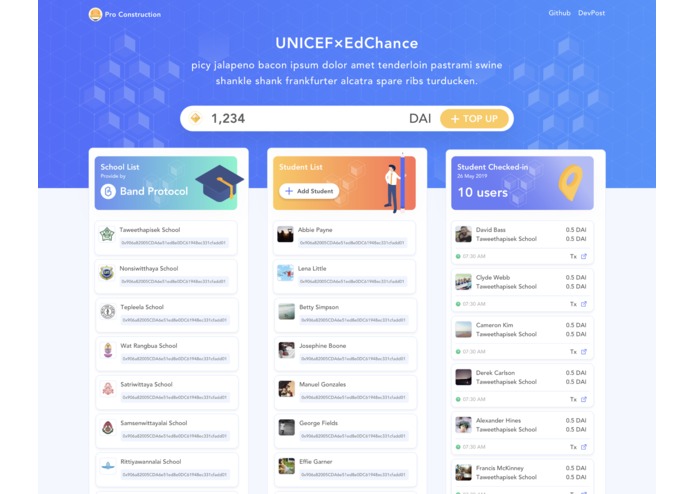
Company Portal
-
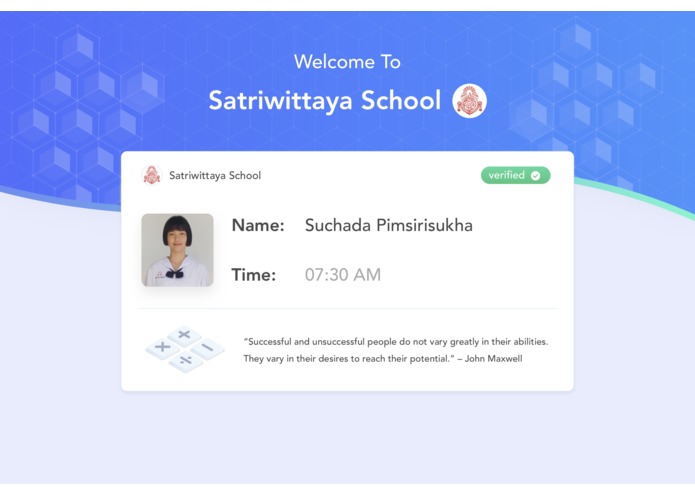
School Check-in Portal
-
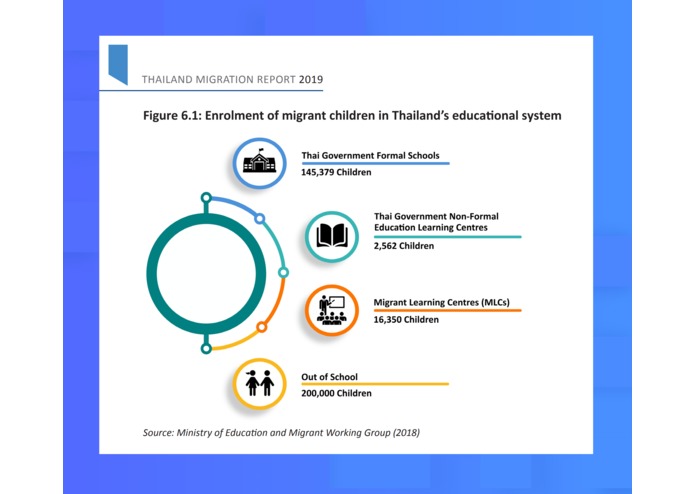
Stats on Migrant Children's Education
-
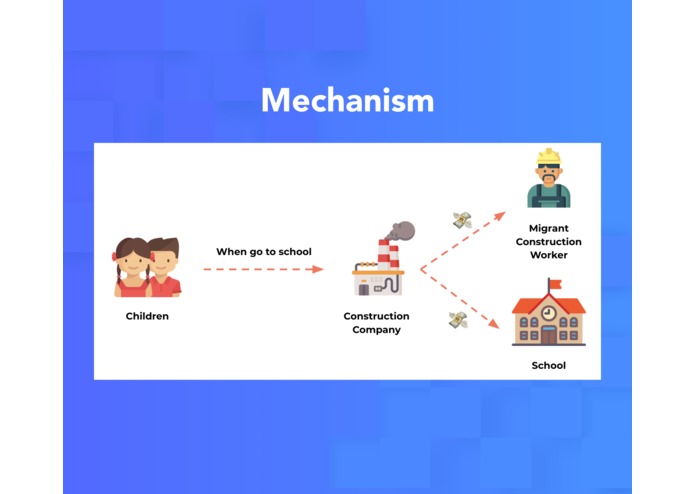
Incentive Mechanism
-
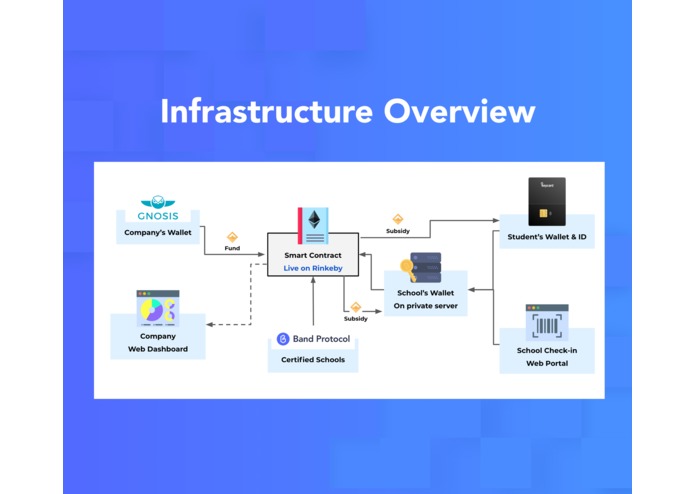
Infrastructure Overview
-
Thumbnail


Important Links
Google Presentation: https://bit.ly/2QmvjVy
Contract Address: https://rinkeby.etherscan.io/address/0x6D09631c692c56ABF90277E0C5AE2b155c4542e5
Github for Smart Contract: https://github.com/prin-r/UnicefHackathon
Github for School Check-in Portal: https://github.com/evilpeach/surge-keycard
Problem Statement
According to United Nations's Thailand Migration Report 2019, only 164,000 migrant children are enrolled in school (up to secondary school), while more than 200,000 migrant children remain out of school and are not receiving any form of education.
The lack of necessary financial support precludes more than half of the migrant children from receiving the basic education level. As we talk to Jakub Lambrych, a UNICEF Innovation Consultant, we have learned that the problem is severe and is one if the key area that UNICEF is experimenting to find the solutions for. We also found that the problem is rooted in multiple areas:
- The cost of sending children to school is prohibitive for some migrant parents; it costs them an upward of 6,454 THB (~$204) per year to send a child to public primary school.
- Migrant parents working in construction typically move from one construction site to another for multiple times a year, making it difficult for children to attend and stay in school.
- In many cases, migrant children face difficulties in language difference, requiring special support from the school, which may contribute to more expensive tuition fee.
Our Solution
We present a solution to allow funding of migrant children's education while aligning the incentive of all the parties involved. The demographic of migrant workers we focus on is in construction sector, which is the pilot group that UNICEF Thailand work closely with.
According to UNICEF's studies, construction companies are willing to subsidize the cost of education as it would improve the quality of life of their workers. Therefore we have engineered an incentive structure such that:
- Company will subsidize education cost of immigrant worker's children.
- Every time a migrant child goes to school, the subsidy will be given to both the child's parent and the school that he/she attend to.
Incentive Analysis
- Company benefits from higher-quality labors with a relatively minimal cost.
- Parents benefit from company's subsidies.
- Schools benefit form company's subsidies.
- Children benefit from higher chance to attend school and better education with more funding to support their special language need.
Implementation
- We deploy a smart contract that allows the company to deposit DAI to a token pool, which will release a fixed amount of subsidies to a student and his/her school upon a successful proof that the student attends the school. This functionality is allowed once a day.
- We then distribute a personal identification card with wallet functionality (Status keycard) to each student.
- When arriving at school, students would scan their ID cards, which will generate an unforgeable signature to prove then they actually arrive.
- Once the school gets signature, it trigger
claimRewardmethod in the smart contract, which then send the allocated DAI to both the student and the school.
Why Blockchain?
- In order to allow companies to fund migrant children without using blockchain, some organization must be in-charge of managing companies' subsidizing money — most likely an NGO. Not only the companies and regulatory body have to put tremendous trusts on such organization, it is nearly impossible for an NGO to expand operations and take the project to the national scale.
- By utilizing smart contracts, we have created a scalable solution to the problem with minimal infrastructure costs.
- Using ID with built-in wallet functionality creates permanent, auditable proofs that every dollar spent actually goes to student and certified school.
- Migrant workers can conveniently send DAI cross-border to their family overseas.
How did we build it?
- We write Ethereum smart contracts via Solidity along with 33 test cases to make sure that all the functionalities work as intended. The contract are deployed to the Rinkeby testnet. The code is on Github.
- We use a dataset of certified schools from Band Protocol, which allows the companies to verify that their money goes to actual institutions.
- We utilize Gnosis's Safe to store funds for companies and allow them to interact with the smart contracts. The Team Edition with multi-sig features would be especially useful for managing fund in the organizations.
- We use DAI stable coins to distribute funds from companies to schools and migrant parents — other tokens with high fluctuation in value (ETH for example) won't be accepted by businesses and legislative bodies.
- We use Status keycard to represent student's identity, store funds, and prevent schools from forging student's attendance records and fraudulently claim funds from the companies. The low-profile characteristic of the keycard also ensure easy distributions to the migrants.
- We build a web application that interfaces with Status keycard reader. It show student's name and picture on upon checking in and send the attendance record to the blockchain.
- We build a PoC of the company's dashboard from React (designed with Sketch and Zeplin).
Expected Outcomes & Future Plans
First, we'd like to collaborate with UNICEF and carry this PoC to actually pilot it with construction companies and schools in Bangkok area. Through future iterations, we hope to see this idea adopted and help the 200,000 migrant children gain access to education they deserve.
Furthermore, the incentive structure presented here not only works with education, but it can also be expanded so that migrant children have better exposure to:
- Healthcare
- Child protection services
- Birth Registration
Challenges we ran into
- Gnosis Safe for Rinkeby is not available on iOS at the moment
- Status keycard still lacks the language-specific binding




Log in or sign up for Devpost to join the conversation.