-
-
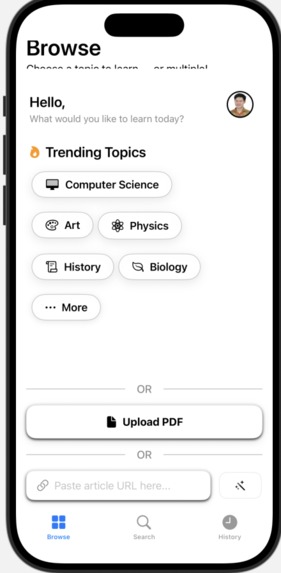
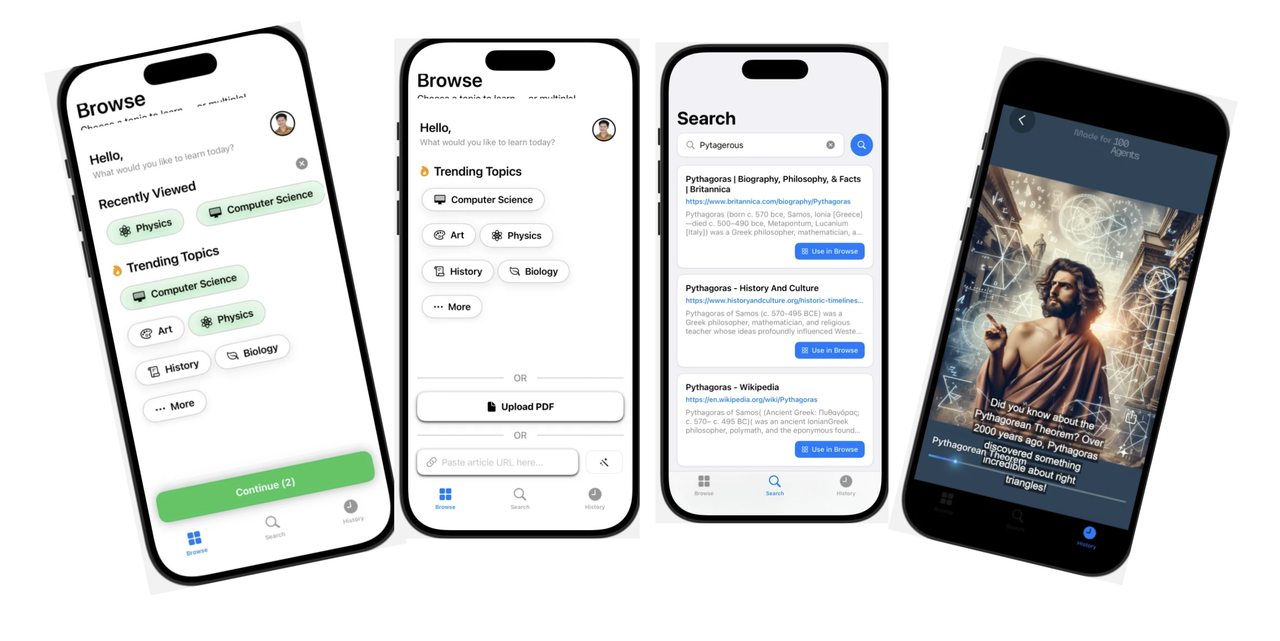
Flexible Content Input: Choose a subject, upload a PDF, or paste an article URL SmartSwipe adapts to your learning preferences and sources
-
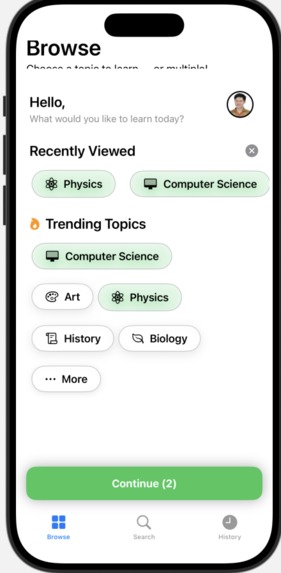
Topic Selection Screen: resume learning with "Recently Viewed" topics and explore what’s trending across subjects
-
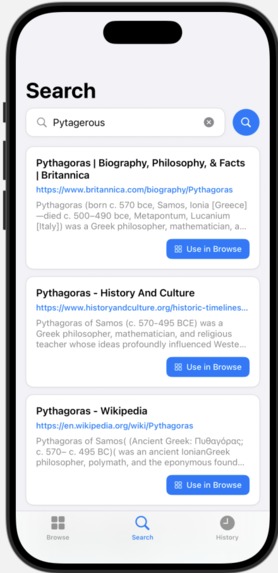
Agent-Powered Web Search: Enter any topic and fetch high quality, relevant articles you can instantly convert into short form videos
-
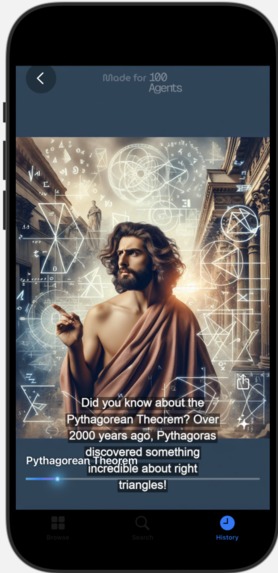
Auto-Generated Educational Shorts: Watch AI-generated videos complete with narration and visuals crafted from academic content in seconds


📢 Targeted Tracks → Jury Winner + Best Open Source Submission (by Appwrite) + Best Crawler Agent (by Tavily)
👥 Team Name: SmartSwipe
Team Profiles: Pratyay Banerjee, Brayton Lordianto

Inspiration 💡
In today's fast-paced digital world, students often struggle to stay engaged with dense academic content spread across textbooks, PDFs, and scattered online articles. Traditional learning resources can be overwhelming, time-consuming, and unmotivating especially when compared to the short form, visually engaging content dominating social media platforms.
We wanted to reimagine education through the lens of agentic AI. Inspired by the idea that autonomous systems could bridge the gap between serious learning and addictive media formats, we built SmartSwipe: an agent-powered educational platform that turns complex academic material into short form, scrollable videos. Our goal was to make high quality, personalized learning as frictionless and captivating as scrolling through your favourite app.
Declining Attention Spans: Studies have observed a significant reduction in the average human attention span, decreasing from approximately 2.5 minutes in 2004 to around 45 seconds in recent years.
Increased Stress Levels: Engaging in multitasking, especially with digital devices, can lead to cognitive overload, resulting in elevated stress levels and reduced comprehension.
Impact on Learning: Media multitasking has been associated with poorer academic performance, diminished executive function, and reduced memory retention.
Content Consumption Patterns: The rise of short-form content and infinite scrolling has conditioned audiences to prefer brief, easily digestible information, potentially reducing the capacity for sustained focus.
What it does 🤔
SmartSwipe is an autonomous agent-powered platform that transforms dense educational content like articles, PDFs, and scientific topics into short form, scrollable videos tailored to your interests.
Objective: Turn any article, link, or PDF into an AI-narrated short from static content to scroll-stopping educational videos, automatically ✨
Users begin by selecting a subject like Math, History, or Computer Science, with the option to mix and match subtopics even across disciplines (like "Biology + CS"). Our agent system then crawls the web using intelligent search to find high-quality educational resources, summarizes the content using advanced AI, and generates engaging short videos using cinematic visuals, narration, and subtitles.
Each video is built automatically through a chain of intelligent tools: AI-based scriptwriting, automated image generation, specialized animations for mathematical concepts, and seamless video assembly. To track user learning progress, topic choices, and generated content, we use a robust backend database and authentication system.
Although educational platforms already exist, they often fail to capture students' attention in the way social media does. That's where SmartSwipe comes in. We aim to transform lecture slides, textbooks, and course materials into bite-sized, algorithm-driven content that students can consume through an infinite-scroll interface, ultimately improving information retention while satisfying the desire for quick, engaging content. The app can also provide a platform for students to share knowledge, ask questions, and engage with peers through comments and likes, creating a collaborative learning environment.
At its core, SmartSwipe is built to replace mindless scrolling with meaningful learning. Instead of getting lost in endless TikTok or Instagram reels, users can hop on SmartSwipe to learn something new every time they scroll—turning screen time into study time without sacrificing engagement.
By combining agentic AI with personalized tracking and seamless content generation, SmartSwipe makes high-quality education as accessible and addictive as scrolling through your favourite feed while helping users actually learn and absorb content.
UX Flow:
- Users visit SmartSwipe's landing page and proceed to sign in via Google OAuth powered by Appwrite
- Upon login, users land on the dashboard to explore courses or upload materials.
- Users drag and drop PDFs, lecture slides, textbook excerpts, or paste blog/website links.
- AI extracts key insights, converts them into short-form video explainers, and formats them into an infinite scroll-friendly feed.
- Users go to their feed and can scroll through their reels. They engage and learn with the reels generated by watching, liking, and sharing them.
- Students control the visibility of their notes; public feeds are categorized by course for collaborative learning.
- A spaced repetition algorithm ensures critical concepts reappear at optimal intervals.
- Users track progress, identify knowledge gaps, and refine their learning strategy.
Log in → Upload Data → AI Parses → Generate Short-Form → Ready to Publish → Engage 🚀
How we built it ⚙️
🚀 Crafted with passion & innovation, our AI-powered full-stack app tackles real-world challenges.
⚡ Built with cutting-edge tech, it seamlessly integrates AI, ML, and modern development stacks.
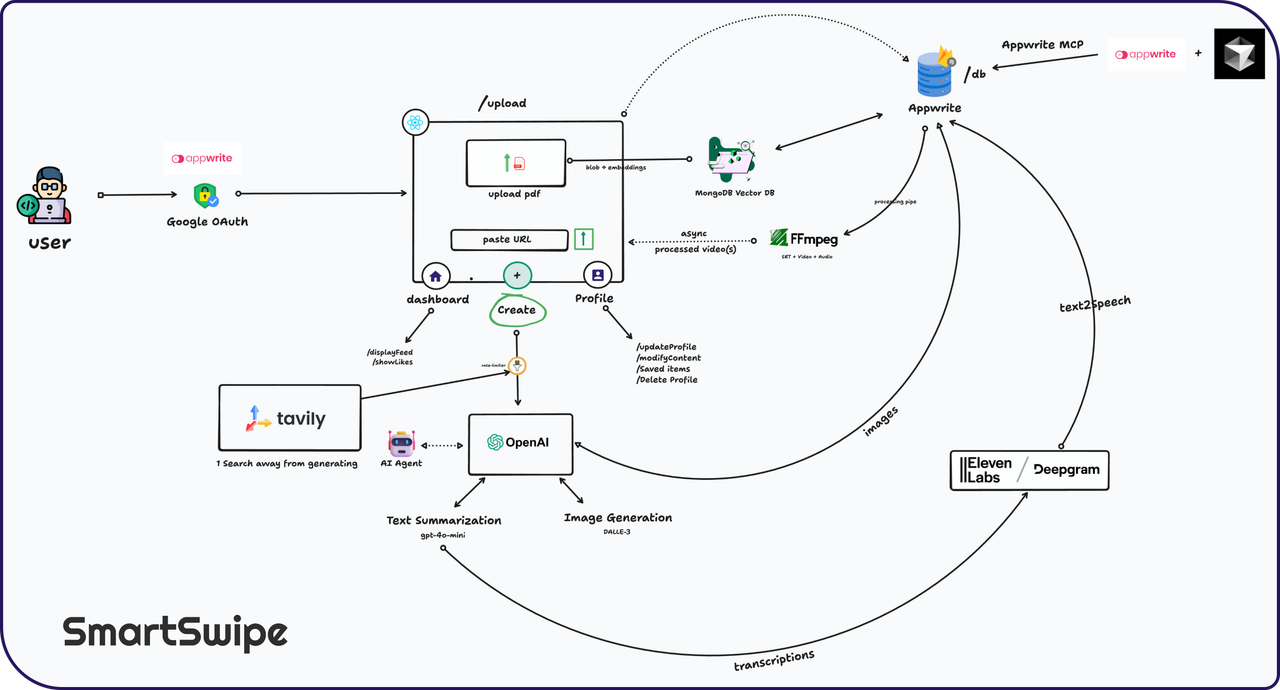
- Frontend: Swift + SwiftUI – Powers the native iOS app with a clean, modular interface and smooth user experience with Appwrite's Google OAuth
- Development Environment: Xcode – Used as our primary development environment for building and debugging the iOS app
- Backend & Database: Appwrite – Serves as our backend platform for user authentication, progress tracking, and video metadata storage
- AI & ML Stack: OpenAI GPT-4o – Converts article and PDF content into short-form video scripts using custom system prompts for educational storytelling
- Search & Content: Tavily API – Handles intelligent agentic search to fetch the most relevant online educational content
- Visual Generation: DALL·E – Used to generate vivid, AI-created visuals for scenes in the videos
- Video Processing: FFmpeg – Automates the stitching of narration, visuals, subtitles, and background music into vertical short-form videos
- Orchestration Backend: Flask + Python – Acts as our orchestration backend, managing the video pipeline from content ingestion to final rendering
- Mathematical Animations: Manim + Gemini AI – Powers a RESTful service that generates clean mathematical animations from natural language concepts!
Design 🎨
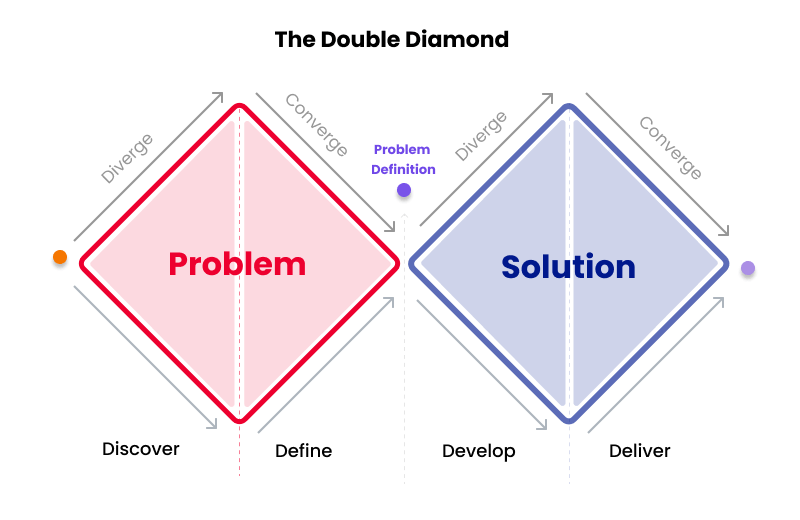
We drew inspiration from the evolved Double-Diamond design process, which goes beyond visual design to incorporate a comprehensive research cycle. Before diving into solutions, we discover and define the problem, ensuring a structured approach before developing and delivering the final product.
🔍 Discover – Deep exploration of the problem we aim to solve.
🎯 Define – Refining insights into a clear problem statement.
💡 Develop – Brainstorming and iterating on potential solutions.
🚀 Deliver – Selecting and building the most effective solution.
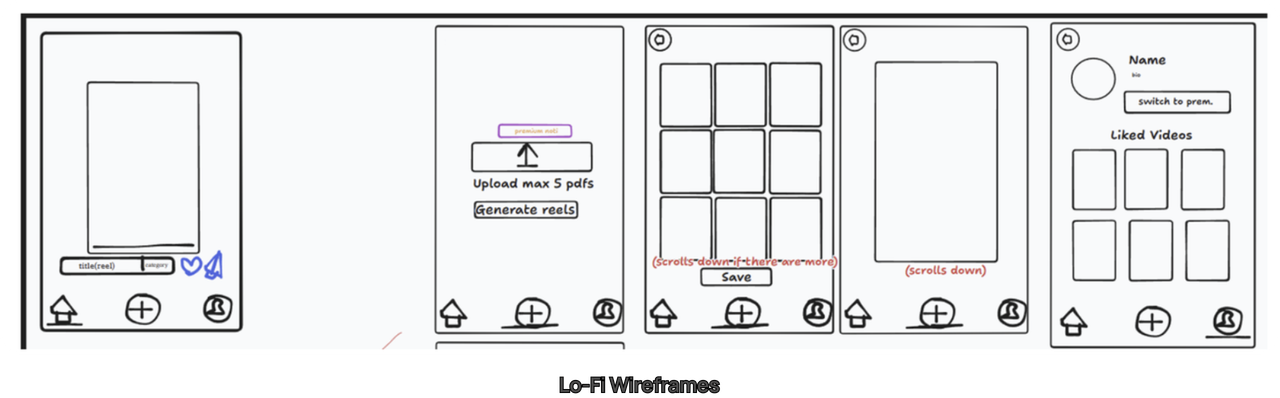
To ensure precision, we used Figma, TLdraw, and other tools to prototype before writing a single line of code. This iterative approach allows us to gather feedback early, minimizing the need for extensive rework.
Research 📚
To build a truly impactful solution, we delved deep into research, exploring how digital habits shape learning. Here are some insightful resources that guided our approach:
- Why our attention spans are shrinking, with Gloria Mark, PhD
- Is Social Media Destroying Our Attention Spans?
- TikTok is killing your brain, one short-form video at a time
- Learning Media and Technology: Generation Z and Alpha
- Emerging research on social media use in education
- Impact of Social Media on Learning Motivation
- What is brain rot? The science behind what obsessive scrolling does to our brains
- Social Media Influence on Students' Knowledge Sharing
- We Asked Experts—Is the 'PDF to Brain Rot' Tool Useful for Studying?
- TikTok is killing your brain, one short-form video at a time
Resources stacked up for future ⚡
- The Future of Online Learning in 2025: The Role of AI and Personalization
- Machine Learning Advancements In Education: An In-Depth Analysis And Prospective Directions
- Cloud Computing In Education Market Share, Size and Industry Growth Analysis
- Scalable and adaptive deep learning algorithms for large-scale machine learning systems
Challenges we ran into 😤
One of the biggest challenges was integrating a fully autonomous pipeline that could take messy, unstructured web content and convert it into clean, engaging short-form videos. Articles often include LaTeX, code blocks, or irrelevant noise, so building a robust content parser that could extract the core educational material reliably took significant iteration.
Another key challenge was synchronizing multiple moving parts—search agents, script generation, image synthesis, narration, subtitle alignment, and video rendering—into a smooth end-to-end process. Ensuring each module (from GPT to DALL·E to FFmpeg) played nicely together required careful orchestration and error handling.
Additionally, ensuring that the generated content was both educational and entertaining required significant refining—we experimented with the background video, music, and text of the videos. Another critical challenge was ensuring that the music and visuals matched the content being displayed in the video, enhancing engagement without distracting from the learning experience.
On the frontend side, making the app intuitive for users while giving them flexible control over learning topics was tricky. Designing an interface that lets users explore subjects while tracking their progress seamlessly pushed us to think hard about user experience and database schema.
Accomplishments that we're proud of ✨
We're proud of building a fully functional, end-to-end system that turns raw web content and PDFs into educational videos complete with narration, images, subtitles, and smooth transitions. SmartSwipe brings together multiple technologies across frontend, backend, and AI pipelines, all working in sync.
We are proud of creating a platform that successfully merges education with the social media experience. Our AI was able to generate surprisingly engaging and accurate educational content from complex academic materials. We're especially proud of how seamless the user experience turned out: learners can simply choose topics, and the app intelligently generates short-form content tailored to them.
This project was a notable accomplishment for us because it addressed a critical gap in modern education while leveraging familiar technologies in an innovative way. We believe SmartSwipe has the potential to transform how students engage with educational content.
What we learned 📖
Throughout building SmartSwipe, we deepened our understanding of how to orchestrate multiple AI agents and APIs into a cohesive pipeline. We learned how to handle real-world challenges like parsing complex web content (including LaTeX), generating concise scripts from long-form articles, and aligning visuals, audio, and subtitles to create polished educational videos.
Integrating tools for user state management and content retrieval gave us valuable experience in managing full stack agentic systems. We also learned how important it is to design with the end user in mind—balancing automation with customizability so learners feel empowered, not overwhelmed.
What's next for SmartSwipe 🚀
We plan to expand SmartSwipe with support for more languages, deeper personalization based on user learning habits, and higher-quality video output using richer visual libraries. We're also exploring integration with educational platforms to allow teachers to assign, track, and tailor SmartSwipe content to their students' needs.
SmartSwipe's next steps focus on pushing short-form educational content to the next level. We plan to refine our AI-generated video reels, making them even more engaging and contextually rich. Enhancements like dynamic animations, improved voice modulation, and seamless music-video alignment will create a smoother experience.
We're also exploring real-time personalization, where content adapts based on user interaction and learning behavior. Additionally, we aim to introduce collaborations with educators and student communities to diversify content styles while maintaining the addictive nature of scrolling. Finally, we aim to optimize the agent pipeline for faster video turnaround and scale the app for wider classroom and individual use.
The future of learning is fast, fun, and powered by SmartSwipe!



Log in or sign up for Devpost to join the conversation.