-
-
-

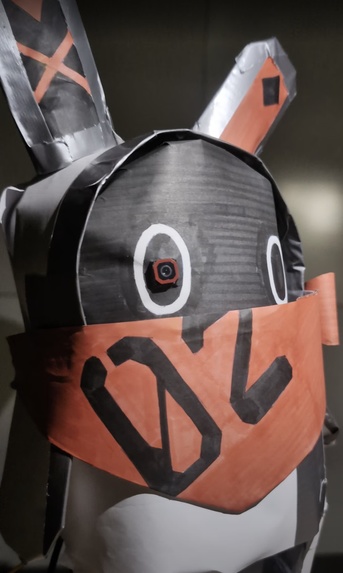
Photo taken by our Bangboo, Eous!


Eous — Your AR Bangboo Assistant
Inspiration
We wanted to build a fully hands-free assistant that lives in augmented reality — something you can wear, gesture to, and speak to, and that can see and act in the physical world. Inspired by Zenless Zone Zero’s Bangboo robots, we imagined a tiny helper that follows you around, listens, watches, and supports you in daily tasks. AR glasses felt like the perfect medium to bring that vision to life.
What it does
Eous is an embodied AR assistant that connects your gestures, voice, and environment to a real robot.
- Gesture-based control: Move your hand and pinch to drive a robot car in real time.
- Photo capture: Short left-hand pinch triggers image capture with a shutter effect.
- Voice recording: Long left-hand pinch records audio from the AR glasses’ microphone.
- Transcription display: Eous shows live transcriptions inside the AR interface.
- Video streaming: The robot streams a live camera feed into the AR HUD.
- On-device processing: Everything runs on a phone + AR glasses — no PC required.
Eous becomes a mixed-reality companion that listens, sees, and reacts.
How we built it
- XReal Air 2 Ultra for hand tracking and AR display
- Unity running inside an Android host app
- Custom gesture recognition using XR Hands
- Local HTTP server inside Unity (
HttpListener) handling:/command→ robot control/send→ robot video feed/audio→ WAV recording retrieval/transcript→ subtitle display in AR
- Raspberry Pi-controlled robot for movement + camera streaming
- Python backend for:
- Video encoding
- Command forwarding
- Speech-to-text (STT)
- Transcript packaging
- Video encoding
We engineered a realtime bidirectional system between AR glasses ↔ phone ↔ robot.
Challenges we ran into
- Getting mic access through AR glasses on Android
- Preventing audio feedback (hearing yourself through the glasses)
- Streaming a video feed into Unity efficiently
- Ensuring gesture detection was stable and not jittery
- Synchronizing recording → upload → transcription → AR display
- Handling thread-safe communication between Unity and background HTTP threads
- Keeping latency low across three devices
Accomplishments that we're proud of
- Built a seamless gesture-to-robot control pipeline
- Achieved live AR subtitles from physical-world voice recordings
- Got fully working mic recording + WAV encoding on XReal glasses
- Created an intuitive AR UI that feels natural and persistent
- Integrated AR, robotics, audio, and networking into a single real product
- All running locally — no cloud dependencies required
What we learned
- Unity can be used as a full network server on Android
- AR gesture design requires careful tuning to avoid false triggers
- Audio pipelines on Android are extremely tricky
- Efficient video transfer needs strict encoding discipline
- Managing concurrency in Unity requires main-thread syncing
- AR UI/UX matters far more than expected — clarity beats complexity
What's next for Eous
- On-device object detection via lightweight ML
- Pathfinding so the robot can navigate autonomously
- Multi-modal memory: store conversations, photos, and events
- A full web dashboard to review captured data and robot logs
Eous is just the beginning — an AR assistant that blends digital intelligence with real-world embodiment.
Built With
- csharp
- python




Log in or sign up for Devpost to join the conversation.