-
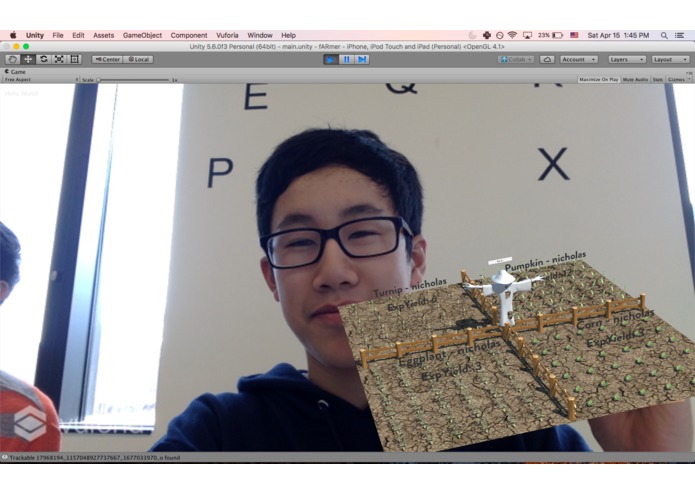
Making progress with our AR garden plot!

Inspiration
We were inspired by various community-supported agriculture (CSA) organizations. CSAs offer ethical, biodynamic produce from various local farms. However, these organizations are often prohibitively expensive and inconvenient for the working class. Our goal was to create affordable ecosystems that could effectively feed diverse neighborhoods while fostering a sense of community. As we discussed this problem, we found the perfect technology to solve it: augmented reality. Augmented reality is not only extremely intuitive to set up, it also allows groups of people to share a collective vision of potential and growth. fARmer gives communities this vision.
What it does
fARmer is both a web and mobile application that allows communities to plan and maintain urban gardens. The AR interface gives users a glimpse into the future of the garden, while the web application allows users to keep up to date with their garden plots as well as their neighbors'. Finally, when it comes time to harvest the fruits and vegetables of their labor, fARmer gives a central location to trade produce and swap recipes. fARmer enables communities to achieve more self-sufficiency, especially those that live in so-called food deserts. Additionally, fARmer promotes a healthier, balanced diet through home grown vegetables.
How we built it
We built the augmented reality in Unity with a specific framework called Vuforia. Using the Vuforia SDK, we designed the garden plots, the corresponding label displays, a fancy login/map UI, among other cool features. The augmented reality then called a REST API run by a Rails application with a PostgreSQL database to get and send the necessary information. We set up various relations using Rails' ActiveRecord, such as plots, produce and plants. This Rails application also served as our web application, allowing users to make accounts and track their plots.
Challenges we ran into
We had some difficulty getting Unity to work, as this was the first time any of us had used it. We spent long hours reading documentation and understanding how the UnityEditor and Engine operated. Not only that, but Unity required us to code in the C Sharp (C#) language, which was somewhat foreign to us syntactically. Furthermore, we ran into a little bit of difficulty connecting Unity to the Rails application through POST requests. That being said, we are proud of the progress we made in such limited time.
Accomplishments that we're proud of
We are proud to have come up with what we believe to be a very unique and interactive solution to environmental sustainability. It does not only have practical applications but is also very enjoyable and fun. Additionally, two of us managed to learn Unity and C# with no previous experience. We also managed to deploy, test and refine a Rails application that acted as both a JSON API and a full functioning web application.
What we learned
We learned that AR is easier to implement than we previously thought. We also learned C# and Unity. Finally, we learned that GET/POST requests are rather tricky when dealing with overly opinionated security (CSRF Tokens).
What's next for fARmer
We'd love to work with people more experienced in urban agriculture, whether through programs like WOOF or CSAs. That way we could integrate features such as recipes and bartering. We'd also love to publish the application on the App Store for both iPhone and Android.




Log in or sign up for Devpost to join the conversation.