-
-
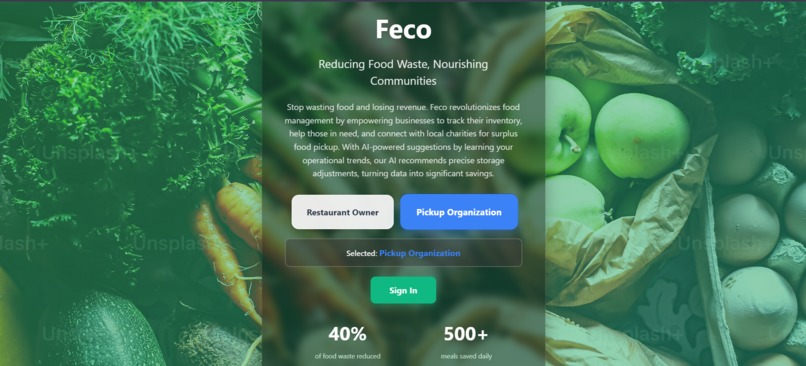
Login
-
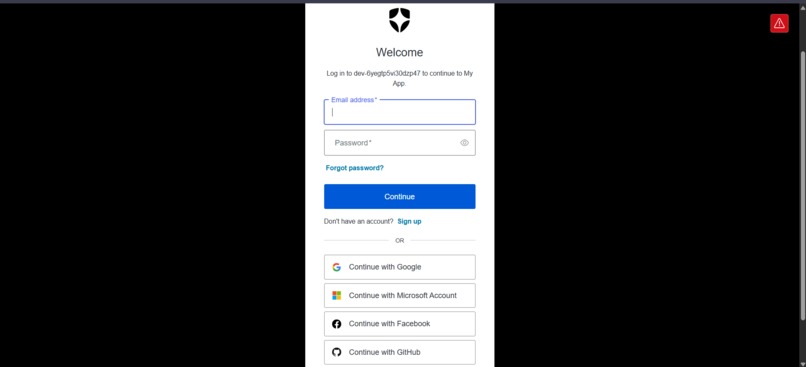
Auth0 login
-
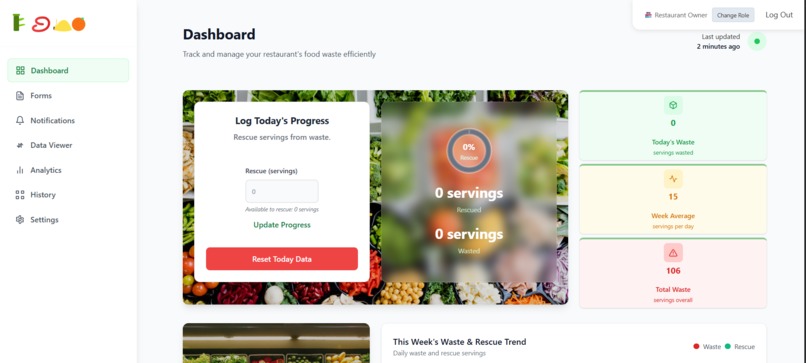
Daily dashboard
-
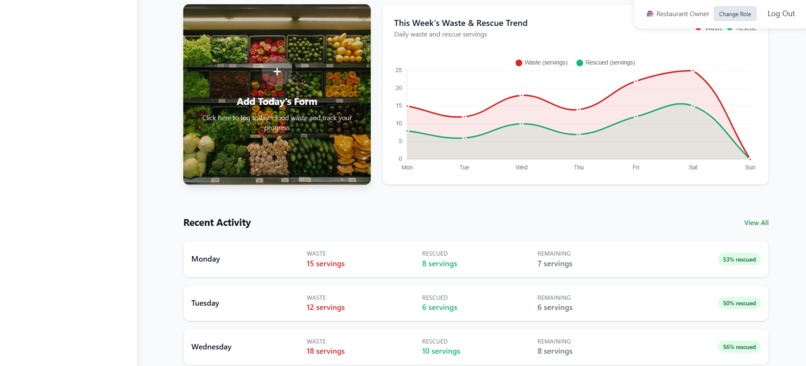
Week trend
-
-
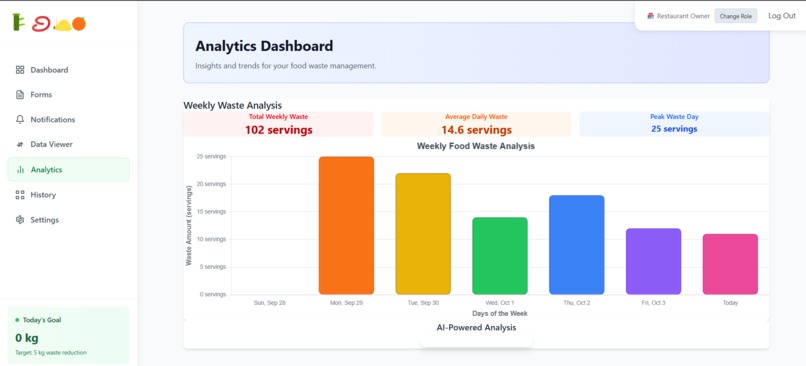
Data stored weekly
-
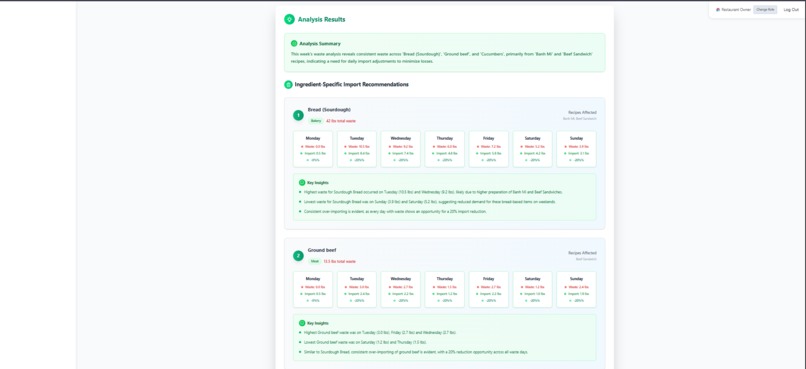
AI analysis 1
-
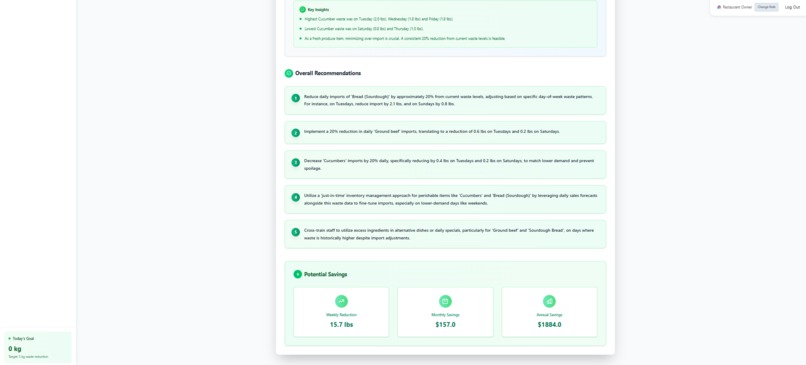
AI analysis 2
-
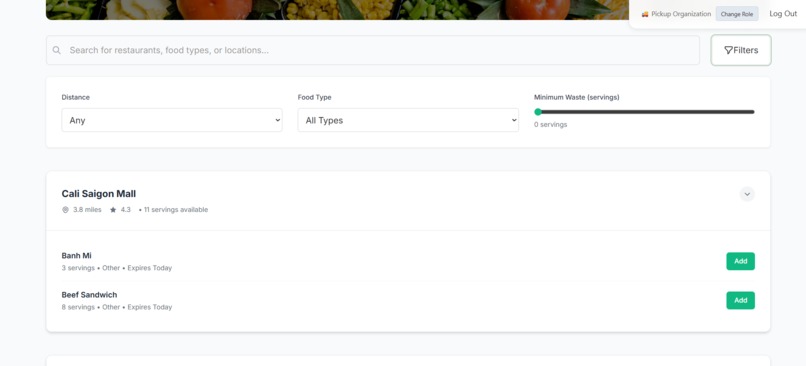
Pickup page


Inspiration
The US wastes nearly 60 million tons — 120 billion pounds of food each year. Even though nearly 35 million people across America, including 10 million children, suffer from food insecurity. We wanted to create a solution which can slowly help redirecting those leftovers to those who are suffering from food insecurity, meanwhile mainly reducing food waste. By doing so, we encourage more responsible consumerism and reduce costs for businesses.
What it does
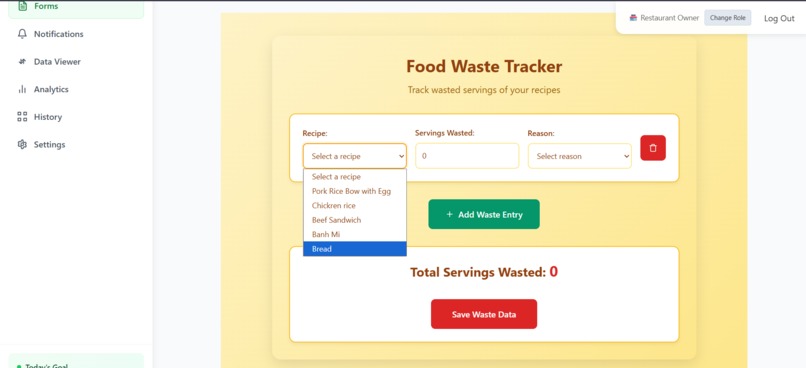
The app has two separate functions for 2 types of accounts: Businesses (e.g. restaurants, ...) and Receivers (e.g. people in need, organizations, charities,...), but mainly focus on businesses who want to reduce their food waste. Business can create accounts using Auth0. Afterwards, they can input daily data regarding how much food is wasted each day and how much is saved each day (by being picked up by people in need or sent to organizations and charities). In particular, for a long term solution, all past inputs will be saved and a weekly graph is created to show trends for the past week. They have the choice to send all data through Gemini API to have it evaluated and receive precise feedback on food imports to reduce business costs and food waste. Receivers can see a real-time list of businesses that have listed items for pick-up. For each business, they can see the available food items, quantities, and a designated pick-up window. To make this process efficient, Receivers can filter listings by proximity, type of food, and quantity.
How we built it
We built our application using React for a dynamic and responsive frontend experience. For our backend, we chose Supabase to securely store and manage data for both businesses and pick-up users. We integrated Auth0 to handle our sign-in system, allowing users to easily select their role as either a business or a pick-up account. The core intelligent feature of our platform is powered by the Gemini API, which analyzes the collected data to provide businesses with actionable feedback on their operations.
Challenges we ran into
Integrating Gemini API: We spent a significant amount of time studying the documentation to understand the specific request/response architecture, manage authentication with API keys securely, and handle asynchronous operations within our app. Connecting the Frontend to the Backend: We had some connection issues with Supabase. However, after looking through the schema and seeing the connections in the database view, we figured out the issue and solved it.
Accomplishments that we're proud of
Integrating APIs: We successfully incorporated two powerful services. We used Auth0 to build a secure and reliable authentication system from the ground up, and we utilized Gemini API to create intelligent, data-driven feedback that is the core feature of our platform. Developing a complete solution: From a user securely signing up to a business receiving actionable, AI-generated insights, the entire workflow is thoroughly thought out and completed. Overcoming the technical challenges to bring this full vision to life in such a short time was a major victory for our team.
What we learned
Despite all of us being first time hackers, we were able to communicate and collaborate effectively. We assigned tasks depending the person’s skill level to ensure tasks being completed on time and efficiently. Working on a project from start to finish gave us insight into the stages of application development and more hands-on experience. It definitely gave us more confidence in our ability and tackle complex challenges and learn new technologies on the fly. Building a working application from scratch proved to us that we can not only envision a solution but also execute it successfully.
What's next for Feco
Connecting with trustworthy review companies: Restaurants needs incentive to continue this kind of “giveaway”. Hence, letting users rate restaurants they received food from and connect those reviews to sites such as Yelp or Google Maps to update their ratings real time. This keeps people coming to these locations and increasing revenue.
AI-Powered inventory automation: Beyond providing insights, the next evolution of our AI feature is to help businesses automate inventory management. By connecting with suppliers, Feco could use predictive analysis to suggest or place orders for ingredients on behalf of businesses. This ensures businesses have exactly what they need, reducing waste and human error.
Verification with QR codes: We plan to implement a QR code system to streamline ordering and picking-up orders. When a Receiver checkouts an order, they will receive a QR code that will expire in 30 minutes to make sure people can’t just order everything then not picking up. If they do pick up, the Donator can scan the Receiver’s QR code to instantly verify the order and updating their inventory.


Log in or sign up for Devpost to join the conversation.