-
-

Fire Front
-
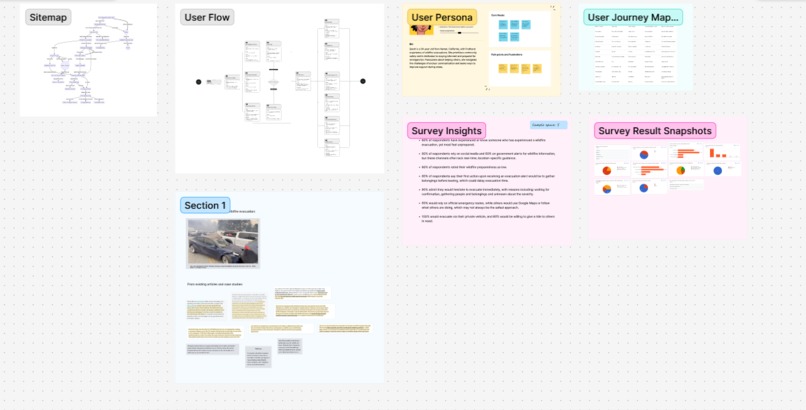
Research Board
-
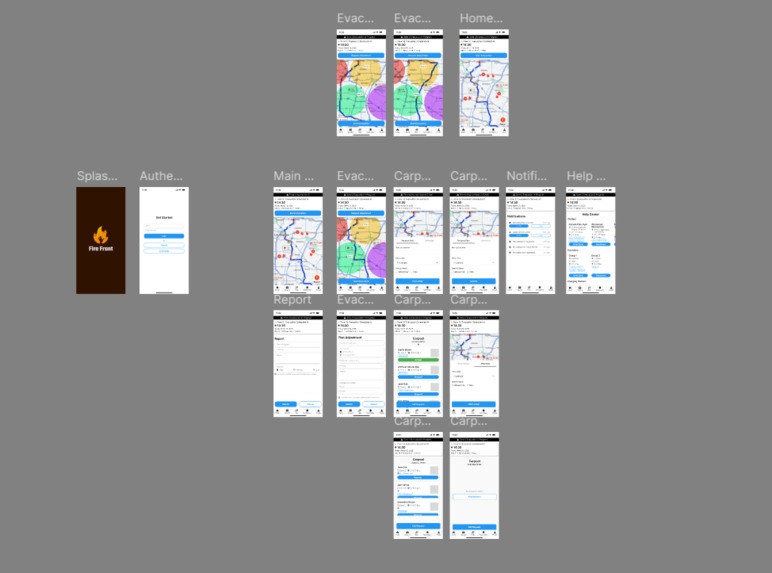
Design Board


Inspiration:
Our inspiration for the Fire Front app began with a simple yet urgent question: How can we make emergency evacuations safer, more efficient, and accessible for everyone? We recognized the growing impact of wildfires and other natural disasters, where chaos and uncertainty often leave communities struggling to evacuate in time. To understand the problem deeply, we conducted research by analyzing past evacuation challenges, studying emergency response systems, and gathering insights from those directly affected. We found that one of the biggest issues was the lack of real-time, accessible information, leading to traffic gridlock, miscommunication, and heightened risks for vulnerable populations. With these insights, we set out to develop Fire Front---a solution designed to provide clear, data-driven evacuation routes and shelters, real-time updates, and a community-driven support system. Our goal is to empower individuals with the information they need to make quick, informed decisions when every second counts.At the heart of Fire Front lies a commitment to inclusivity and accessibility. We believe that everyone, regardless of background or ability, should have access to life-saving information in emergencies. This belief shaped our design process and reinforced our mission. As we move forward, we invite communities, organizations, and individuals to stand with us in fostering resilience against emergencies. Together, we can ensure that no one is left behind when seconds count.
Problem Identification:
Vulnerable communities during crisis During emergencies, certain demographics such as the elderly, disabled individuals, children, and low-income families without access to transportation, are disproportionately affected. These groups often face significant challenges that expose them to greater risk during crises.
Elderly individuals and disabled people often face significant mobility challenges during emergencies, which can hinder their ability to evacuate quickly and safely. Factors such as physical limitations, reliance on mobility aids, or health concerns can complicate their escape routes, making them particularly vulnerable in crisis situations. Children, dependent on adults for guidance, may be particularly vulnerable if their caregivers are caught off guard. Additionally, low-income families without access to vehicles face a dire situation, as they may not have the means to evacuate quickly or evacuate at all.
This gap in resources and accessibility exacerbates the dangers faced during emergencies, highlighting a systemic issue that calls for urgent attention. As communities work to improve emergency response strategies, it is crucial to ensure that all individuals, regardless of age, ability, or economic status, are supported and prioritized in crisis planning and response initiatives.
Traffic congestion/gridlock During the LA wildfire, the abandonment of cars in Pacific Palisades exemplified how traffic congestion can lead to gridlock, severely hindering evacuation efforts. As vehicles became trapped in a bottleneck, many drivers found themselves unable to move, creating a chaotic situation that delayed the escape of those in danger.
Some drivers resorted to dangerous maneuvers, like driving the wrong way on Palisades Drive, in a desperate attempt to evade the traffic jam. Others chose to abandon their vehicles altogether, grabbing bags and pet carriers as they fled on foot. This behavior not only highlights the panic that ensues during emergencies but also underscores the dangers posed by traffic congestion.
Such gridlock can make evacuation routes unmanageable, preventing emergency services from reaching those in need and complicating rescue operations. In high-stress situations like wildfires, the inability to move quickly can lead to life-threatening consequences, emphasizing the urgent need for effective traffic management and clear evacuation protocols in disaster scenarios. Addressing these issues is crucial to ensuring that communities can respond swiftly and safely during emergencies. Problem Statement:
During emergencies, vulnerable communities, including the elderly, disabled, and families with no means of transportation, are at heightened risk due to their unique challenges in evacuating quickly and safely. Concurrently, traffic congestion exacerbates this issue by creating gridlock that delays the evacuation process. In chaotic situations, individuals may struggle to find transportation, while traffic jams obstruct access for emergency services, further complicating rescue efforts. This interplay between vulnerable populations and traffic congestion underscores the urgent need for effective strategies to enhance evacuation processes, ensuring that everyone has equitable access to assistance, allowing for a swift escape from dangerous situations.
How it’s being dealt with right now:
Despite the increasing threat of wildfires, our current evacuation systems remain fragmented and inefficient. According to our user research, 60% of respondents have either experienced or know someone who has experienced a wildfire evacuation, yet most still feel unprepared. When evacuation alerts are issued, 80% rely on social media or government notifications, which often lack real-time, location-specific guidance, leaving people uncertain about the safest course of action.
One of the biggest challenges is hesitation and uncertainty where 80% admitted they would hesitate to evacuate immediately, with reasons ranging from waiting for confirmation to ensuring family and belongings are secured. This uncertainty stems from the fact that we don’t have a centralized, reliable resource that provides clear, up-to-the-minute evacuation instructions, forcing people to rely on scattered information and guesswork. When they do evacuate, the vast majority which is 80% would rely on private vehicles, which leads to massive congestion on official emergency routes. While some would attempt alternative navigation through Google Maps or by following others, these methods aren't always the safest or most efficient. And despite the overwhelming dependence on personal vehicles, only 60% would be willing to offer rides to those in need which might leave many needy people stranded without transportation. These insights highlight the urgent need for a better, data-driven evacuation system, one that provides real-time, location-specific guidance to help people make informed decisions quickly and efficiently. Without it, we will continue to see gridlocked roads, last-minute panic, and increased risks for those most vulnerable during emergencies.
Bridging the gap with ‘Fire Front’ app:
Natural disasters, such as wildfires, often lead to chaotic evacuation scenarios, as seen in the LA wildfire incident. Recognizing the challenges posed by traffic congestion and the urgent need for effective response and recovery strategies, our app aims to bridge these gaps and enhance the evacuation process.
The app features color-coded zones that indicate varying levels of danger, allowing users to quickly assess their situation and understand the urgency of their evacuation. By providing real-time evacuation times based on the severity of the threat, the app helps individuals make informed decisions about when to leave, reducing the likelihood of gridlock.
Additionally, the app includes a carpooling and ride-sharing feature, facilitating shared transportation options for those without access to vehicles. This not only alleviates traffic congestion but also fosters community support, as neighbors can help each other during difficult times.
Furthermore, users have the flexibility to report their status, adjust evacuation times, and flag any dangers they encounter. This feature ensures that help is accessible to everyone, creating a network of support that enhances safety and efficiency during emergencies.
By addressing these critical issues, our app empowers individuals to navigate evacuations more effectively, ultimately saving lives and fostering a sense of community resilience during natural disasters.
How did we build it?
The development of the Fire Front app began with rigorous quantitative research and extensive survey to identify the specific challenges people face during emergency situations, particularly wildfire evacuations. We analyzed existing articles and gathered data from video interviews of LA wildfire survivors, as well as various case studies documenting the incidents.
1. Identifying Key Challenges: Through our research, we discovered that traffic congestion was a major barrier to effective evacuations. Many evacuees reported feeling trapped by gridlock, which significantly delayed their exit and complicated emergency response efforts. This insight highlighted the need for an app that could facilitate more efficient evacuations.
2. Defining Essential Features: Based on these findings, we outlined the critical features necessary for the app. We prioritized the inclusion of:
AI-Powered Route Optimization: To help users find the fastest evacuation routes, our app employs AI algorithms that analyze real-time traffic conditions.
Ride-Share Matching: This feature connects users who need transportation with those who can offer rides, thereby alleviating congestion and promoting community assistance during evacuations.
Real-Time Updates: Providing users with immediate information on traffic status, danger zones, optimal routes, and nearby shelters was essential to empower them to make informed decisions.
3. User-Centric Design: Throughout the development process, we emphasized creating an intuitive and accessible interface to make it user-friendly for everyone, including individuals with disabilities.
4. Prototype Development and Testing: Using an agile methodology, we developed prototypes of the Fire Front app, ensuring that each iteration brought us closer to a user-friendly and effective solution. Our process started with low-fidelity wireframes, allowing us to map out core functionalities and user flows before refining them into high-fidelity interactive prototypes. To gather initial feedback, we conducted informal testing with our friends and peers, observing how they interacted with the app and noting any usability issues. While this gave us valuable insights, we didn’t have enough time to conduct broader usability testing with real users facing wildfire risks. This remains a crucial next step to further refine the app and validate its effectiveness in real emergency situations.
Accomplishments we are proud of:
Identifying the Gap: Through thorough research and user insights, we were able to pinpoint the major challenges people face during wildfire evacuations—particularly traffic congestion, lack of real-time guidance, and hesitation due to uncertainty. Understanding these pain points allowed us to propose a solution that directly addresses these issues.
Developing a Practical Solution: We didn’t just identify the problem—we took it a step further by designing Fire Front with features that could genuinely improve the evacuation process. From AI-powered route optimization to ride-sharing and real-time updates, every element was crafted with the goal of making evacuations smoother and safer.
User-Centered Approach: Instead of building based on assumptions, we ensured that real user experiences and needs shaped our design. Our user personas and journey maps helped us step into the shoes of those affected, guiding our decisions in a way that prioritizes their safety and ease.
Creating a Strong Foundation: While Fire Front is still evolving, we’re proud of the groundwork we’ve laid. Our research, design, and feature development have set the stage for an app that has the potential to truly make a difference in emergency situations.
What did we learn?
The Importance of Intentionality: Every design choice we made had to be purposeful. It’s easy to get caught up in adding features, but we learned that true impact comes from focusing on what truly serves the users rather than what just seems innovative.
Prioritizing Users Over Our Opinions: As designers and developers, it’s tempting to assume we know what’s best. But through research and user insights, we realized the value of setting aside our assumptions and letting real needs guide our decisions.
The Power of Teamwork: Building Fire Front reinforced how essential collaboration is. Each team member brought different strengths and perspectives, and working together allowed us to refine ideas, challenge each other, and create something stronger than any of us could have done alone.
Every Problem is Different: No two challenges should be approached the same way. Each step of this project required us to rethink our approach—whether it was designing an intuitive interface, finding ways to reduce evacuation time, or ensuring real-time accuracy. We learned that flexibility and adaptability are just as important as technical skills.
What’s Next for the Fire Front?
Expanding Coverage: Enhancing fire detection and evacuation route accuracy for more regions. Refining User Feedback Integration: Improving in-app feedback features to better respond to user concerns and suggestions. Enhancing Real-Time Data Sources: Partnering with more emergency services to ensure the most accurate and timely wildfire updates. Optimizing Performance: Ensuring the app runs smoothly under high demand, even in areas with limited connectivity. Introducing a Preparedness Checklist: Adding a feature that takes the guesswork out of packing during an emergency, so users don’t have to waste precious time deciding what to grab.
Links to documents: Research figjam board: link
Built With
- figjam
- figma




Log in or sign up for Devpost to join the conversation.