-
-
-
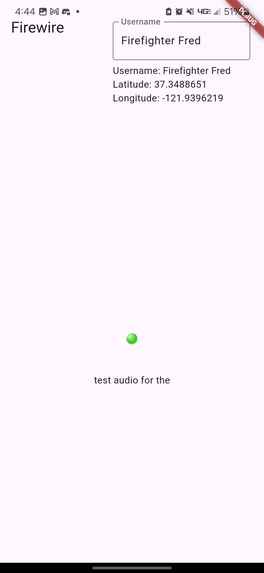
Our phone app tracks speech and location for each user and submits it to our system.
-
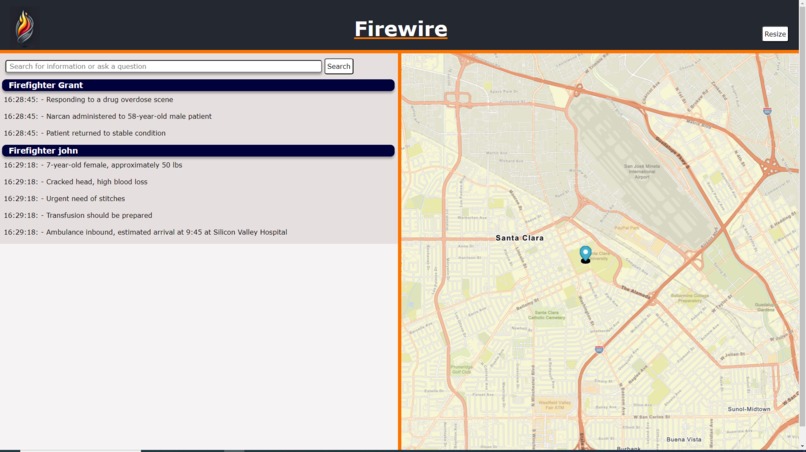
AI consolidates info from the users into concise summaries and displays them on our website


Inspiration
Communication, especially in live, rapidly shifting scenarios often faced by firefighters and other first responders, is absolutely crucial. Fast, clear organization can be the difference between confusion and clarity in life or death scenarios. Relatives of our team members who work in these fields have expressed a need for communication systems that allow instantaneous relay between first responders and operators. By optimizing the communication process, precious seconds in urgent scenarios can be saved. With access to AWS services and the capabilities of AI, we envisioned a summarization scheme that allows fire chiefs, dispatchers, medical professionals, and authorized third parties to listen in on unfolding events with no extra time cost.
What it does
Firewire begins on the personal devices of each user. A mobile application tracks the name, location, and audio of each first responder. We continuously store this information, where we then clean and process it into comprehensive summaries using AI. These summaries transform conversations into digestible bulleted lists. Finally, this information is displayed on a website (along with an interactive map of every Firewire user's location) for swift, efficient access of current information across complex situations.
How we built it
We used Dart with the Flutter framework to develop our Android application. Our backend, hosted on an AWS EC2 instance, is written in Python using Flask and REST APIs. We store our user data within our EC2 server and process it with an Amazon Bedrock instance. In addition, private keys are stored on Secrets Manager to convenient access. Our results are displayed and served on a webpage using HTML and CSS.
Challenges we ran into
The most difficult aspect of this project was the sheer number of moving parts involved. We had to create numerous systems from scratch that all communicate with one another to accomplish our goal: a telemetry gathering mobile application, an organized database, an AI parsing model, a responsive website, and a robust backend web server to tie everything together. It was one challenge to have to separate as a team to individually put each of these components together, but an entirely separate challenge to link them into a cohesive, reliable system. Each of us had to learn new technologies on our own, while simultaneously coming together as a team to discuss what we learned and collaborate on the final product.
Accomplishments that we're proud of
As a team, we’re incredibly proud of the sheer volume of code we wrote throughout the day and the quality of each system we developed. Those of us who worked on the mobile application had never touched mobile development prior to this event, and we were able to put together a system efficient enough to serve as the endpoint of a large-scale communication system. We are also proud of our Bedrock AI model and the fact that it parses a constant, live flow of data, rather than in a prompt-response format. This imposed a number of difficulties on the training process. Our summary viewing website is incredibly clean and concise, providing efficient, digestible insight on users of the system. Lastly, we are incredibly proud of our EC2 backend web server, and the number of complex processes it handles in order to bring each component of our product together.
What we learned
Each member of our team learned a lot about their respective assigned portions of the project. Individually, we learned about the basics of mobile app development, ECHTTP protocols, generative AI training, web development, AWS products, and collaborative software development. While each of us had our individual learning journeys throughout the event, we all came together to learn about the use cases and capabilities of AWS services. Our project wouldn’t have been possible without cloud hosting or powerful, responsive generative AI.
What's next for Firewire
Firewire was designed with a future, large-scale solution in mind. Should we continue to develop Firewire into a full communication system, we would replace our mobile application with dedicated hardware given to each user. This would replace and enhance their preexisting radio systems, allowing for normal communication protocols while simultaneously implementing our summarization and reporting software. From an implementation standpoint, we also intend to generalize the use cases of Firewire for several fields of work. We envision that a live, autonomous summarization system like Firewire could be used to facilitate meetings among organizations, provide reports of long-distance calls, and even assist during widespread emergencies like natural disasters.
Built With
- amazon-bedrock
- amazon-ec2
- amazon-map
- amazon-web-services
- css
- dart
- flask
- flutter
- html5
- javascript
- python
- secrets-manager


Log in or sign up for Devpost to join the conversation.