-
-
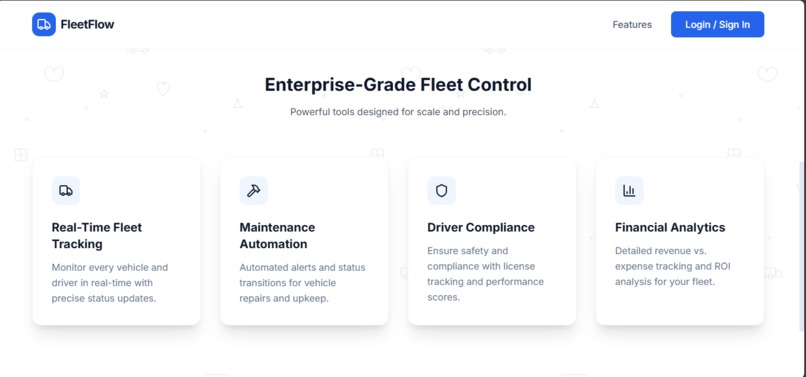
FleetFlow homepage introducing the unified fleet operations platform.
-
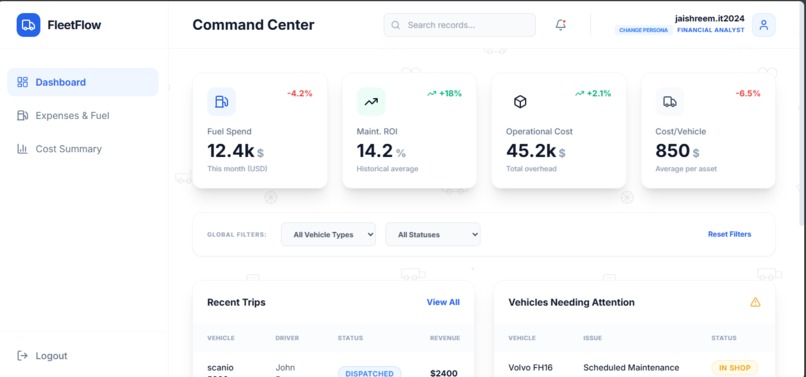
Role-based command center displaying real-time fleet metrics, vehicles, trips, and operational insights.


Inspiration
Fleet operations are often bogged down by fragmented systems like spreadsheets, disconnected tools, and manual processes. These inefficiencies reduce visibility and increase the risk of compliance failures and operational errors. FleetFlow was born out of a need to unify these processes into a single intelligent platform. The goal was to centralize vehicle tracking, driver management, compliance monitoring, maintenance scheduling, and financial oversight, all within a real-time system tailored to different operational roles.
What It Does
FleetFlow is a role-based fleet management platform designed to serve fleet managers, dispatchers, safety officers, and financial analysts. It empowers users to manage vehicles, drivers, trips, maintenance, and expenses from one dashboard. The system also monitors compliance and license expirations, sends automated alerts for critical operational events, and provides real-time updates. Users can generate exportable operational and financial reports, all while benefiting from backend-enforced access control that ensures each role only accesses relevant data and functionality.
How We Built It
FleetFlow was developed using a modern, scalable tech stack. The frontend is built with React.js, offering a modular and component-based architecture. Tailwind CSS ensures responsive and consistent UI styling. Supabase handles authentication and backend services, while PostgreSQL manages relational data. To enforce strict data isolation, Row-Level Security (RLS) is implemented. The app architecture supports protected routes and role-based policies at both frontend and backend levels. Real-time subscriptions keep dashboards instantly updated without compromising performance or state management.
Challenges We Faced
Implementing secure Role-Based Access Control (RBAC) across both frontend and backend layers was one of the most complex challenges. Aligning Supabase RLS policies with UI-level restrictions required meticulous planning to prevent privilege leaks while maintaining usability. Another major hurdle was optimizing real-time updates. Balancing performance with scalable state management while handling live database changes demanded thoughtful architectural decisions.
Accomplishments We’re Proud Of
Despite the constraints of a hackathon timeframe, FleetFlow emerged as a secure, multi-role, real-time fleet command center. Key achievements include backend-enforced security with RLS, automated compliance alerting, integrated financial tracking, and a clean, modular architecture. The system reflects enterprise-level thinking while remaining intuitive and efficient.
What We Learned
Building FleetFlow deepened our understanding of secure database design, real-time system implementation, and scalable frontend state management. It also reinforced the importance of aligning software architecture with real-world operational workflows. Most importantly, we learned how backend security and frontend usability must work in harmony to deliver a robust production system.
What’s Next
FleetFlow’s next phase will focus on expanding intelligence and automation. Planned enhancements include AI-driven predictive maintenance, advanced operational analytics, GPS-based real-time vehicle tracking, mobile app support, and expanded financial forecasting tools. Our vision is to evolve FleetFlow into a fully intelligent fleet operations platform that enables proactive, data-driven decision-making.
Built With
- git
- github
- javascript
- postgresql
- react.js
- supabase
- tailwind
- vercel
- vite


Log in or sign up for Devpost to join the conversation.