-
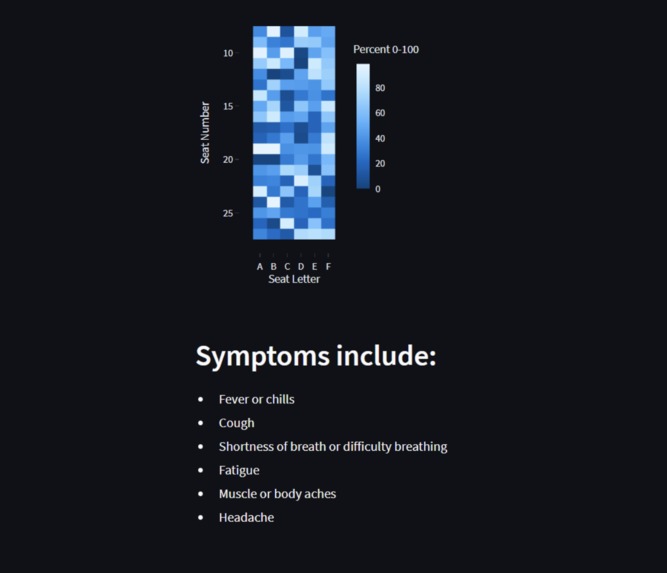
Flight Simulation Approximator
-
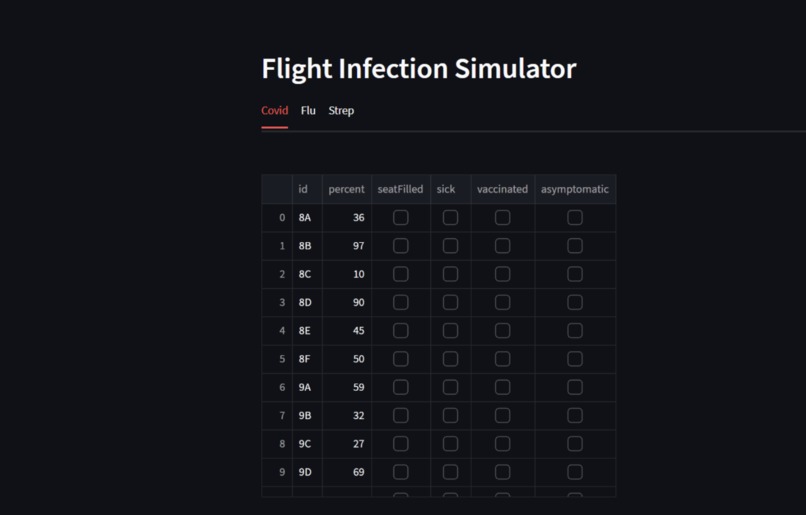
Covid Seat Selector
-
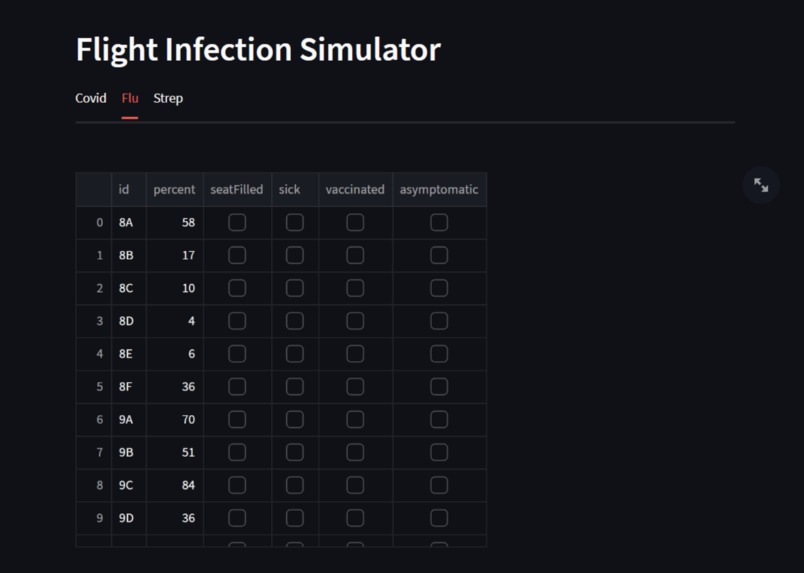
Flu Seat Selector


Inspiration
Following the pandemic, illness became of the utmost importance and flying became quite scary. Being in such an enclosed space with complete strangers and being unsure of their health status became a debate of safety in the world. Our product, Flight Infection Simulator, helps visualize the risk of sickness when various types of passengers board.
What it does
Flight Infection Simulator offers a tangible way to visualize the possibility of each individual passenger contracting and illness when an infected individual is on board. Currently, our model is running on the Airbus A319 seating pattern and can simulate COVID, Flu, and Strep.
How we built it
For the model, we used python to make the heatmap and dataframe. Our IDE of choice was JupyterNotebook. For the heatmap, we used the plotly library and the dataframe was done using pandas. We then used Streamlit to upload the results to the website. Streamlit is a python framework that allows you to create web apps for various data science applications.
Challenges we ran into
The main issue we ran into was the mathematical equation we had in mind being more complicated than we had imagined. During our initial work on the project, we envisioned an equation that would be able to take into account which individual passengers had the disease, if they were asymptomatic, if they were vaccinated, air flow in the plane, etc. Making an equation with this many variables is quite impractical and a machine learning model would have been more effective, but we did not realize until too late into the hackathon.
Accomplishments that we're proud of
We are most proud of striving to better the health and safety of passengers and crew on airlines. However, computationally speaking, we are proud of using Streamlit for the first time, making heatmaps for the first time, and making such an intricate, impactful project in such a short amount of time. We truly believe in our product and the positive infection prevention it can have in passengers.
What we learned
We learned to continue even when things were hard. Driving from UTSA at 6am on Saturday morning made us even more sleep deprived than usual at hackathons, but we had no choice but to persevere and submit our projects. As a team, we were able to unite and overcome all of our obstacles.
What's next for Flight Infection Simulator
The next steps for Flight Infection Simulator include optimizing our infection equation, making the website even more user friendly, and increasing the marketability of the UI/UX.
Built With
- python
- streamlit


Log in or sign up for Devpost to join the conversation.