-
-
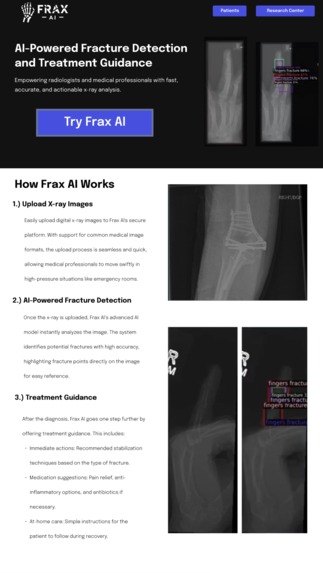
Landing Page for FraxAI
-
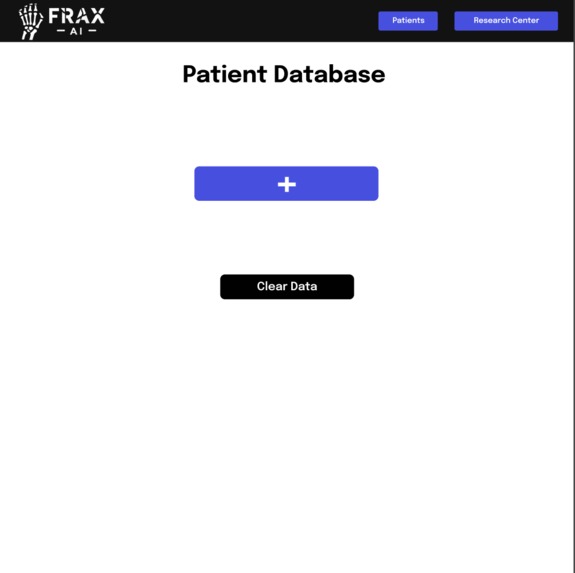
Patient Data Page when the button "patients" is clicked
-
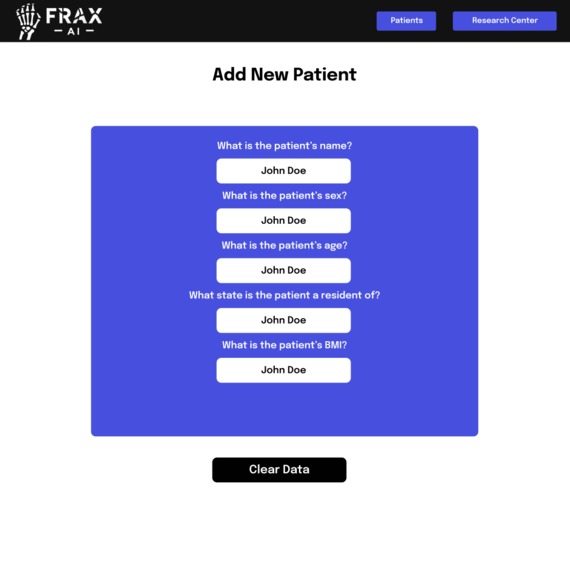
Add New Patient Page when the button "+" is clicked
-
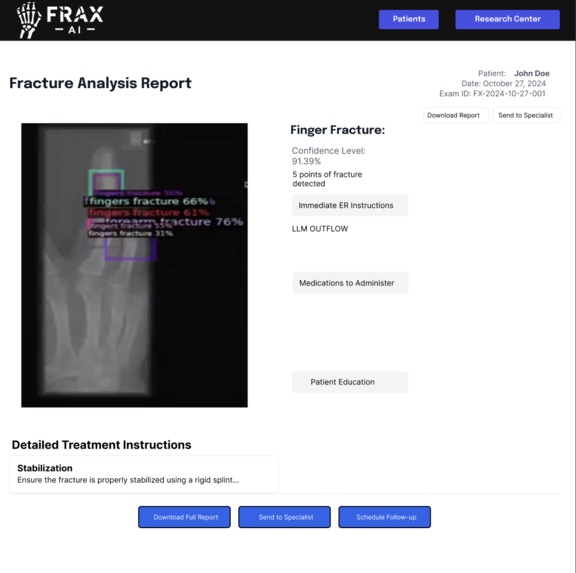
Fracture Analysis Report Page when X-Ray image is added


Inspiration
The inspiration for Frax AI comes from a personal experience I had after a minor accident that resulted in a wrist fracture. I went to the emergency room, hoping for quick treatment, but was met with a crowded waiting room. As hours passed, my injury worsened due to the delay, turning a simple issue into a more complex one. This experience highlighted the inefficiencies in emergency care and made me realize the potential for an AI solution to quickly assess fractures. I envisioned a tool that could streamline the process, reduce ER congestion, and provide timely recommendations, ensuring patients receive the care they need without unnecessary delays.
What it does
Frax AI is an innovative AI model designed to analyze X-ray images for fractures. It identifies and classifies various types of fractures—such as those in fingers, limbs, or arms—providing detailed output that includes the specific points of fracture and a confidence score for each diagnosis. This allows healthcare professionals to quickly understand the nature of an injury without the need for extensive manual review. In addition to fracture detection, Frax AI features an integrated large language model (LLM) that interprets the model's output and generates patient-friendly recommendations. This includes guidance on fracture management and next steps for care, helping nurses and patients understand the best course of action. By combining advanced image analysis with actionable insights, Frax AI aims to enhance decision-making in emergency care settings, reduce wait times, and improve overall patient outcomes. Its goal is to provide fast, reliable assessments that can help alleviate the burden on medical staff and optimize care delivery in crowded ER environments.
How we built it
We built Frax AI using a combination of advanced machine learning techniques and robust frameworks. The core of our model is developed in Python, utilizing PyTorch for deep learning. To train our fracture detection model, we gathered a diverse dataset of labeled X-ray images, which included a variety of fracture types. This dataset was crucial for teaching the model to accurately identify and classify fractures. We employed techniques such as data augmentation to enhance the model's robustness, helping it generalize better to unseen data. The architecture we chose, Faster R-CNN, is well-suited for object detection tasks, allowing us to efficiently detect fractures in the images. To manage the machine learning lifecycle, we integrated MLflow, which enabled us to track experiments, manage model versions, and streamline the deployment process. This allowed us to maintain a clear overview of our training runs and easily reproduce results. The integration of the large language model (LLM) was another critical component. We utilized OpenAI's API to enhance the user experience by providing natural language explanations and recommendations based on the detected fractures. Fine-tuning the LLM to ensure it generated practical and comprehensible advice required iterative testing and feedback from healthcare professionals. Throughout the development process, we prioritized collaboration with medical experts to validate our model's performance and ensure its real-world applicability. This collaborative approach helped us align our technical capabilities with the practical needs of healthcare providers, resulting in a tool that is not only effective but also user-friendly.
Challenges We Ran Into
Throughout the development of Frax AI, we encountered several significant challenges:
- Mosaic Data Augmentation: We initially attempted to implement mosaic data augmentation to enhance our training dataset. However, the model struggled to accurately learn from these mixed images, leading us to pivot to simpler augmentation techniques that yielded better results.
- Google Vision API Integration: We explored using the Google Vision API for preliminary fracture detection but faced limitations in customization and specificity. The results did not meet our expectations for our specific use case, prompting us to focus on developing our own dedicated model instead.
- Overfitting Concerns: During training, we observed signs of overfitting due to the limited training data. This required us to implement additional regularization techniques and diversify our dataset to ensure better generalization to unseen X-ray images.
- Balancing Speed and Accuracy: Achieving a balance between rapid inference time and high accuracy proved challenging. We had to fine-tune the model's architecture and parameters to provide timely assessments without compromising diagnostic quality.
- Deployment and Usability Testing: Once the model was trained, deploying it in a way that healthcare professionals could easily use was a significant hurdle. We focused on designing a user-friendly interface and conducting thorough testing to ensure reliability and ease of use in real-world environments.
Accomplishments That We're Proud Of
We are proud of several key accomplishments achieved during the development of Frax AI:
- High Accuracy: Our fracture detection model boasts an impressive accuracy of 90%, demonstrating its effectiveness in identifying and classifying various types of fractures from X-ray images.
- Seamless Integration: Successfully integrating the fracture detection model with the large language model (LLM) enabled us to provide meaningful, patient-friendly recommendations based on the detected fractures. This dual functionality enhances the overall utility of the tool in clinical settings.
- User-Friendly Prototype: We developed a functional prototype that showcases the capabilities of Frax AI. The user interface is designed to be intuitive, ensuring that healthcare professionals can quickly and easily access the tool's insights.
- Potential Impact: Our solution has the potential to significantly improve patient outcomes by reducing wait times and streamlining fracture assessments in emergency care settings. By addressing the inefficiencies in current processes, we aim to alleviate some of the burdens on medical staff.
What We Learned
The development of Frax AI taught us valuable lessons, including:
- Importance of Robust Data: We learned that having a diverse and well-annotated dataset is critical for training effective models. This reinforced the need for thorough data preparation and augmentation strategies.
- Iterative Development: The challenges we faced highlighted the necessity of an iterative approach. Experimenting with different techniques and being open to pivoting when something didn’t work were key to our success.
- Ethical Considerations: We gained insights into the ethical implications of using AI in healthcare, particularly regarding patient data privacy and the importance of ensuring our tool supports, rather than replaces, healthcare professionals.
- Technical Skills: Our technical expertise in machine learning, specifically with PyTorch and MLflow, expanded significantly throughout the project, equipping us with new skills for future endeavors.
What's Next for Frax AI
As we look to the future, addressing privacy and patient data concerns is our top priority, particularly in compliance with regulations like HIPAA. Alongside these enhancements, we plan to pivot Frax AI to create a similar application for military use, aimed at assisting combat medics and doctors. This new app will enable personnel in the field to quickly assess wounds, such as gunshot injuries, by simply taking a picture. The AI will provide immediate guidance on treatment, allowing for timely and effective care. This approach has the potential to empower paramedics and military personnel to manage multiple patients more efficiently, improving response times and outcomes in critical situations. Ultimately, we aim to harness AI technology to enhance medical care in high-pressure environments and save lives.


Log in or sign up for Devpost to join the conversation.