-
-
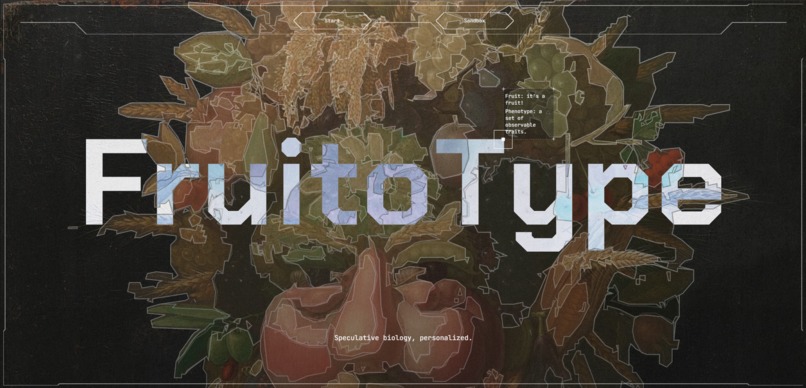
Hero
-
Identity
-
Introduction (transition)
-
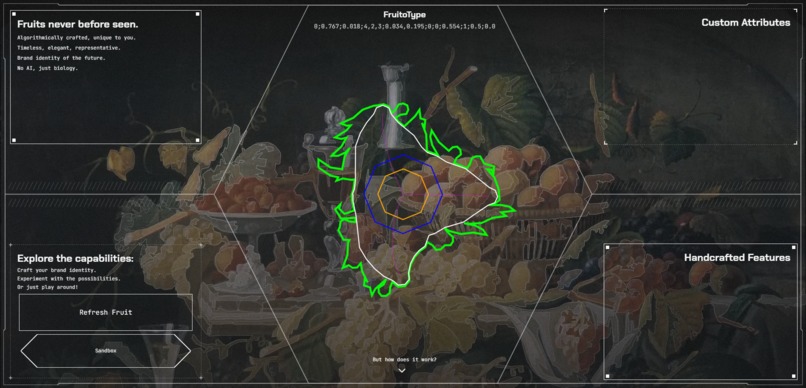
Demo
-
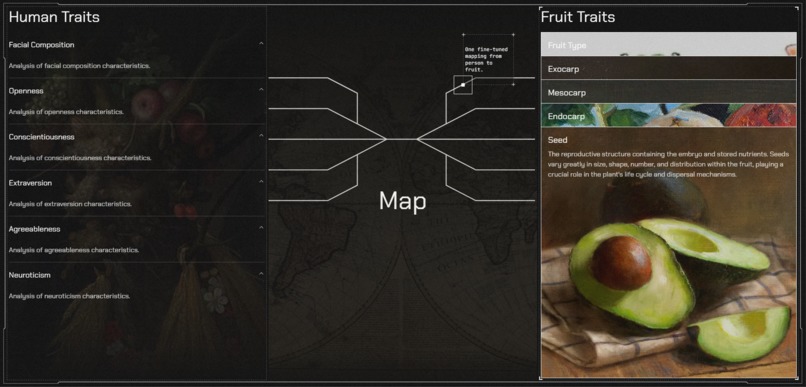
Mapping
-
Footer
-
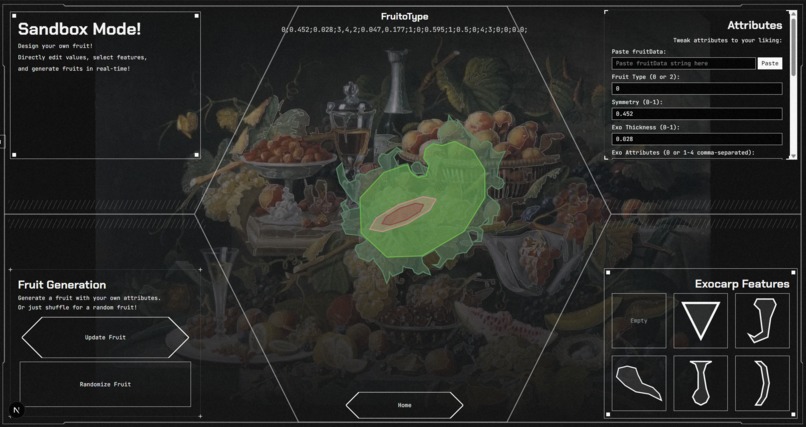
Sandbox Mode


FruitoType Project Analysis
Inspiration
FruitoType was inspired by the intersection of speculative biology and personalized identity. The project explores the concept of creating unique, procedurally-generated fruit designs that are personalized to individual users. The tagline "Speculative biology, personalized" captures the essence of the project - combining biological principles with computational creativity to generate never-before-seen fruit phenotypes that serve as unique brand identities.
The project draws inspiration from:
- Phenotype Expression: How observable traits manifest in biological organisms
- Personal Identity: Creating unique visual representations that reflect individual characteristics
- Speculative Biology: https://www.youtube.com/@CuriousArchive
- Procedural Generation: https://youtu.be/qlfh_rv6khY?si=yWR7KyIbehilXvVx -This Specific Reel: https://www.instagram.com/reel/DRi6T-1EZg6/?igsh=MTdneG91NWVhMGZtaw==
What it does
FruitoType is a web application that generates personalized, procedurally-created fruit SVG designs based on facial analysis and personality attributes. The system works in several stages:
Facial Analysis: Users can access their webcam through a multi-step form interface. The application uses real-time facial recognition and analysis to extract detailed facial measurements including:
- 68-point facial landmark detection
- Face symmetry calculations
- Eye aspect ratios (EAR)
- Eyebrow angles
- Mouth corner angles and openness
- Jaw angles and chin width
Personality Analysis: Users provide various personality attributes. The application pushes the information from this and facial analysis through a mapping onto fruit characteristics. Some personality attributes include:
- Openness
- Conscientiousness
- Extraversion
- Agreeableness
- Neuroticism
Fruit Generation: The facial analysis data is used to parameterize procedurally-generated fruit SVGs with multiple layers:
- Exocarp (Outer Layer): Customizable thickness and features (spikes, hooks, scales, trichomes)
- Mesocarp (Middle Layer): Variable thickness with linear or quadratic functions, supporting fleshy, fibrous, or dry attributes
- Endocarp (Inner Layer): Configurable thickness with woody, membranous, or papery attributes
- Seeds: Positioned at anchor points with customizable scale
Interactive Experience: The frontend features a beautiful, parallax-scrolling website with:
- Smooth scroll animations using Lenis
- Interactive 3D elements with Three.js
- Real-time fruit preview and regeneration
- Sandbox mode for experimentation
- Form-based workflow for capturing facial data
How we built it
Frontend Architecture
- Framework: Next.js 16 with React 19 and TypeScript
- Styling: TailwindCSS 4 with custom animations
- Animations:
- Framer Motion for component animations
- GSAP for advanced timeline animations
- Lenis for smooth scrolling
- 3D Graphics: Three.js with @react-three/fiber and @react-three/drei
- Real-time Communication: Socket.IO client for WebSocket connection to backend
- SVG Generation: Custom algorithms using:
- Polygon clipping for shape union operations
- D3 Voronoi for cellular patterns
- Procedural growth algorithms for organic shapes (a whole lotta vector math)
- Custom UI Component Library: Collection of animated, responsive elements perfectly suited to the elegant futuristic UI style, centered around SmartSVG.tsx, a powerful SVG component that dynamically resizes within its parent element, with the user being able to specify through tailwind-esque positioning conventions and keywords (including an arithmetic parser) to ensure angles and geometry are not incorrectly distorted.
Backend Architecture
- Framework: Flask with Flask-SocketIO for real-time communication
- Computer Vision:
- OpenCV for face detection using Haar cascades
- dlib for 68-point facial landmark detection
- NumPy for image processing
- WebSocket Communication: Eventlet-based async mode for handling real-time video frame processing
- Facial Analysis: Custom
FacialAnalyzerclass that calculates:- Eye aspect ratios
- Facial symmetry scores
- Geometric measurements (angles, distances)
- Feature-specific metrics
Key Components
Frontend Components:
FruitSVG: Core component that generates fruit SVGs from parameter stringsFormStepper: Multi-step form interface for facial analysis workflowSectionHero,SectionIdentity,SectionFruitSVG: Parallax-scrolling sectionsImageTraced,ImageTracedSpread: Image tracing and animation components- Various UI components:
BoxExpand,OutlineCorners,TagHover, etc.
Backend Modules:
app.py: Flask application with WebSocket handlers for real-time frame processinganalysis.py:FacialAnalyzerclass with comprehensive facial measurement algorithms
Data Flow
- User accesses webcam through frontend form
- Video frames are captured and sent via WebSocket to backend
- Backend processes frames with OpenCV and dlib
- Facial analysis results (symmetry, angles, measurements) are returned
- Analysis data is used to generate fruit parameters
- Fruit SVG is procedurally generated and displayed
Challenges we ran into
Real-time Video Processing: Implementing efficient WebSocket communication for streaming video frames while maintaining low latency required careful optimization of frame capture rates and data encoding.
WebSocket Compatibility: Ensuring reliable WebSocket connections between the Next.js frontend and Flask backend, especially with different transport methods (websocket, polling) and handling connection errors gracefully.
Facial Landmark Detection: Integrating dlib's 68-point facial landmark predictor required proper model file management and handling edge cases where faces aren't detected or are partially obscured.
Procedural SVG Generation: Creating organic, biologically-plausible fruit shapes using mathematical algorithms (polygon clipping, Voronoi diagrams, growth functions) while maintaining visual appeal and uniqueness.
Coordinate System Conversions: Managing multiple coordinate systems (OpenCV BGR, image coordinates, SVG coordinates) and ensuring proper transformations between them, especially for overlay rendering.
Performance Optimization: Balancing real-time analysis performance with visual quality, including optimizing frame processing rates and managing memory for image buffers.
Parallax and Scroll Animations: Implementing smooth, performant scroll-based animations across multiple sections while maintaining 60fps performance.
Data Parameterization: Mapping facial analysis metrics (symmetry, angles, ratios) to meaningful fruit generation parameters in a way that creates visually interesting and personalized results.
Accomplishments that we're proud of
Real-time Facial Analysis Pipeline: Successfully implemented a complete real-time facial analysis system with 68-point landmark detection, providing detailed facial measurements through WebSocket communication.
Procedural Fruit Generation Algorithm: Created a sophisticated procedural generation system that produces unique, organic fruit shapes with multiple layers (exocarp, mesocarp, endocarp) using advanced computational geometry techniques.
Beautiful, Modern UI: Built an aesthetically pleasing, parallax-scrolling website with smooth animations, interactive 3D elements, and a cohesive design language that effectively communicates the project's vision.
Comprehensive Facial Metrics: Developed a robust facial analysis system that calculates multiple meaningful metrics including symmetry scores, eye aspect ratios, eyebrow angles, mouth measurements, and jaw characteristics.
Modular Component Architecture: Created a well-structured component system with reusable UI elements (BoxExpand, OutlineCorners, TagHover, etc.) that maintain consistency across the application.
Seamless Integration: Successfully integrated multiple complex technologies (computer vision, WebSockets, procedural generation, 3D graphics, animations) into a cohesive user experience.
Biological Accuracy: Implemented fruit generation that respects biological principles, with proper layering (exocarp, mesocarp, endocarp) and realistic feature placement.
Interactive Sandbox: Created an experimental sandbox mode that allows users to explore and experiment with fruit generation parameters independently.
What we learned
Computer Vision Integration: Gained deep understanding of facial landmark detection, OpenCV image processing, and real-time video analysis techniques.
WebSocket Architecture: Learned to implement efficient real-time communication between frontend and backend, handling binary data transmission, connection management, and error recovery.
Procedural Generation: Explored advanced algorithms for creating organic shapes, including polygon clipping, Voronoi diagrams, growth algorithms, and path simplification techniques.
Performance Optimization: Developed skills in optimizing real-time applications, including frame rate management, memory optimization, and efficient data encoding/decoding.
Modern Frontend Development: Mastered Next.js App Router, React 19 features, TypeScript best practices, and modern animation libraries (Framer Motion, GSAP, Lenis).
Mathematical Algorithms: Applied mathematical concepts including vector operations, angle calculations, symmetry analysis, and geometric transformations to create visually appealing results.
User Experience Design: Learned to create engaging, interactive experiences that guide users through complex workflows while maintaining visual appeal and usability.
Full-Stack Integration: Gained experience in seamlessly connecting frontend and backend systems, handling data flow, error states, and user feedback.
What's next for FruitoType
Complete Facial-to-Fruit Mapping: Fully implement the connection between facial analysis data and fruit generation parameters, creating meaningful correlations between facial features and fruit characteristics.
Enhanced Fruit Features: Expand the library of exocarp, mesocarp, and endocarp features, adding more biological attributes and visual variations. Attributes such as taste, texture, material properties can be easily integrated into the modular system and displayed with pattern masks and feature placement functions.
Export and Sharing: Add functionality to export generated fruits as high-resolution images or SVG files, and enable sharing capabilities.
Community Gallery: Build a gallery where users can share their generated fruits, vote on favorites, and explore the diversity of generated designs.
Scientific Applications: Explore applications in education (biology, genetics), art (generative design), and branding (unique visual identities).
API Development: Create a public API that allows developers to integrate FruitoType's fruit generation capabilities into their own applications.


Log in or sign up for Devpost to join the conversation.