-
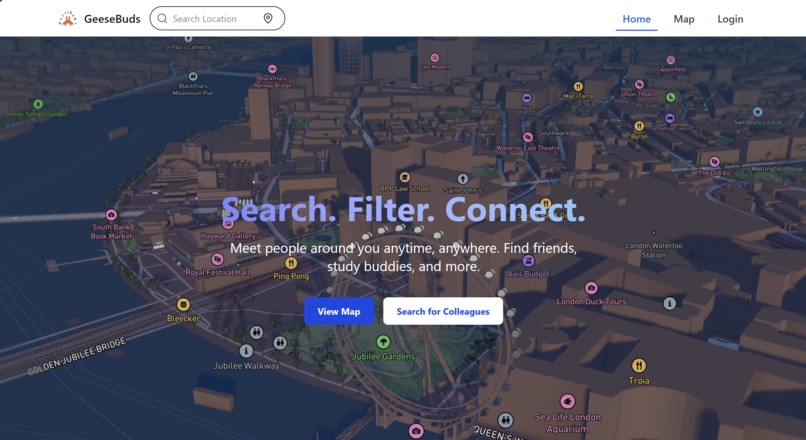
Home Page
-
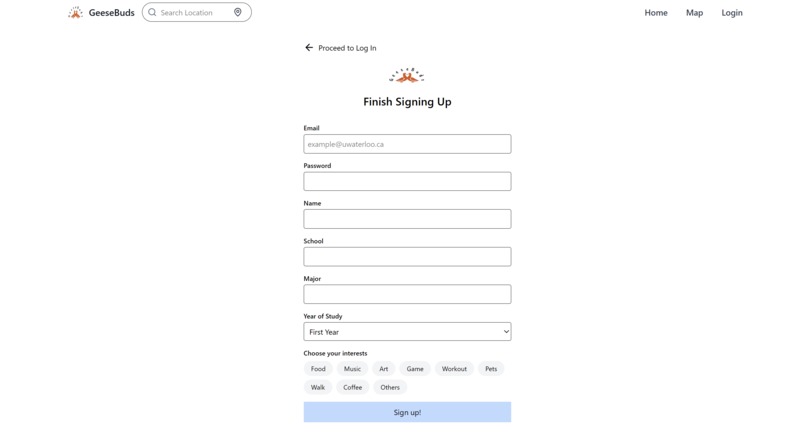
Sign Up
-
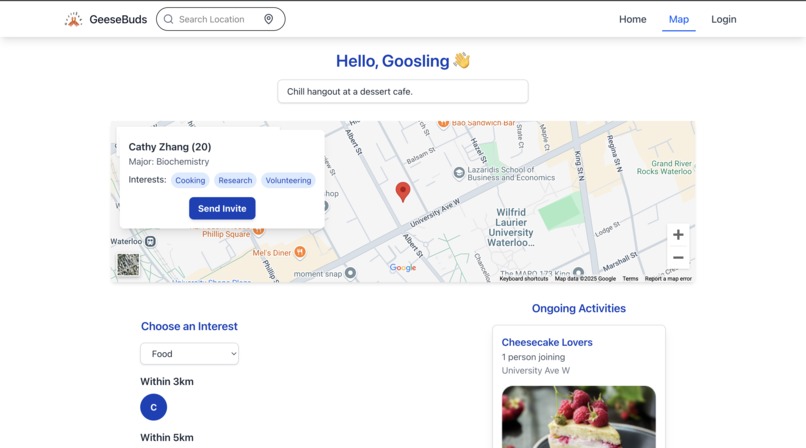
Map Page (With Friend Selected)
-
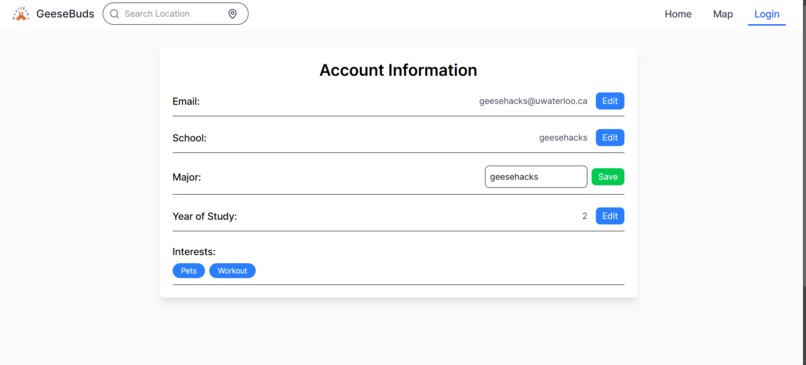
Account Settings


Inspiration
With Waterloo students being quite famous for having, lets just say, less than stellar social lives, our team wanted to help change that for the better. Drawing inspiration from Google Maps, family planning apps, and networking tools like LinkedIn, we decided to build a friend-finder app tailored for the average Waterloo student.
What it does
GeeseBuds combines the functionality of several existing apps to make it easier for university students to find and connect with friends. Users start by providing information about themselves, including their major, interests, and activities they'd like to partake in. The app then displays a map showing nearby people with similar interests and group activities happening in the area. If a user wants to join or meet up, they can click on another user’s profile and the web-app will display their locations on a shared map. Together, they can choose a collective meeting point to hang out and have fun.
We planned on using AI through semantic search and vector embeddings. The user, once logged in, can input a prompt on what they want to do. Using trained models, we will create embeddings for each user and connect like minded users together! Alternatively, the current events panel should present options for events which are linked to interests stated upon account creation.
How we built it
We prototyped our app along with its layout through Figma before beginning the build. We turned this into a working web-app through coding the frontend with React.js and TailwindCSS.
For the backend, we used Google's Firebase for account authentication and data storage, along with it's high degree of scalability. Moreover, we attempted to implement semantic search and vector embeddings to connect like minded individuals!
Challenges we ran into
Our React App used TypeScript for our React app, which was new to one of our group members. It also helped improve the app’s scalability and maintainability. Time in general was also a major difficulty for our project, as the depth and tech that it required made it hard to fully implement all of our planned features.
Another major challenge was getting the AI functionality up and running, which turned out to be much more time-consuming than we had anticipated. Initially, we planned to train an AI model ourselves, but this introduced additional complexities, mainly including the heavy time constraint and computing power.
As expected, our code broke a lot, which took quite a while to debug.
Accomplishments that we're proud of
We’re proud of coming up with a creative and innovative idea that addresses a real problem faced by university students.
Additionally, we successfully learned and implemented several new technologies, including multiple APIs and AWS services. This project not only solves an important issue but also highlights our ability to create a practical and impactful solution.
What we learned
Throughout this project, we learned how to work with new APIs and tools (eg: Mapbox), and were able to improve on the efficiency at which we developed our front-end. We also learned how to work together effectively and within a short period of time, even though our group members never knew each other before the hackathon.
What's next for GeeseBuds
Our platform is highly scalable, and this means we could expand our services to other university campuses (eg: UofT). Expanding to additional campuses not only increases our impact but also opens exciting business opportunities for our app in the future.
Additionally, we plan to fully implement the AI functionality using Cohere and/or AWS ML frameworks to enhance the app’s capabilities and provide an even better user experience.


Log in or sign up for Devpost to join the conversation.