-
-
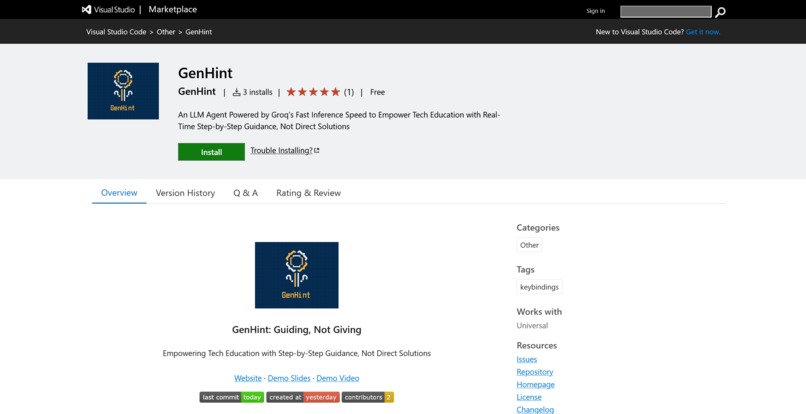
Deployed on VS Code Marketplace!!
-
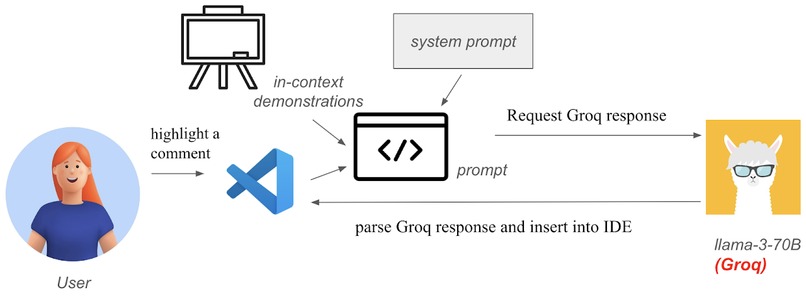
Project Overview
-
GenHint Logo


Inspiration
In an era where generative AI offers instant answers at the click of a button, we noticed a troubling disconnect: users receive solutions without learning the journey to reach them—much like being handed a fish without learning how to fish. This shortcuts the very essence of education, which thrives on exploration, problem-solving, and self-discovery. Banning AI tools outright in academic settings is akin to killing the goose that lays the golden eggs; it overlooks the immense potential these tools have when used wisely.
Inspired to bridge this gap, we created GenHint—an education-focused AI agent that provides step-by-step pseudocode guidance. It empowers users to engage deeply with each phase of problem-solving, allowing them to elaborate on steps, refine their understanding, and ultimately verify their solutions. By imitating the authentic learning process, GenHint aims not to replace effort but to nurture it, teaching users how to fish so they can feed themselves for a lifetime.
What it does
GenHint transforms the way of learning coding in 3 aspects: Structurize: A clear, step-by-step guidance built directly into VS Code that walks you through complex coding tasks, breaking them down into manageable actions. Elaborate: If you need more understanding of any step, just click in your IDE, and GenHint dives deeper, offering detailed explanations that clarify the “how” and “why” behind each move, making sure you truly grasp the concepts. Review: Once your code is complete, GenHint reviews it, checking for accuracy and best practices, giving you feedback to ensure your code is indeed working.
How we built it
GenHint was built using Node.js, leveraging the VS Code API and Groq’s rapid AI Inference API to enhance the learning experience for developers. Our focus was on creating a tool that provides valuable hints without giving direct answers, promoting better problem-solving and learning outcomes. To achieve this, we meticulously crafted both system and user prompts to ensure helpful, non-intrusive guidance. We also designed an intuitive set of shortcuts for seamless integration into the VS Code IDE, making GenHint a natural extension of the coding workflow. Warp's modern terminal editing and command generation features helped us speed up the development of GenHint by allowing us to quickly write, edit, and recall complex commands without constantly switching contexts. Plus, with Warp Drive’s shared workflows, we easily shared key processes within the team, making collaboration smoother and improving overall efficiency.
Challenges we ran into
Developing GenHint presented several significant challenges, particularly around the inherent limitations of large language models (LLMs). One of the key obstacles was managing the hallucinations that LLMs often produce, which required careful post-processing to ensure the generated content was accurate and contextually appropriate. Since GenHint works within a highly structured coding environment, it was crucial to ensure that the output was properly formatted to fit as comments within different programming languages. However, during our tests, we found that the model occasionally generated markdown text or comments in incorrect languages, disrupting the codebase. To address these issues, we implemented regex-based post-processing to reformat the model's output and ensure compatibility with the intended file structure. Additionally, we refined the system prompt, integrating more explicit instructions to guide the model's behavior. After exploring state-of-the-art (SOTA) LLM pipelines, we adopted a one-shot learning approach, which is widely researched in the academic community of LLM agents, to improve the model’s adaptability and accuracy. These combined efforts allowed us to minimize errors and create a more reliable and effective tool for developers.
Accomplishments that we're proud of
Imagine a student struggling late into the night, toggling between countless browser tabs, endlessly searching for solutions that never seem to fit just right. They’re overwhelmed, lost in the maze of documentation, forums, and scattered code snippets that offer more confusion than clarity. Or perhaps they turn to ChatGPT/GitHub Copilot/Claude/Gemini, copying code that works but leaves them with no deeper understanding of what it does or why it’s written that way.
The result? A generation of learners bypassing the learning process, missing out on the essential skills that coding truly teaches—problem-solving, critical thinking, and the joy of figuring it out.
By building GenHint, we helped build a world where students don’t just get to the answer—they understand the path to it, becoming more skilled, confident, and independent coders. We believe that learning should be a guided, interactive experience, where every challenge is an opportunity to grow, every mistake is a chance to learn, and every line of code written is a step closer to mastery.
What we learned
Through this project, we gained deeper insights into the intricacies of prompt engineering, especially when working with LLMs in structured environments like code. As a team, we reinforced our collaborative abilities and strengthened our awareness of project management, specifically workload estimation and buffering. On the other hand, we now have a deeper understanding of the power of AI, which is not only about model performance and its potential in replacing humans, but also about its capability to really help people to learn, being really human-centered. We also learned how to strike a balance between providing helpful guidance and fostering independent problem-solving, which is crucial for educational tools.
What's next for GenHint
Our vision for GenHint reaches far beyond the confines of a simple coding assistant; we aspire to ignite a revolution in next-generation AI education. Learning isn't just a phase limited to classrooms or early careers. It's a lifelong journey that should engage and inspire at every stage. Like a compass guiding explorers through uncharted territories, we aim to expand GenHint into a comprehensive platform—a dynamic website or learning app—that empowers individuals across all professions and ages.
By incorporating multimodal functionalities and interactive experiences, we'll break down complex, large-scale tasks in fields ranging from mathematics and natural sciences to social sciences and beyond. Our mission is to guide users on their educational journeys without simply handing them the answers, nurturing a culture of curiosity and continuous growth. We believe this approach not only paints the picture of the future of education but also hands each learner the brush to create their own masterpiece.
Built With
- azure
- git
- github
- groq
- javascript
- json
- llama3
- llm
- microsoft
- node.js
- typescript
- vscode
- warp




Log in or sign up for Devpost to join the conversation.