-
-
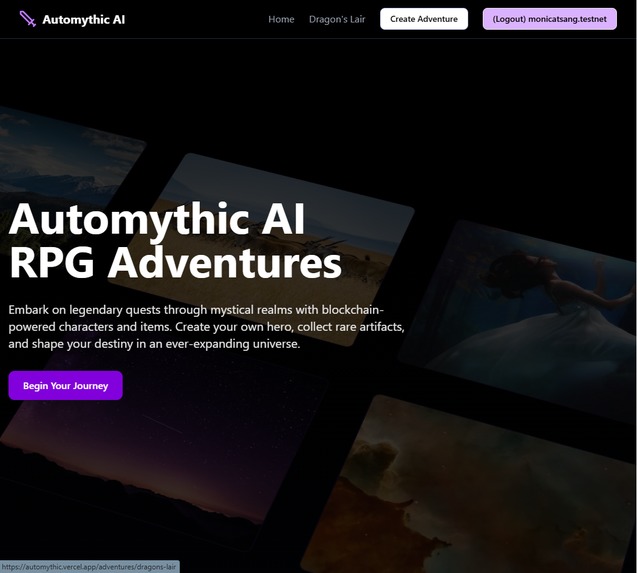
Title Screen - try out the ready-made adventure demo or create your own game
-
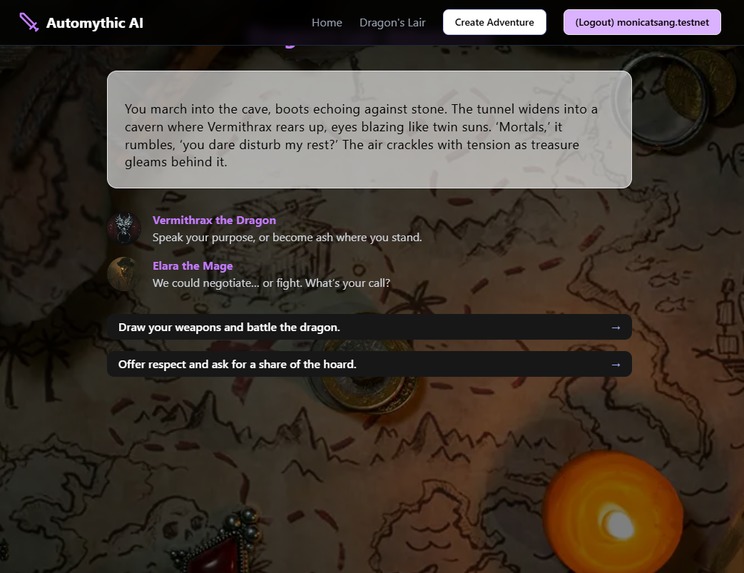
Dragon's Lair - game demo (more functionalities to follow)
-
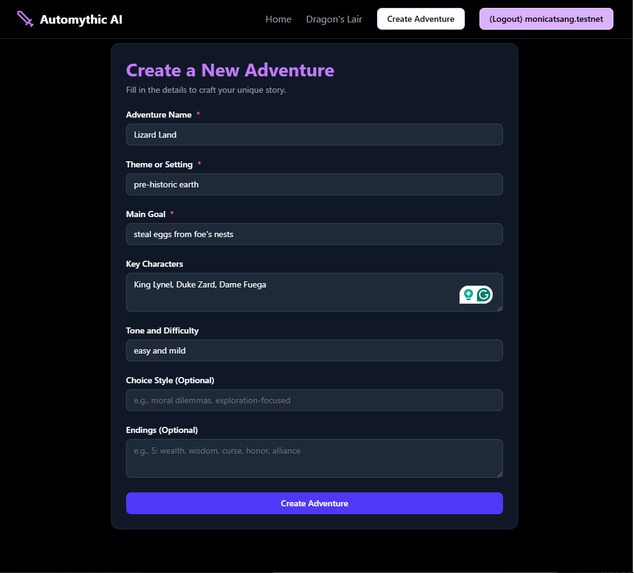
Create your own game, generated by LLM
-
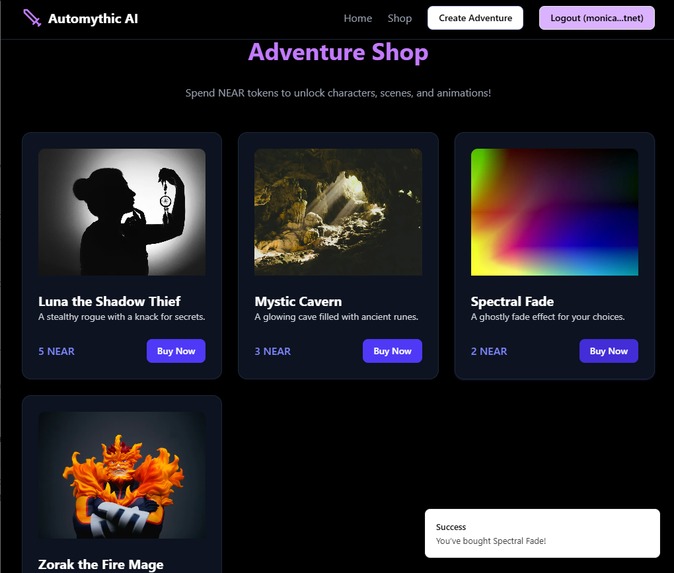
Adventure Shop - purchase add-ons to enhance your
-
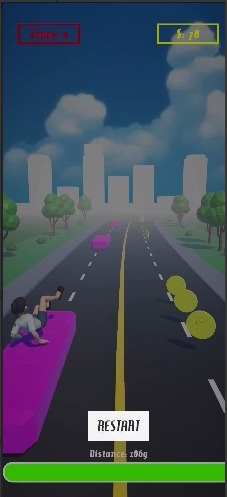
Future Roadmap: off-chain, but functioning, active 3d game with assets moving in sandbox environment


Introduction
Automythic AI is a generative AI agent that allows users to create personalized, immersive mini-games or metaverse experiences based on prompt input. It ensures real, unique players, utilizes its own coin for in-game economies/purchases wherever applicable, with any Blockchain as the underlying technology to preserve user-generated content and histories. By integrating techniques like LCM LoRA (Low-Rank Adaptation Stable Diffusion Modules) fine-tuning and Large Language Models (LLMs), we can enable real-time image and text generation for consistent characters and world design, dynamic narratives, and lifelike NPC interactions for multiple rounds or levels of games. These experiences can be shared and/or sold to other players.
How it works
- User-generated mini-games/dynamic procedural worlds: Players can describe the kind of mini-game or experience they want with minimal input on gameplay mechanics, character design and setting (e.g., “A cyberpunk heist with stealth mechanics,” or “A whimsical tea party in a floating castle”), and Automythic AI generates a playable initial setup (textual scene description supported by an image) in real-time.
Consistent Characters with LoRA:
In the upcoming version, users will be able create and customize player characters or NPCs (e.g., "grumpy inventor with a steampunk monocle"), and the fine-tuned LoRA modules ensure that NPCs or recurring characters have consistent personalities, quirks, and later on voices across experiences.
NPC Chat Functionalities:
NPCs in these mini-games or experiences are equipped with conversational AI that adapts to the narrative. Players can engage in lifelike, goal-oriented dialogues with them, offering replayability and gameplay depth.
Economics & Progression:
- Coin payment for topping up prompts, and to tip.
- Next steps are to monetize the experiences by charging for microtransactions or in-game assets, as well as on-chain tracking the game's progression, player achievements, and shared worlds.
What we're demonstrating in the Hackathon
Demo mini-game generator:
- Query LLMs to generate text characters, and choose your own adventure based on user prompts.
- A functional prototype for small narrative-based games (similar to “choose your own adventure books”), where the user continues the story with freely chosen prompts, leading to infinite possibilities.
Blockchain Integration:
- Our Automythic AI website allows users to login with their NEAR account. In fact, users use $NEAR to purchase other user-generated games in the online shop.
- Additional blockchain integration we include is the use of a Shade agent for facilitating the story generation process. With the shade agent, users can submit prompts to the agent itself, which then sends it to an LLM running in its local environment, it then returns the response to the user.
What inspired us.
All our team members love playing quick flash games on our browser, or very dedicated games via console or pc, but if we want to make our own games there's often a lot of coding and development overhead. Additionally, setting up features like in game payment, saving progress, and using generative features are also difficult. The gaming industry needs more democratization, and we felt that giving users the opportunity to make their own games generatively with a single prompt would be a great way to achieve this. Incorporating NEAR protocol features for in game payment and a game marketplace make the experience more transparent and easy to use. Using shade agents for game generation also helps decentralize the web infrastructure used for generation. This submission is just the beginning and we're really excited to continue building out other parts of Automythic AI.
What we learned.
We learned a bunch about front end and back end for integrating the NEAR protocol. Specifically, we learned how to integrate a widget into our webpage so that users can connect their NEAR account and gain access to the shop feature on the website. This involved using typescript and special packages for NEAR integration. As for the Shade agent we learned how to deploy an LLM locally on a server rather than calling from an API so that the agent and LLM can run side by side in a TEE, this involved developing javascript bundles for interfacing with the server and integrating them into our Shade Agent API. Another challenge we faced was deploying to Phala Cloud. We were successfully able to build
How we built our project.
We built our project using a typescript frontend built with next.js. The back end containing the Shade Agent is a javascript API along with a python server running the LLM locally.
Challenges we faced.
Initially it was really difficult to develop a shade agent that could authenticate to its smart contract and also query the LLM, this is due to the secure nature of the TEE where you can't simply import whatever packages you would like during runtime. This also made it difficult to run development on the agent locally, but we were able to solve the problem and run the agent locally, and fund it on testnet. Another challenge was NEAR Wallet integration, but we were able to solve this by carefully integrating the wallet connection features into our existing front end skeleton.
Built With
- agent
- ai
- blockchain
- llms
- near
- phala
- typescript


Log in or sign up for Devpost to join the conversation.