-

Hacklify — Entry point
-
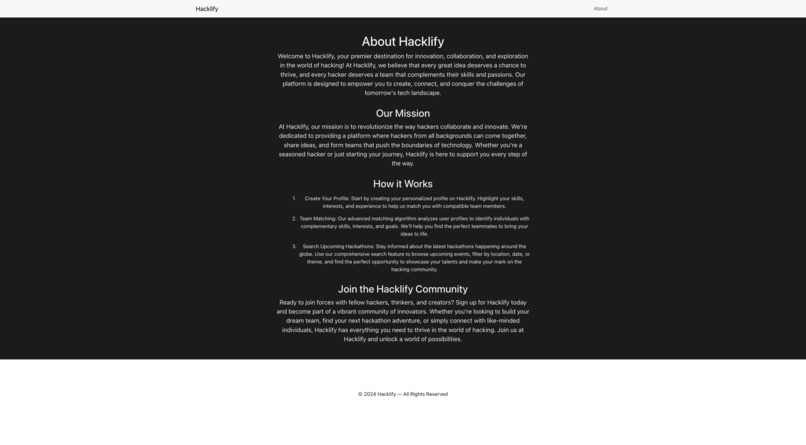
Hacklify — About Hacklify Page
-
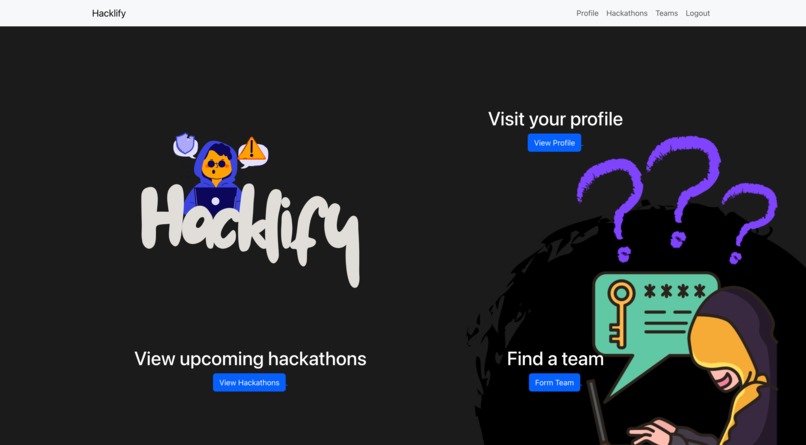
Hacklify — Home Page
-
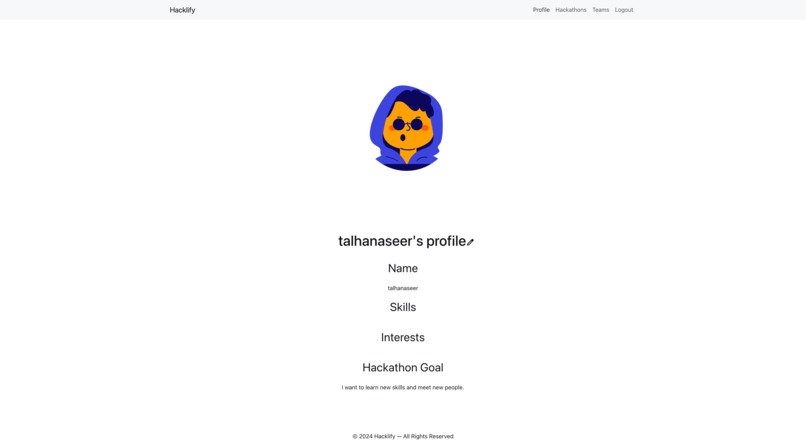
Hacklify — Profile Page


Inspiration
Hacklify was inspired by the growing need for a dedicated platform that fosters collaboration and innovation within the hacking community. As passionate hackers ourselves, we often found it challenging to connect with like-minded individuals and form effective teams for hackathons. We wanted to create a solution that not only streamlines the team formation process but also provides a supportive environment for hackers of all skill levels to come together and turn their ideas into reality.
What it does
Hacklify is a comprehensive platform designed to revolutionize the way hackers collaborate and innovate. Users can create personalized profiles highlighting their skills, interests, and experience. Our advanced matching algorithm analyzes these profiles to identify individuals with complementary skills, interests, and goals, helping users find the perfect teammates for their projects. Additionally, users can search for upcoming hackathons worldwide, filter by location, date, or theme, and discover the perfect opportunity to showcase their talents.
How we built it
We utilized a modern tech stack to bring Hacklify to life, ensuring a seamless and robust user experience. Here's a breakdown of the key technologies and services we employed:
Frontend Development:
- React: We leveraged React, a powerful JavaScript library, to build the frontend interface of Hacklify. React's component-based architecture allowed us to create reusable UI elements and efficiently manage state throughout the application.
- JavaScript: JavaScript served as the backbone of our frontend development, enabling dynamic and interactive user experiences.
- Bootstrap: We integrated Bootstrap, a popular CSS framework, to streamline the design process and ensure a responsive and visually appealing layout across different devices and screen sizes.
Backend Infrastructure:
- AWS Amplify: For deploying and configuring the backend infrastructure, we turned to AWS Amplify. This comprehensive platform provided us with a suite of services for hosting, authentication, and more, simplifying the deployment process and ensuring scalability.
- AWS Cognito: We utilized AWS Cognito for user authentication and authorization, enabling secure access control and seamless user management.
- AWS Route 53: Route 53 served as our domain registrar, allowing us to register and manage our custom domain for Hacklify.
- AWS S3 Buckets: We leveraged S3 buckets for storage, storing static assets such as images, videos, and other media files associated with the application.
- Amazon DynamoDB: DynamoDB, a fully managed NoSQL database service, was utilized for handling relational queries and powering the match-making algorithm behind Hacklify's team formation feature.
- GraphQL APIs: We implemented GraphQL APIs to facilitate efficient data retrieval and manipulation, providing a flexible and intuitive interface for interacting with our backend services.
Challenges we ran into
One of the main challenges we faced during the development of Hacklify was designing and implementing the match-making algorithm. Building an algorithm that accurately assesses user profiles and suggests compatible team members required careful consideration of various factors, including skills, interests, availability, and project preferences. Additionally, integrating external APIs for fetching upcoming hackathon data presented its own set of challenges, such as handling rate limits and parsing complex JSON responses.
Accomplishments that we're proud of
We're incredibly proud of creating a user-friendly and feature-rich platform that addresses the needs of the hacking community. Our advanced match-making algorithm has successfully facilitated countless connections between hackers, enabling them to form teams and collaborate on exciting projects. Moreover, receiving positive feedback from users who have found success through Hacklify has been immensely rewarding and validates our efforts in building a valuable tool for the hacking community.
What we learned
Throughout the development process, we gained valuable insights into various aspects of web development, including frontend design, backend architecture, and API integration. We learned how to leverage technologies such as React, and AWS services effectively to create scalable and performant web applications. Additionally, tackling complex challenges such as algorithm design and API integration taught us valuable problem-solving skills and deepened our understanding of software engineering principles.
What's next for Hacklify
Looking ahead, we envision expanding the capabilities of Hacklify to further enhance the hacking experience for our users. Some potential future enhancements include implementing real-time collaboration features, integrating project management tools for task tracking and progress monitoring, and enhancing the match-making algorithm to consider additional factors such as project complexity and team dynamics. Additionally, we plan to continue gathering feedback from our users to iteratively improve and refine the platform based on their needs and preferences. With ongoing development and community support, we aim to establish Hacklify as the go-to platform for hackers worldwide, empowering them to unleash their creativity and make meaningful contributions to the tech community.
Built With
- amazon-dynamodb
- amazon-web-services
- aws-cognito
- aws-lambda-function
- aws-route53
- bootstrap
- css
- graphql
- html
- javascript
- react

Log in or sign up for Devpost to join the conversation.