-
-
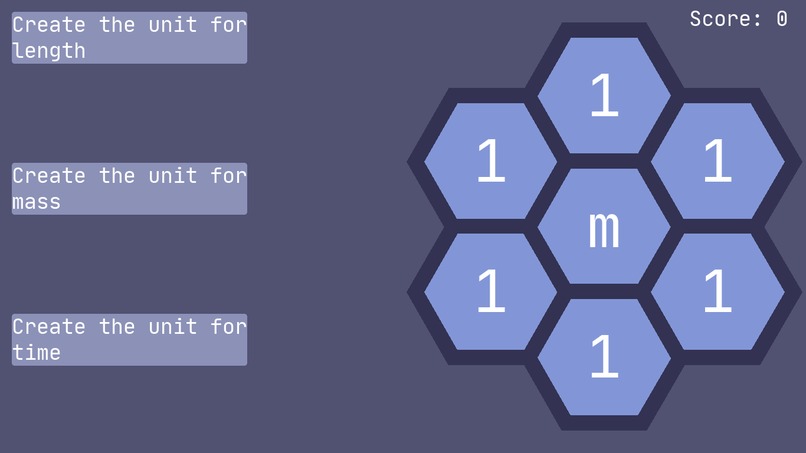
The starting screen
-
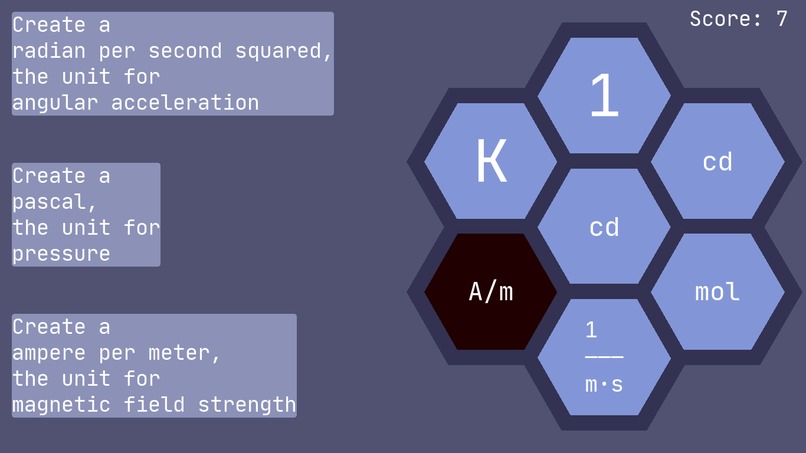
Me about to get an ampere per meter
-
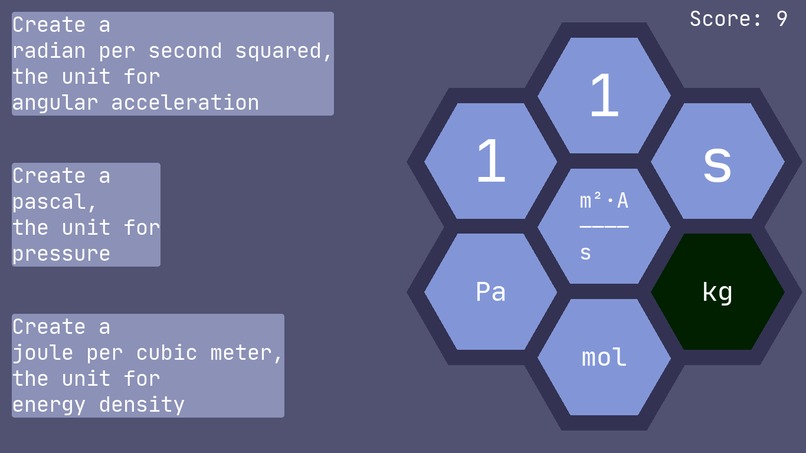
Dividing kilograms by something


Inspiration
Lectures are boring. To no student's surprise, research has found that lectures aren't very effective at teaching as a result of this (Banfield & Wilkerson, 2014; Prensky, 2005). By contrast, video games are awesome [citation needed].
An educational video game certainly isn't a new thing, but most educational video games today are unengaging (Prensky, 2005; Wouters et al., 2013). Because educational video games do a better job of teaching when they're engaging (Cheng et al., 2017; Prensky, 2005), students would learn much better than they currently do if instructors started to use (or at least recommend) engaging educational games. As such, we wanted to create an engaging educational game that could be used in classrooms.
What it does
In our game, the player must multiply and divide the 7 SI base units (meters, kilograms, seconds, etc.) to create derived units (newtons, joules, hertz, etc.). On the screen, there's 7 hexagons arranged in an almost-circle, and the player can multiply or divide any 2 adjacent hexagons. At any given point, the player will have three derived units that they are aiming to reach through the multiplication and division of base units. After each multiplication and division, a new base unit spawns on a blank hexagon. The game is rather similar to 2048.
How we built it
For this game, we decided to use pygame since it's a simple engine that can run the game. We used MVVM architecture to separate the game logic classes from the UI classes; this made horizontal scaling much easier.
Challenges we ran into
One significant challenge was creating a bunch of derived units for the player to reach. The solution was quite simple; all we had to do was take a list of derived units from Wikipedia and put it in the code. However, it took a surprisingly long time to do the manual data entry involved in this. Furthermore, we discovered that a good chunk of derived units were misinputted and wouldn't accept the correct combination of units, so we had to go back and look through every derived unit.
Accomplishments that we're proud of
The biggest accomplishment is definitely creating a fun educational game. Although it's a fairly simple game, it could easily be integrated into a browser or a mobile app for students to play in quick 5-minute bursts (potentially even during lectures). We're also quite proud of the gameplay loop, as it's quite hard to create something that's both fun and educational.
What we learned
We learned that a Henry is a kilogram meter squared over the quantity of seconds squared times amperes squared. That's probably not going to do us any good, but it's neat. On a more serious note, we learned how difficult it is to create a game that's both educational and fun. It's worth the effort, though—improving how students learn could have big effects.
What's next for hexSIgon
Since we both have a free .tech domain for a year, making this into a webapp is probably the way to go. We could also make an Android app since it's relatively easy and cheap.
References
Banfield, J., & Wilkerson, B. (2014). Increasing student intrinsic motivation and self-efficacy through gamification pedagogy. Contemporary Issues in Education Research (CIER), 7(4), 291–298. https://doi.org/10.19030/cier.v7i4.8843 Cheng, M.-T., Lin, Y.-W., She, H.-C., & Kuo, P.-C. (2017). Is immersion of any value? Whether, and to what extent, game immersion experience during serious gaming affects science learning. British Journal of Educational Technology, 48(2), 246–263. Wiley. https://doi.org/10.1111/bjet.12386 Prensky, M. (2005). Computer games and learning: Digital game-based learning. In J. Raessens & J. H. Goldstein (Eds.), Handbook of computer game studies (pp. 97–121). MIT Press. https://www.academia.edu/1113207/Computer_games_and_learning_Digital_game_base d_learning Wouters, P., van Nimwegen, C., van Oostendorp, H., & van der Spek, E. D. (2013). A meta-analysis of the cognitive and motivational effects of serious games. Journal of Educational Psychology, 105(2), 249–265. American Psychological Association. https://doi.org/10.1037/a0031311



Log in or sign up for Devpost to join the conversation.