-
-
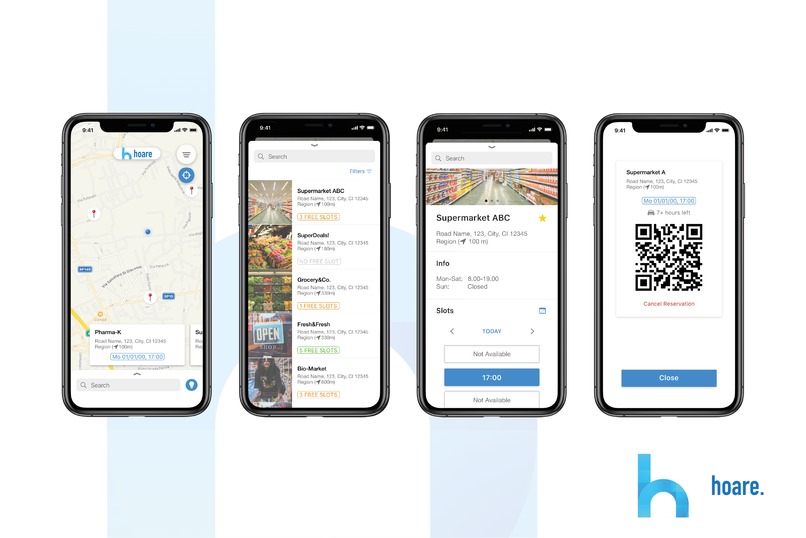
Hoare App reservation
-
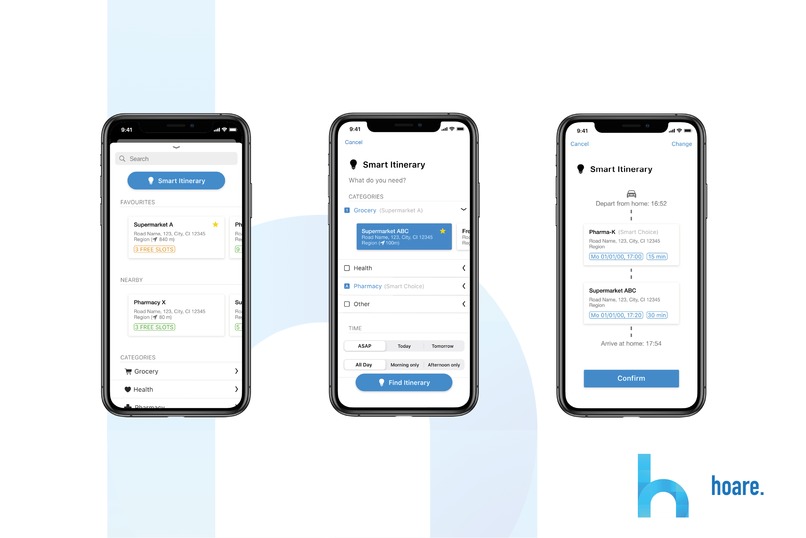
Hoare App Smart Itinerary
-
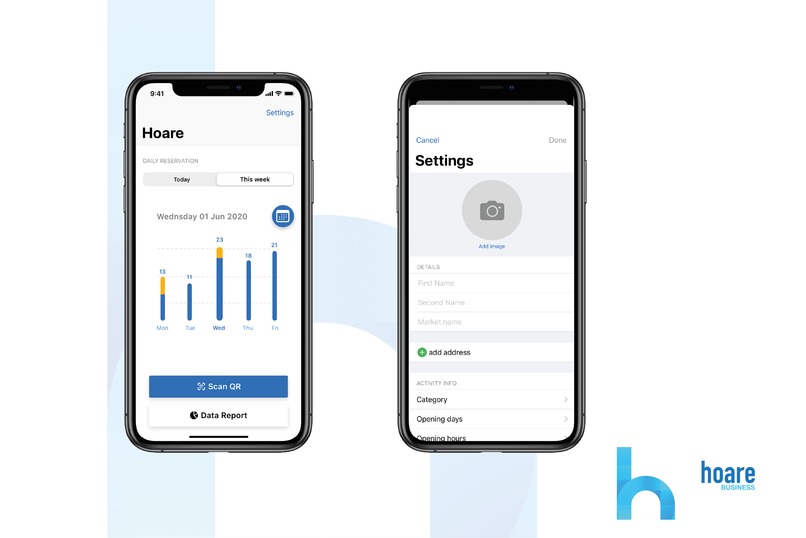
Hoare Business


Introduction
Coronavirus: the social distancing
As coronavirus spreads into more and more communities, public health officials are placing responsibility on citizens to help slow the pandemic. Social distancing is crucial at this moment for preventing our health care system from getting overwhelmed, according to public health officials and scientific experts. But it won’t be easy.
This means that people must simply stay at home, far enough from each other so that the coronavirus, or any pathogen, cannot spread from one person to another.
For all those unavoidable relationships such as work relationships, it is necessary and highly recommended to keep at least 1-meter distance among people.
The effects of social distancing
The direct consequence of social distancing was the closure of schools, universities, offices and gatherings at local businesses.
The businesses that provide essential necessities and services, of course, are not part of this lockdown but they need to follow severe restrictions. One of them is limiting the number of people who can simultaneously access within the premises in order to respect the 1m distance rule.
Identification of the challenge
These new regulations for businesses that provide essential necessities and services do solve the problem inside, but result in the formation of an endless queue outside which could be extremely and equally dangerous.
Starting from this problem we defined our challenge. We focused on the waiting times and on the strategies that could be implemented in order to suppress them. We looked into all the proposals whose main purpose is to solve the same problem, studied their solutions and found what we believe are their caveats.
All these solutions operate when the problem is already present and needs constant data feeding by users in order to work. That data is needed both to verify and to update the status of the services.
So instead of stopping these solutions, we went further and based our reflections on some solid principles:
- Optimise protection of people's health;
- Creation of a more efficient system that works on a win-win scheme (end-user and businesses).
Aware of the information obtained from the researches, we understood that the turning point lies in positioning the solution before the problem and not during.
Our challenge is to avoid the creation of the queue itself, without the need of constant updates by the users on the status of service.
Our Solution
Introduction
Hoare is a service that aims to solve queue problems allowing the user to book a slot at businesses. This is not intended to be a service that provides reports and statistics on the status of queues, it’s instead a service to make and regulate reservations to access businesses.
Users don’t need to interact with the system unless it’s strictly necessary - when using the system they would give all the information needed to avoid or start queues that generate gatherings. The entire queue would be handled while the user is still safely and comfortably at home.
Hoare App
Hoare App is the core of the entire process, it is the data entry point for all the information needed to let the service work properly.
With Hoare App a user can keep track of all the businesses in its specific area, giving the possibility to search or filter them depending on its needs, and make reservation for them in the available time slots.
A user has also quick access to all the required information for each specific business such as the opening hours and realtime announcements (e.g. they don’t have a specific highly requested product). In this way the user wouldn't go outside for no reason.
Hoare also offers a service to plan the entire itinerary: thanks to machine learning, it suggests reservations in order to optimise the duration of the itinerary by avoiding the problem of jumping out multiple times or getting stuck in a queue. It would creates what we have called a “Smart Itinerary”.
The system allows to keep reservations valid for a limited time (customisable by the business operator). After a certain time or deadline, the reservation expires.
This avoids losing available spots and lets other people waiting in the queue without Hoare App reservation to enter. A warning system is also provided. If customers don’t show repeatedly after reserving a time slot (not giving the possibility to other customers to book that slot) they won’t be able to make reservations anymore for a limited time.
Hoare Business
With Hoare Business every business can use the service of reservations and have access to a lot of settings to shape the service basing on its needs: opening hours, number of total spots available and also notices for customers.
Hoare Business has a QR Code reader integrated into the app to allow business operators to read the reservation code generated by the Hoare App installed on the customer’s device so that the check-in process is quick and easy.
The advantages for the business don’t stop here: Hoare Business allows them to have statistics updated in real-time and through data analysis thanks to Machine Learning. This would provide suggestions about the management of reservations (e.g. changing the number of spots available for a specific time frame).
To share awareness of the service, through this app, posters will be provided to every Commercial Activity that requests it. They would be printed and displayed outside to let the service get known to as many customers as possible.
Development status
The concepts and mockups of both apps are completed and we have defined all features, with the related mechanics, giving particular attention to their feasibility in terms of development time and technologies.
We started coding the Front-End of both iOS apps prototypes but we are missing the Back-End development – both Database and Server setup requires time and effort to be ready.
Next Steps
In the near future, we intend to extend the service to as many platforms as possible, providing in addition to the iOS suite, also an Android one and a Web solution, because our priority is to make the service available to as many people as possible, both to deal with the current situation and for the future since the current regulations are envisioning a gradual reopening of the other non-essential businesses which will maintain the same limitations currently in use for the essential ones.


Log in or sign up for Devpost to join the conversation.