-
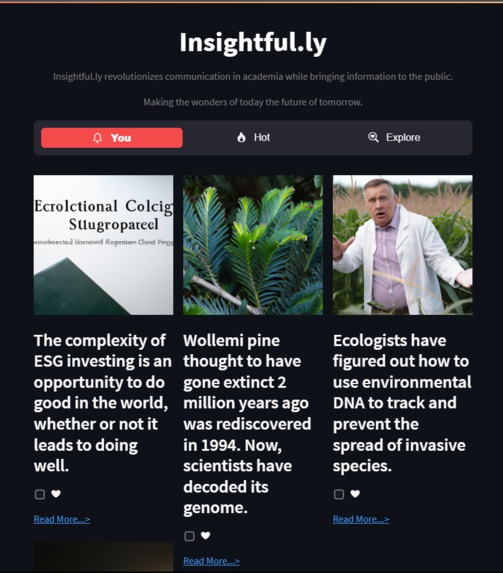
Home page, formatted with AI generated pictures and headlines.
-
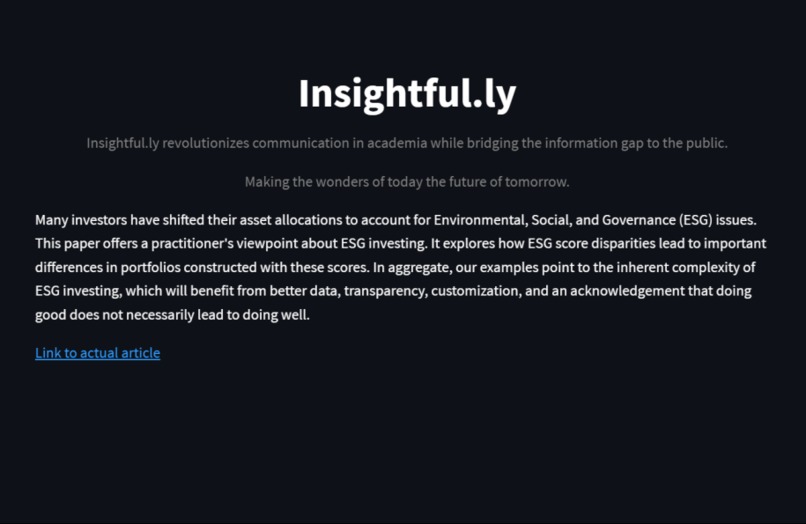
Summarization of articles and links to actual papers
-
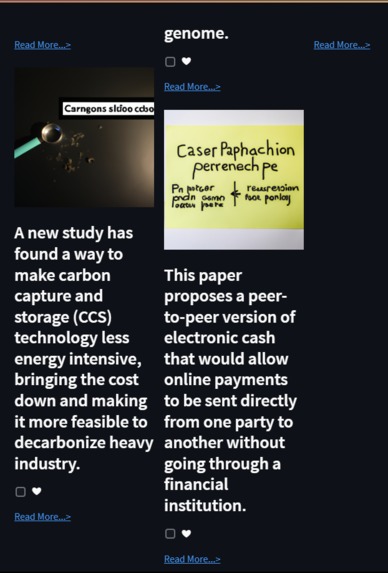
Infinite scrolling of articles
-
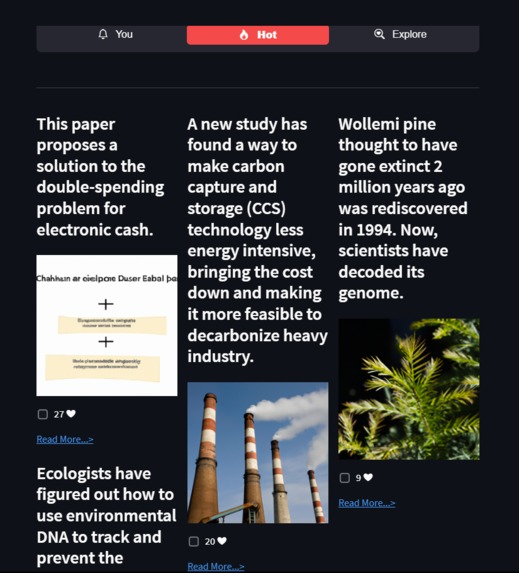
Sorting of articles based on user upvoting (Hot/Trending article section).


Inspiration
Why is science inaccessibility such a problem? Every year, there are over two million scientific research papers published globally. This represents a staggering amount of knowledge, innovation, and progress. Yet, around 91.5% of research articles are never accessed by the wider public. Even among those who have access, the dense and technical language used in academic papers often serves as a barrier, deterring readers from engaging with groundbreaking discoveries.
We recognized the urgent need to bridge the gap between academia and the general public. Our mission is to make scientific knowledge accessible to everyone, regardless of their background or expertise. Open insightful.ly: You are presented with 3 top headlines, which are summarized with cohere as “news headlines” for each research article. You also see accompanying photos that are GPT produced.
What it does
Our goal is that by summarizing long research articles that is difficult to read into headlines that attract people (who can then go on to read the full article or a summarized version), people will be more encouraged to find out more about the scientific world around them. It is also a great way for talented researchers who're writing these articles to gain publicity/recognition for their research. To make the website attractive, we'll be generating AI generated images based on each article using OpenAI's DALL-E 2 API. The site is built using Python, HTML, CSS using Pycharm.
How we built it
Content Aggregation: We start by aggregating peer reviewed research papers from google scholar.
Cohere Summarizer API: To summarize both the essence of these papers and to generate a news headline, we used the Cohere Summarizer API.
User-Friendly Interface: Building using Python, we designed a scroller web app, inspired by Twitter and insta and the reliability of respected news outlets like The New York Times. Users can explore topics on 'you, 'hot,' and 'explore' pages, just like they would on their favorite news website while being captivated with the social media type attention grabbing scroll app.
AI-Generated Visuals: To enhance the user experience, we integrated OpenAI's DALL-E 2 API, which generates images based on each research article. These visuals help users quickly grasp the essence of the content.
User Engagement: We introduced a liking system, allowing users to endorse articles they find valuable. Top-liked papers are suggested more frequently, promoting quality content.
Challenges we ran into
During the development of Insightful.ly, we faced several challenges. These included data aggregation complexities, integrating APIs effectively, and ensuring a seamless user experience. We also encountered issues related to data preprocessing and visualization. Overcoming these hurdles required creative problem-solving and technical agility.
Accomplishments that we're proud of
We take immense pride in several accomplishments. First, we successfully created a platform that makes reading long research articles engaging and accessible. Second, our liking system encourages user engagement and recognition for researchers. Third, we integrated advanced AI technologies like Cohere Summarizer and OpenAI's DALL-E 2, enhancing our platform's capabilities. Lastly, building a user-friendly web app inspired by social media platforms and respected news outlets has been a significant achievement
What we learned
Our journey with Insightful.ly has been a profound learning experience. We gained expertise in data aggregation, API integration, web development, user engagement strategies, and problem-solving. We also honed our collaboration skills and became proficient in version control. Most importantly, we deepened our understanding of the impact of our mission to make science and knowledge accessible.
What's next for Insightful.ly
In the next phase of Insightful.ly, our primary focus is on enriching the user experience and expanding our content. We're committed to making knowledge accessible to an even wider audience by incorporating research articles from diverse domains, enhancing our user interface, and optimizing our platform for mobile accessibility. Furthermore, we aim to harness the latest AI advancements to improve summarization accuracy and generate captivating visuals, ensuring that the content we deliver remains at the forefront of innovation. Beyond technical improvements, we're building a vibrant community of knowledge seekers, facilitating user engagement through features like discussion forums and expert Q&A sessions. Our journey is marked by collaboration, partnerships, and measuring our impact on knowledge accessibility. This is just the beginning of our mission to make knowledge more accessible and insightful for all.


Log in or sign up for Devpost to join the conversation.