-
-
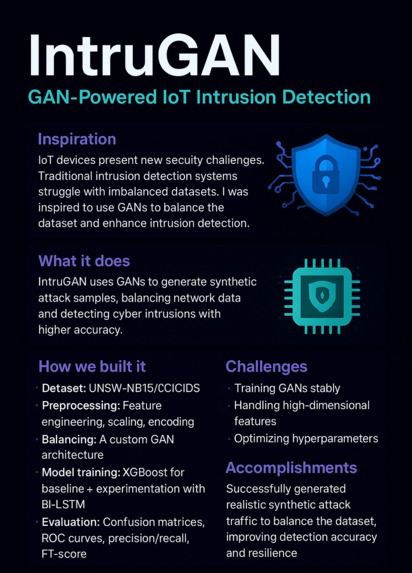
IntruGAN: GAN-Powered IoT Intrusion Detection

Inspiration
The rise of IoT devices in smart homes, healthcare, and industry has created new attack surfaces for cybercriminals. However, traditional intrusion detection systems struggle with highly imbalanced datasets, where rare but critical attacks are underrepresented. Inspired by recent advances in Generative Adversarial Networks (GANs), I set out to solve this imbalance problem and build a more reliable intrusion detection system for IoT.
What it does
IntruGAN is an AI-powered intrusion detection system that uses GANs to generate synthetic samples of minority attack classes, balancing the dataset. It then trains a deep learning–based classifier (XGBoost/Bi-LSTM) to detect intrusions across multiple classes. The result is a more accurate, fair, and robust IoT security model that can identify even the rarest attacks.
How we built it
- Dataset: UNSW-NB15 / CICIDS from Kaggle.
- Preprocessing: Feature engineering, scaling, encoding categorical variables.
- Balancing: A custom GAN architecture to oversample minority attack classes.
- Model training: XGBoost for baseline + experimentation with Bi-LSTM for sequential patterns.
- Evaluation: Confusion matrices, ROC curves, precision/recall, F1-score.
- Deployment: Packaged as a pipeline with Jupyter + Python scripts for reproducibility.
Challenges we ran into
- Training GANs stably without mode collapse.
- Handling high-dimensional network traffic features.
- Ensuring synthetic samples improved generalization instead of overfitting.
- Optimizing hyperparameters for both the GAN and the classifier.
Accomplishments that we're proud of
- Successfully generated realistic synthetic attack traffic to balance the dataset.
- Achieved improved multi-class accuracy and recall compared to baseline models.
- Created a pipeline that can be reused for other imbalanced cybersecurity datasets.
- Learned to bridge GANs and traditional ML (XGBoost) for a real-world application.
What we learned
- How powerful GANs are for data augmentation beyond computer vision.
- The importance of feature selection and preprocessing in security datasets.
- Balancing theory with practice: designing a research-inspired solution under hackathon constraints.
- Clear visualization (ROC, confusion matrix) helps explain technical impact to non-experts.
What's next for IntruGAN
- Extend to real-time IoT traffic monitoring with streaming frameworks.
- Test on multi-source IoT datasets for better generalization.
- Incorporate explainable AI (XAI) to make detection decisions more transparent.
- Deploy as a cloud-native microservice for scalable IoT network defense.



Log in or sign up for Devpost to join the conversation.