-
-
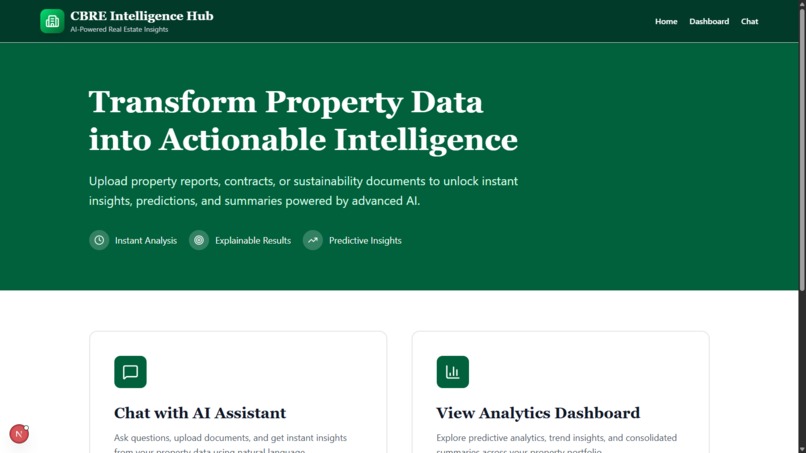
Main page
-
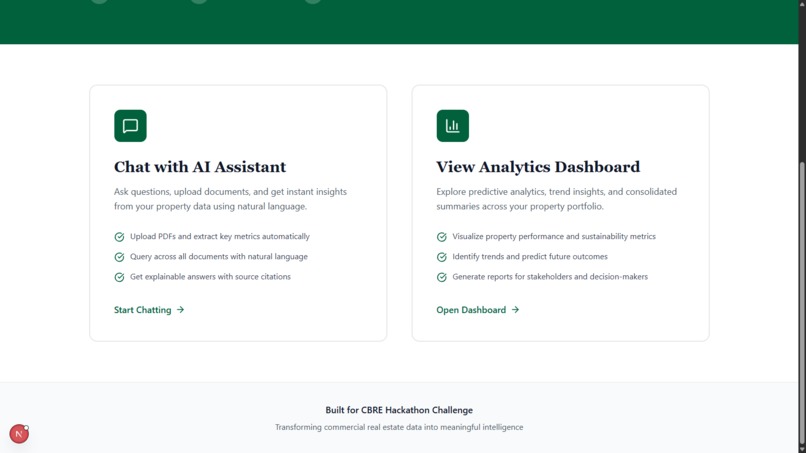
Primary components of our project
-
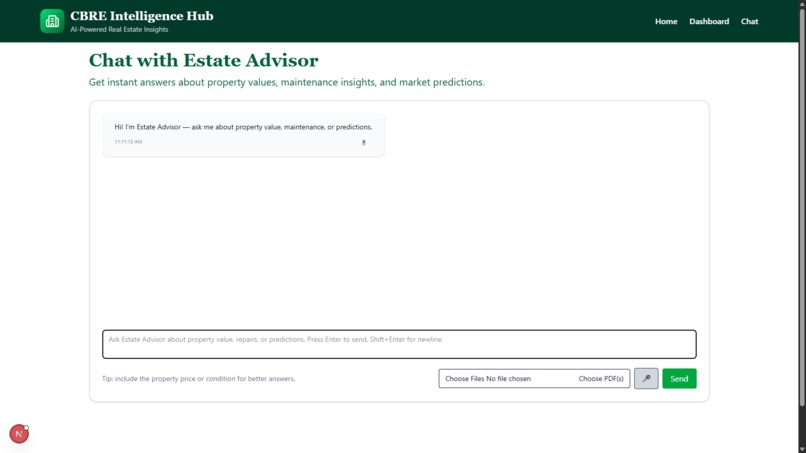
Chat page
-
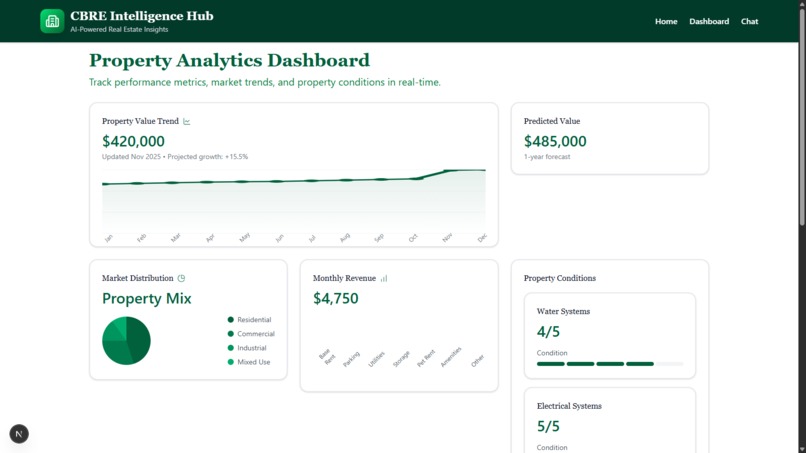
Dashboard page of analytics.
-


Inspiration
Real estate data often hides in thousands of unstructured documents, contracts, reports, appraisals, and sustainability statements. Property managers and investors spend countless hours sifting through them to find actionable insights. We hope to reduce that manual work with a machine learning model that improves over time.
What it does
AI-Powered Real Estate Insights Platform. Achieve actionable intelligence with an improving model over property documents of unstructured format and nature.
The App allows users to:
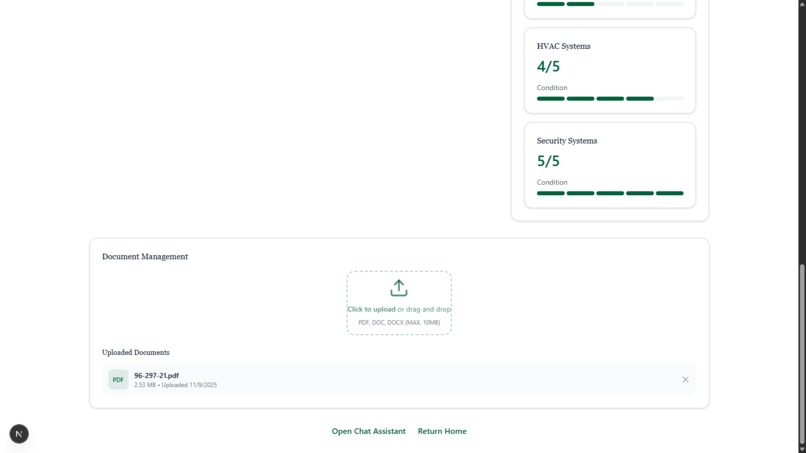
- Upload property documents (PDF, etc.) like maintenance reports or contracts.
- Chat with an AI Estate Advisor to ask about property value, maintenance, or market predictions.
- Use voice input and output to speak to the AI and hear it talk back in real time.
- Get explainable responses with transparent reasoning and source highlights.
- View analytics dashboards summarizing extracted trends and predictions.
The chat collects users input to extract wanted features and filter data to their requirements using an openai model to collect info. The document extractor parses the document like a PDF through, takes a nation-wide Zillow data set, and send that info through a transformer model to extract feature which are sent to a the categorical boosted trees and it outputs a value prediction of the property as well as its future values based on maintenance cost extracted from the documents. With more documents it improves.
Pipeline: user input (txt) --> insert documents (pdf) + Zillow Kaggle national property info data set--> transformer model --> features selected --> categorical boosted regression trees --> final result
How we built it
Front end:
- Next.js, React.js
- Tailwind CSS
Back end:
- Python scripts
- Google Collab scripts (transformer + boosted trees)
- Flask CORS
- OpenAI GPT-based API
- PDF parser (pdfjslib)
Data:
- Zillow Kaggle Dataset
Challenges we ran into
The transformer model was the most challenging part to parse the pdfs. It is difficult to pass a lot of data through both models due to the limitation of processing power and storage on our laptops.
Another issue was the lack of professional real estate knowledge, provided data, or a mentor to guide or assist with questions to help us decide before hand what to parse and how to evaluate property value and predict future value over time.
Also, this year the hackathon was cut short an hour so it was 23, hrs not 24!
Accomplishments that we're proud of
- Built a conversational AI that understands and reviews unstructured real estate documents
- Designed a professional-grade UI inspired by enterprise design systems
- Implemented real-time voice interaction (Text-to-Speech and Speech-to-Text)
- Achieved document to insight transformation with contextual understanding
What we learned
We learned more about the transformer model and ML pipelines. We also learned how to integrate PDF parsing into user friendly chats. Another interesting detail we discovered is there are a lot of property documents that are standard in the state of Texas that have a property ID code.
What's next for CBRE Intelligence Hub Project
If we got the opportunity to redo this hackathon we would scan the document for a unique ID/code that we can use to identify the whole document without having to parse it and covert data, we can then directly scan for the information that we know are in the given form with a simpler neural network or CNN which would compute quicker and extract the data for either another model or an LLM/GPT to train on.
We would also add an option to upload video (formatted to images per N milliseconds) or an image also with the rest of the documents (Excel, CSV, Word, PDF, etc.). It would take all the info including the past, present data on pricing, maintenance costs (gas, electric, water, etc.), weather, property quality in images/video, and geographic/location-historic data into consideration.
We could also add hardware sensors to a camera/phone to detect temperature, air quality, pressure, etc. Maybe even attach it to a remove drone or rover if needed to inspect a property manually.
And finally, we would add a view to see all past documents uploaded (possibly allowing users to sign in and store their property portfolio in app) and view/highlight which parts of the data inputted was used and allow improvements or further chat threads, etc. on it. We could also pull live data for Zillow API and other Geo/weather APIs to get most accurate information.


Log in or sign up for Devpost to join the conversation.