-
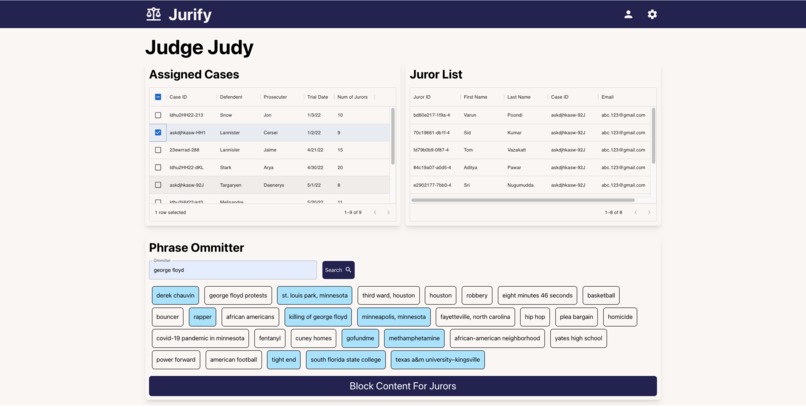
Admin Page
-
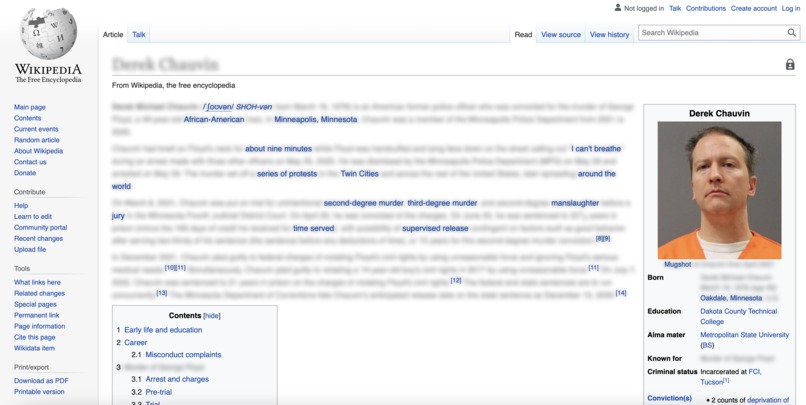
Censored Case Media


Inspiration
Major life decisions are made in the court of law and it becomes increasingly important to maintain fairness in the judicial system. More specifically, the role of a jury is an integral factor in making decisions that affect the rest of an individual’s life. After seeing multiple cases of false accusation and imprisonment, we were inspired to create a plug-in to reduce bias in the jury system.
What it does
The chrome extensions has two components. Firstly, an admin user logs in and selects the current case with list of jurors assigned to the case. Then, the user can specify key words and topics that pertain to the case that may induce bias in the trial. Behind the scenes, the program generates a list of related buzz words that the admin can select to hone in on which topics should be hidden. Then, the user can then press the block button to filter a jury’s internet activity. The second component is a chrome extension that the jury simply turns on, automatically blurring restricted content specified by the administrator.
How we built it
In the front end, we used React with MaterialUI and Tailwind. We built the program’s logic and accompanying word scraper in Javascript with Puppeteer. We used Express.js to set up routing and Mongoose to connect to Mongo DB. We built an API in Node.js to connect our front and back end.
Challenges we ran into
One of the major challenges was learning how to scrape the related words from a website. In the end, the group decided to use Puppeteer to perform headerless web scraping. In addition, it was a challenge to set up the API calls and build out the endpoints to call from. Learning to design the front end UI was a refresher for the whole team and filtering the data based on user selection was also a challenge.
Accomplishments that we're proud of
One feature we were proud of was giving the admin user the ability to chose which words to block from the suggested key-words. We thought it was the most logical way to refine the block list. For this hackathon, we spent a lot more time focusing on which idea/challenge to tackle rather than jumping straight into coding. We were proud not only of building a full stack application in 24 hours, but more specifically spending time to plan each screen and the functionalities our program offers.
What we learned
While building Jurify, we learned that in order to build a high quality product, you need to spend the same if not more time planning out the design and architecture. If you fail to plan, you plan to fail. We also learned useful React libraries and unique Javascript libraries like Puppeteer. Furthermore, we gained more exposure to working on a chrome extension as a majority of the team has a background in web/iOS development.
What's next for Jurify
In future iterations, we want to apply the selected filter to not only the jury's chrome browser, but also build plug-ins for other browsers. Building Jurify on mobile devices is also a future goal. We could also use artificial intelligence to build a reinforced learning model rather than scraping and allowing the admin to decide which words to restrict. This way, there is even less bias and Jurify is even more accurate in blocking unwanted results.
Built With
- express.js
- github
- javascript
- material-ui
- mongodb
- node.js
- puppeteer
- react
- tailwind-css




Log in or sign up for Devpost to join the conversation.