-
-
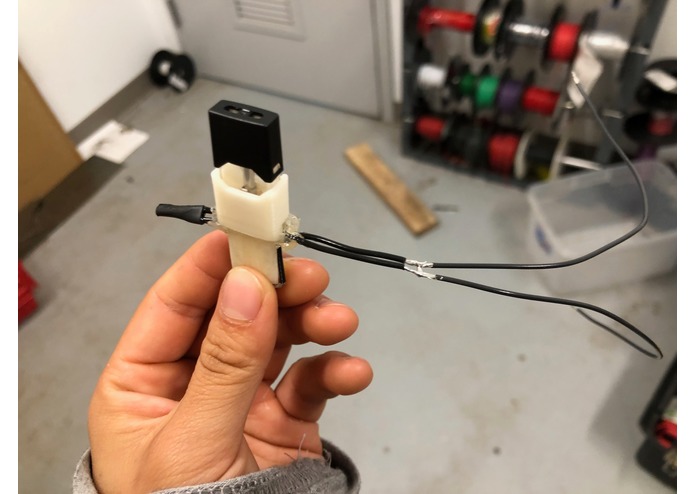
2nd prototype with improved airflow channels and shunt resistor
-
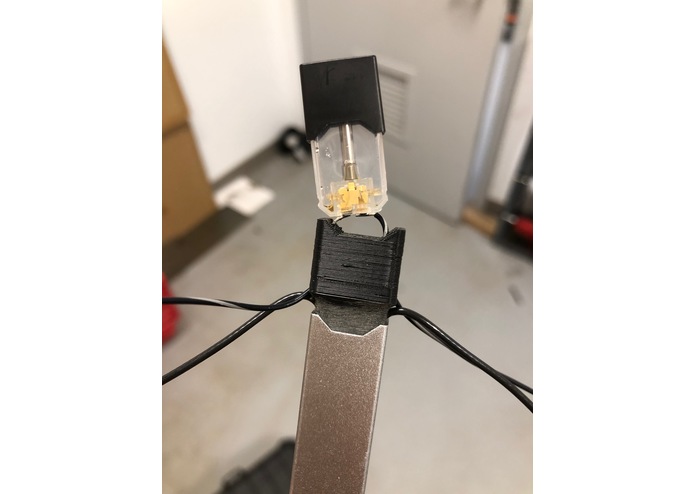
Initial test for breaking out pins
-
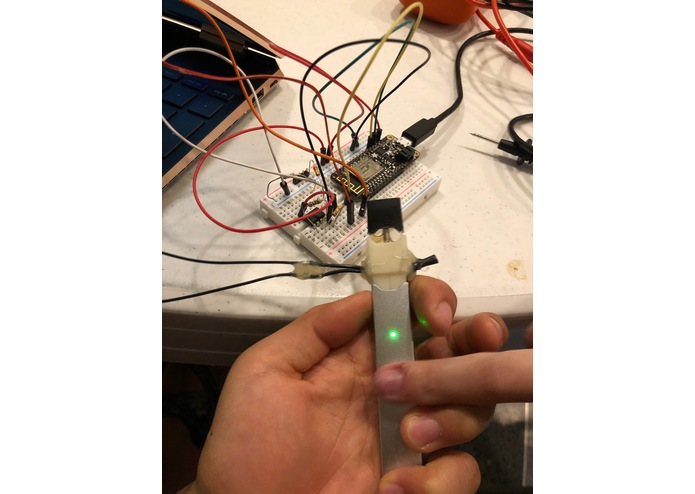
Final setup with Arduino board


Inspiration
Recent news headlines have brought to light the growing teenage vaping epidemic. The uncontrolled usage of addictive nicotine e-cigarettes has flocked the country, with companies like Juul focusing advertising on younger audiences. Especially on college campuses, nicotine addiction is becoming ever more prevalent. Juul.io is a solution to curb and reduce nicotine addiction by allowing Juul users to better understand their e-cigarette usage by tracking it in real time. It would also collect and distribute crucial health data (that Juul itself has been reluctant to provide) about a relatively new, niche, and unknown market leading to more accurate treatments and behavior predictions.
What it does
Juul.io is an IoT adapter that records and monitors your e-cigarette usage. With data on your Juul usage, you can actively track your dosage, frequency, and habits over time. The data is stored on the cloud, offering potential for optimized plans for quitting or reducing usage.
How we built it
The adapter was modeled using CAD, then 3D printed and fitted. The data is collected from the amount of current the Juul delivers on each use. A shunt resistor is inserted in series between the heating element in the pod and the battery in the device. This voltage is then measured across this resistor to accurately monitor current drawn. The current is directly correlated with the vapor produced and therefore the amount of nicotine delivered in each use. An Arduino was used to measure the voltage across the shunt resistor, which then processes the data and uploads it to a cloud server. Our SQL database and web s was hosted through Google Cloud Platform, and we aimed for the Arduino to push data to a webapp using an http request, though that specific component didn't function.
Challenges we ran into
We ran into problems for turning on the device. The Juul was engineered cleverly to use airflow with a pressure sensor to turn on the device. Because of the pressure sensor, the adapter had channels to allow for airflow past the sensor. We also ran into problems mounting electrical pads and connections within such a small space. We also had problems setting up the cloud platform, as the Arduino had trouble establishing a secure connection when uploading data and frequent certificate issues.
Accomplishments that we're proud of
We are able to accurately measure current off the device, providing a proof of concept for a smart connected e-cigarette device. We also built our own cloud MySQL instance connected to a webapp, and while we couldn't get the arduino POST request to properly work due to certificate issues we at least know we could do it in the future.
What we learned
It's hard to link hardware and software. We also learned a lot about the cloud, a new programming language (Go Lang), and the finer points of transmitting http requests from an Arduino to a webapp hosted on a cloud server.
What's next for juul.io
Further prototyping, moving towards an actual small embedded device, wireless data transfer between the data collected from the embedded device and the webapp, and better modelling of the data. From the data models we could extrapolate usage curves that lead to decrease in usage or what frequenting habits use the least amount of nicotine, plastic, and electricity. In the future, it could even be used to shut off a Juul after a max limit has been reached.
Built With
- 3dprinting
- arduino
- esp8266
- gcp
- go
- juul
- mysql


Log in or sign up for Devpost to join the conversation.