-
-
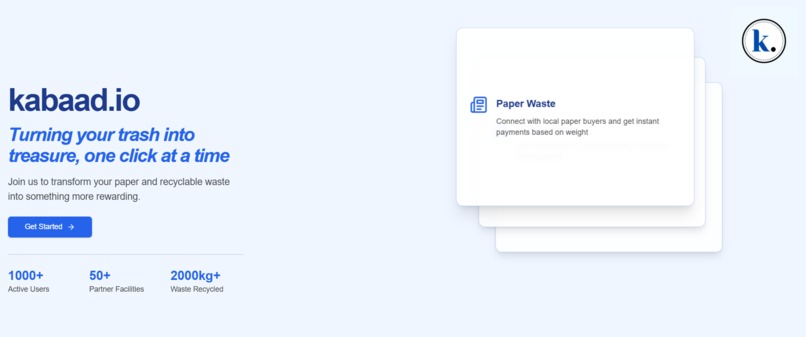
Main page of website
-
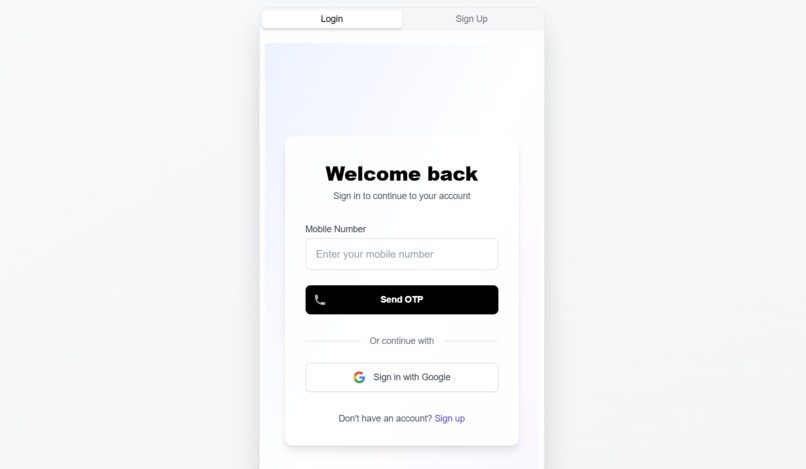
Login/Register Page
-
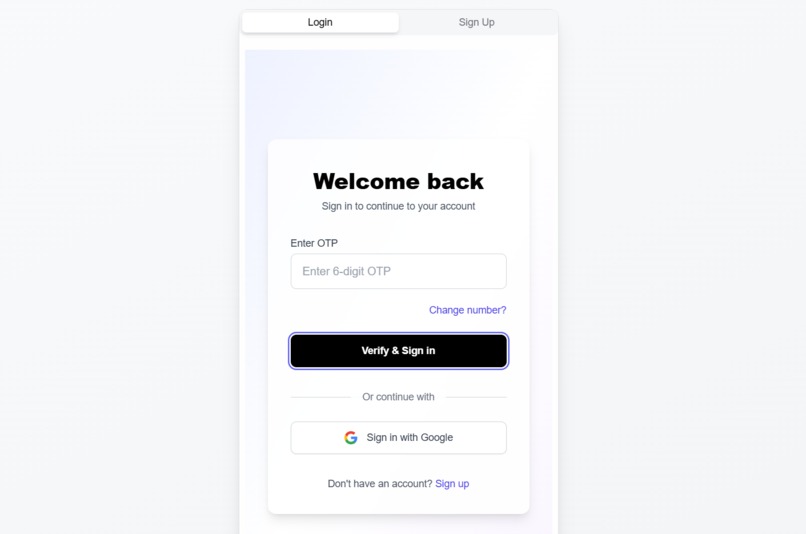
OTP sent
-
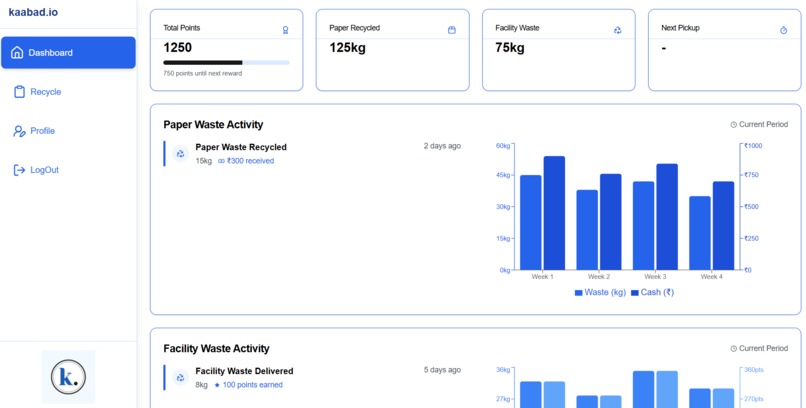
Dashboard with activity status
-
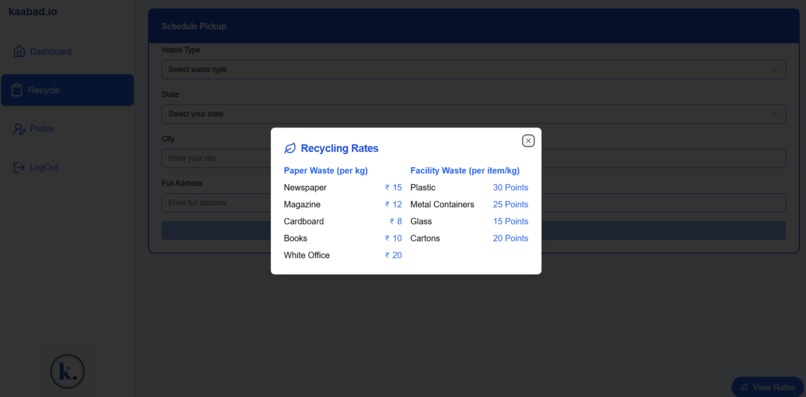
Recycle Page with Waste Rates
-
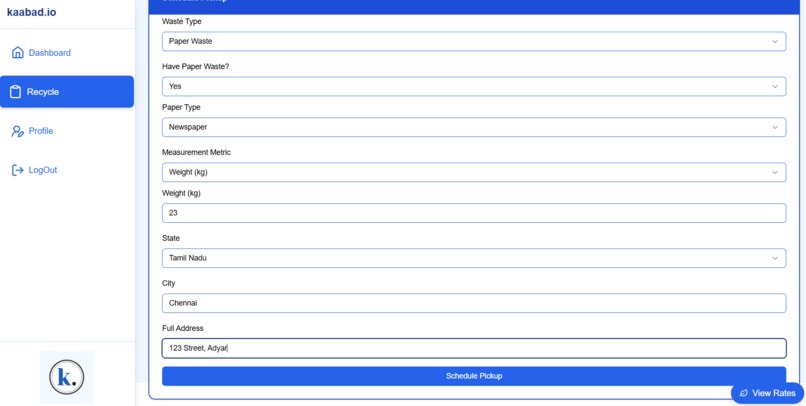
Schedule Waste Pickup
-
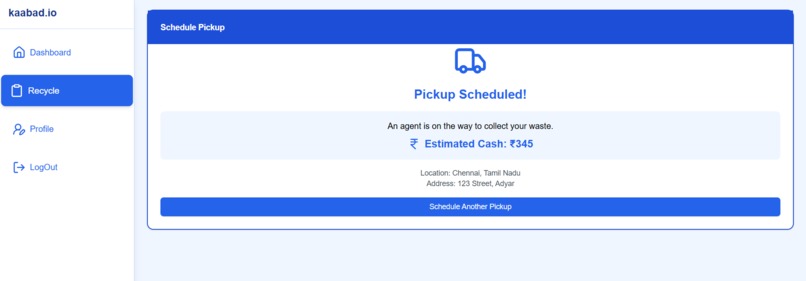
Pickup Confirmation with expected amount


Inspiration
We were not very sure of what projects we could build to promote sustainability or eco-friendly as such because there's been a lot if ideas floating around and we wanted to make something unique, which we and those around us find useful and can relate with. That's when it came to us to build kabaad.io, seeing the many books stacked just lying around and given us being college students we get a lot of books and papers we don't know what to do with. In addition to this, we were also inspired by the large amount of cardboard boxes or plastic packaging which is present at homes just being thrown away coming from e-commerce and online delivery system platforms.
What it does
kabaad.io provides a platform to connect the public with local paper sellers and/or recycling facilities with the help of a delivery agent who acts as the point of contacts between the two. On our portal, waste is categorized into 2 types: Paper and Facility. Paper waste is the different types of paper such as office paper, newspapers, magazine etc. This is taken to local paper sellers nearby to the user's location. Facility wastes includes glass, metal containers, carton, plastic wastes etc. which are recycled in facilities. These are taken to the nearby recycling facilities.
The user creates their account/ logs in using mainly their phone number which is then verified using OTP verification.
The user is redirected to the portal where they schedule their pickup of the waste. They can enter the type of waste, paper or facility, which paper/facility waste it is, enter the weight or amount of waste they have, their state, city and address for pickup of waste.
The user can then click on Schedule Pickup which displays the user of how any points or how much cash they can get and also the estimated pickup time.
When user gives paper waste, the delivery agent would give the user said amount of cash depending on the weight they had entered or amount while scheduling pick-up. For facility waste, the user receives points for the waste given, which they can then redeem for offers/ discounts as such later on after certain amount of points.
The user can track their activity such as no.of points, amount/weight of paper and facility wastes recycled over time on the dashboard.
kabaad.io mainly reduces labour and traveling charges mainly for the public and the local paper sellers as the paper sellers does not have to go from street to street checking to see if anyone is there to give away papers. The public also does not have to wait in their homes for them to come or travel anywhere to find them. All this is done at their ease of their homes. This is aimed at promoting sustainability and recycling by also providing incentives to the users in the form of points and cash for their wastes 💵.
How we built it 💻
The portal is built using the following technologies:
- Next.js: For building the web application’s frontend and backend.
- ShadCN: To style components and create a sleek UI.
- TailwindCSS: To provide additional styles to components such as themes. 4.Python: To implement a basic OTP verification system for user login. 5.Canva: To build our website logo.
Challenges we ran into
The main challenge was to figure out a solution to tackle the issue of waste production in our daily lives which is happening very easily by buying products online or outside in regular intervals. However, after coming up with the idea of kabaad.io, another problem we faced was how we could build this portal well enough. Hence, we decided to build upon the front-end and UI/UX elements of kabaad.io first and foremost as one of the biggest challenges to tackle for this would be to collect the data of local paper sellers in various cities and regions and create a point of connection between them and the portal as well.
Accomplishments that we're proud of
We're glad to produce a solution which we ourselves can envision using for our usage such as when we have books lying around and we don't know what to do with them or paper left from assignments, reports etc. We're proud to be able to implement a solution that is easily accessible, provides an interactive user interface and is appealing to the larger public.
What we learned
Throughout the development process, we gained valuable insights into working with basic OTP verification using Python, how to build a user-friendly web-application, and the importance of real-time interactivity in user experiences.
What's next for kabaad.io 🌐
In the future we plan to:
- Build a robust web-application, fully functional and capable of performing up to its name.
- Include an access portal individual to the pickup and delivery agents and the local paper sellers in addition to the users, helping them to track the waste received and delivered.
- Make an extensive rewards system by collaborating with eco-friendly brands and small business promoting the same.
- Add mobile application support by implementing mobile app-development technologies to deploy the portal.
- Potentially grow the portal into a start-up application that is released into the market on production level for use. We, as a team, are only getting started with the future of recycling and sustainable practices with kabaad.io and look forward to achieving great feats. 🌱


Log in or sign up for Devpost to join the conversation.