-
-
-
-
-
-
-
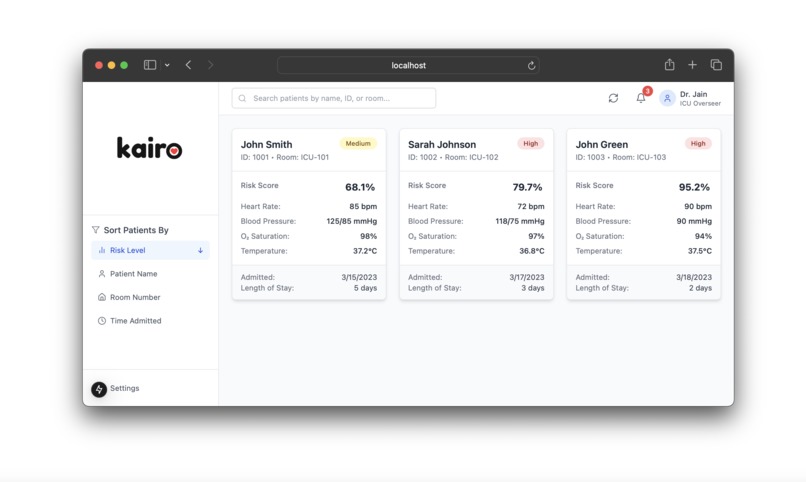
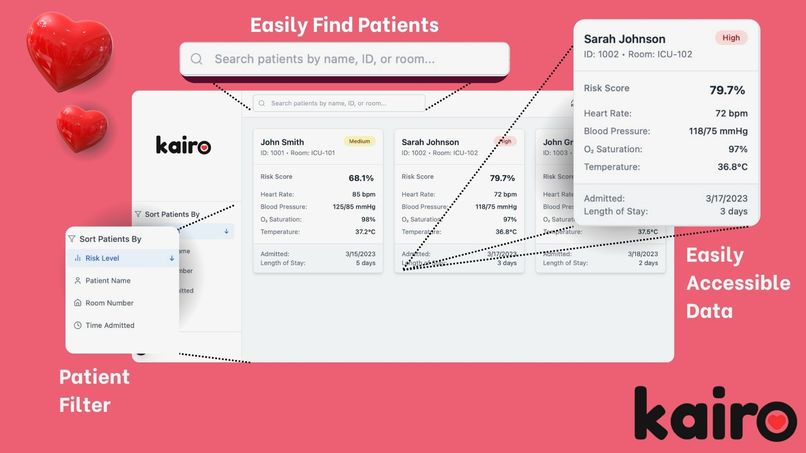
Main Dashboard
-
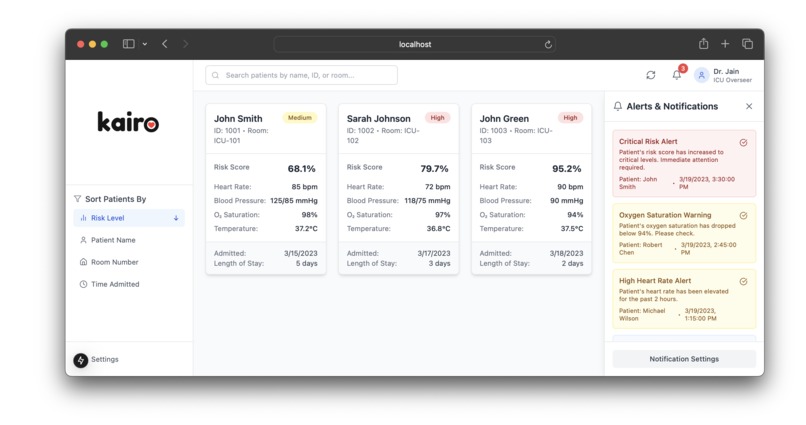
Dashboard with Notification Pane open
-
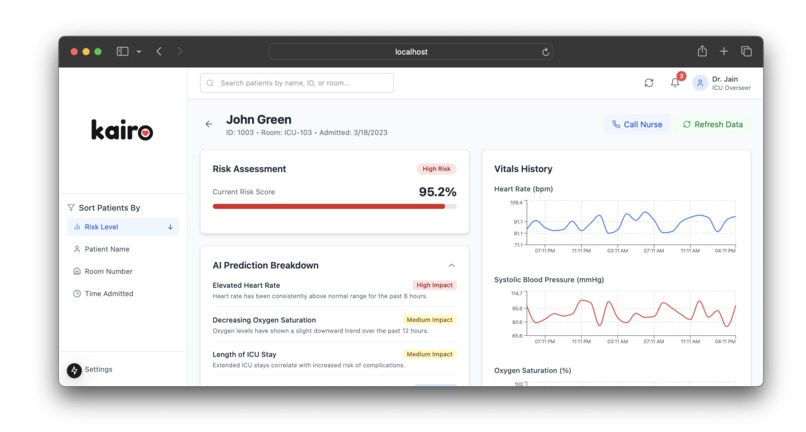
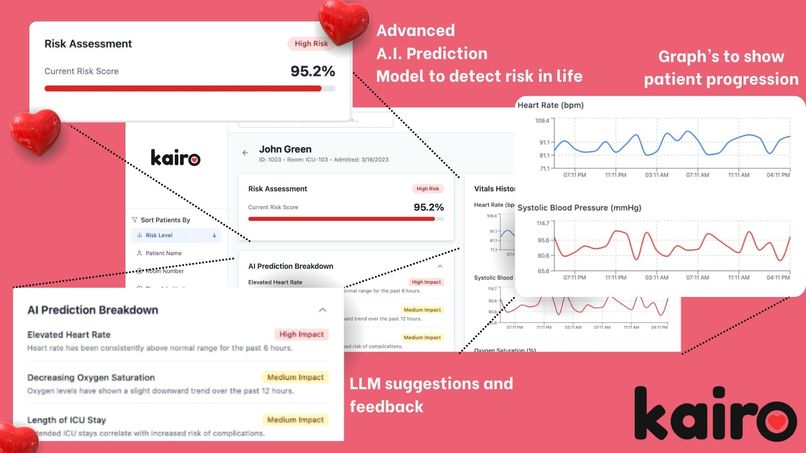
Patient Details
-
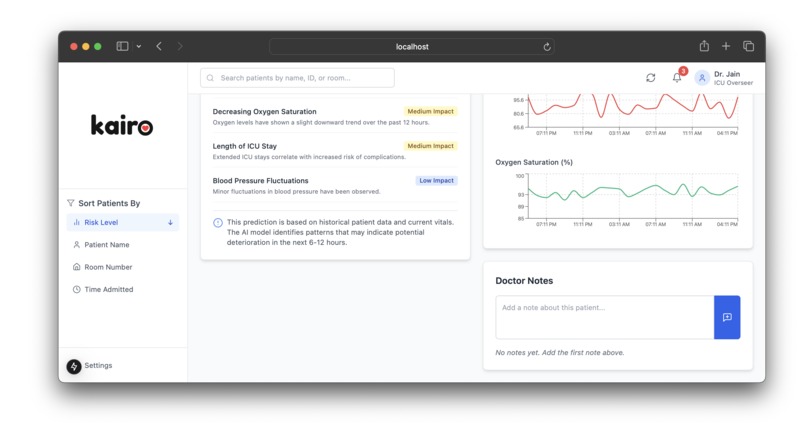
Patient Details Bottom
-
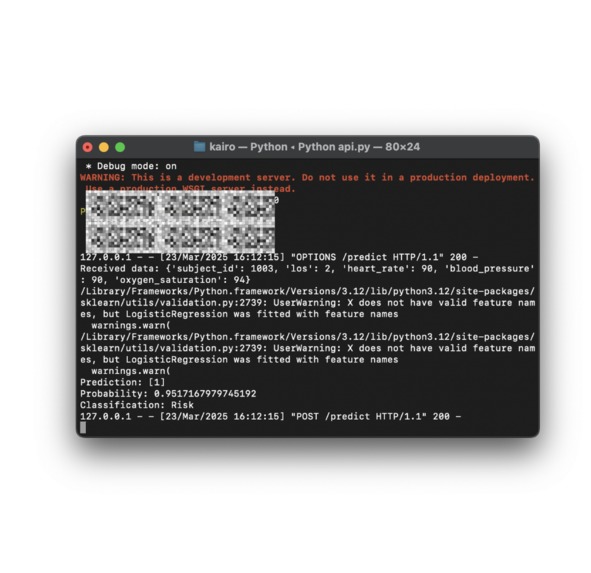
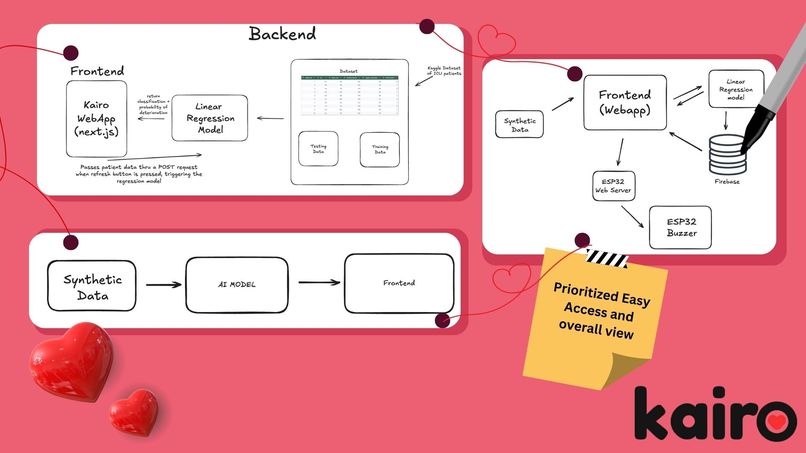
Machine-Learning Backend
-
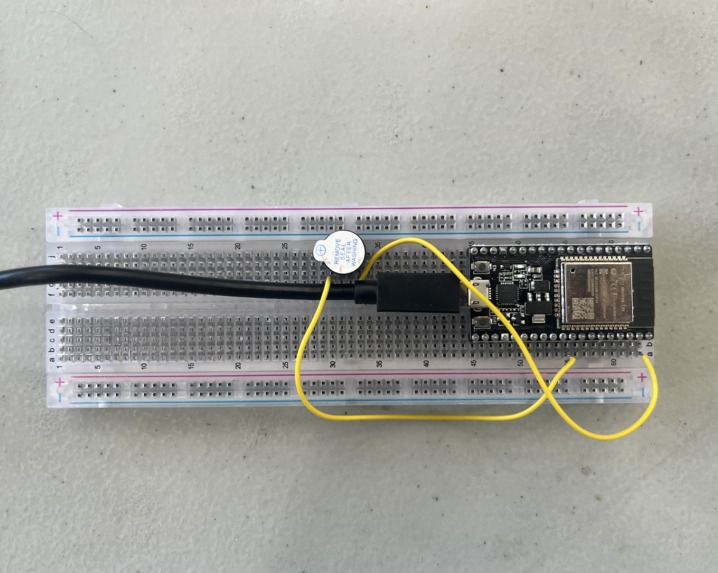
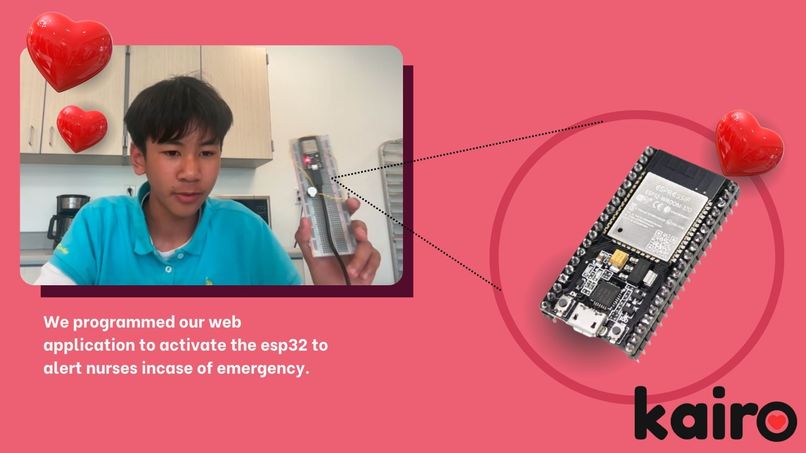
Hardware (ESP32 + Piezo Buzzer)


Inspiration
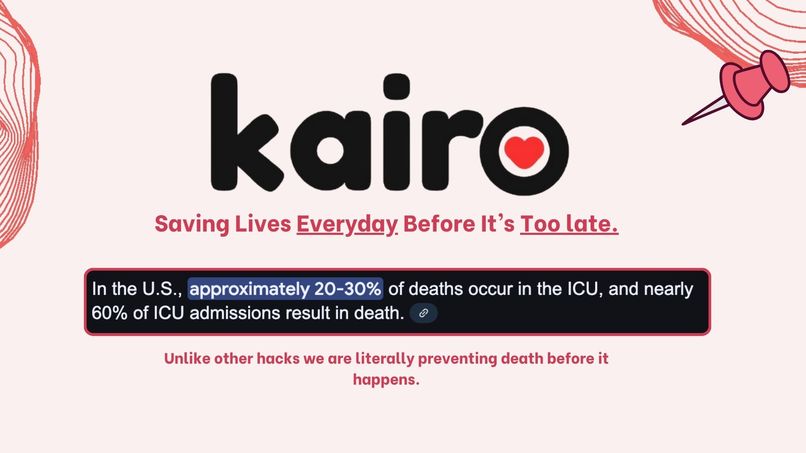
The ICU patients lay in agony, their breath shallow and uneven, clinging to the fragile thread of life as doctors and nurses rushed from bed to bed, desperate to provide a glimmer of hope. Each heartbeat echoed like a ticking clock, reminding them that without immediate care, their chances of survival were slipping away. ICU deaths due to delay are an EVERYDAY PROBLEM and NEED to be solved.
What it does
Rishaan, Ronit, and I are proud to present... Kairo. Kairo is a life-saving tool that revolutionizes ICU care by providing real-time monitoring of critical patient vitals. It not only tracks and graphs essential data such as heart rate, o2 saturation, temperature, as well as length of stay, but also calculates a risk score through an advanced self-made Linear Regression Machine Learning Model, to quickly identify patients in danger, sending instant alerts to doctors and calling for immediate help at the click of a button. By streamlining communication and accelerating response times, Kairo empowers healthcare teams to take swift, life-saving action when every second counts.
How we built it
Backend:
Linear Regression Machine Learning Model Our custom made machine learning model in Python is trained on an OpenAI refined Kaggle Dataset for patients of the ICU and their attributed deterioration. Our model has a 90% accuracy when calculating deterioration rates, and effectively uses historical data of a patient to calculate this. This is then queried by the front-end and is returned with our triage (medium, low, high risk) and a percentage.
Synthetic Data Generation Since we don't have access to real patient biometrics, we made a custom algorithm to generate synthetic patient data mocking REAL ICU patients, this allows us to test our model accuracy.
ESP 32 Web Server For our "Call Nurse" feature, we query our network protocol which is a web server that tells the ESP 32 via an antenna connection to ring a buzzer, this makes it so wirelessly anywhere on the same network we can ring the buzzer when the “Call Nurse” button is pressed.
Frontend
We use a Next.js + React + Tailwind + Firebase tech stack for our frontend.
Challenges we ran into
Some challenges we ran into were linking our Frontend and our Backend with the Firebase database. Since our app relies on historical data we had to think on data structuring and think which is the most storage and optimized way to store our data. We also had a lot of debugging with just the common model and app itself.
Accomplishments that we're proud of
We are proud as we feel a deep moral fulfillment, knowing that our app has the potential to save lives on a global scale. Time management skills Effective Collaboration Skills
What we learned
We are proud of learning technologies such as HTTP protocols, Networking Protocols, as this was important for establishing communication with our website, backend, and our ESP32 server We are also proud of learning Next.js (as before we heavily relied on Vite which was slow and old) and Tailwind for the best and most optimized UI we’ve ever created We also are proud of learning to make ACCURATE Machine-Learning models
What's next for Kairo
The next step for Kairo is integrating with small ICU facilities and refine our model to make it more accurate, as HealthCare technology is a place where HEAVY training is needed. After we are integrated with our small ICU facilities, we can eventually scale up, and save lives GLOBALLY which is entirely what sets us apart from the rest of the projects.
Built With
- arduino
- c++
- esp32
- hardware
- http
- linear-regression
- machine-learning
- networking
- next.js
- python
- react
- typescript
- websockets


Log in or sign up for Devpost to join the conversation.