-
-
-
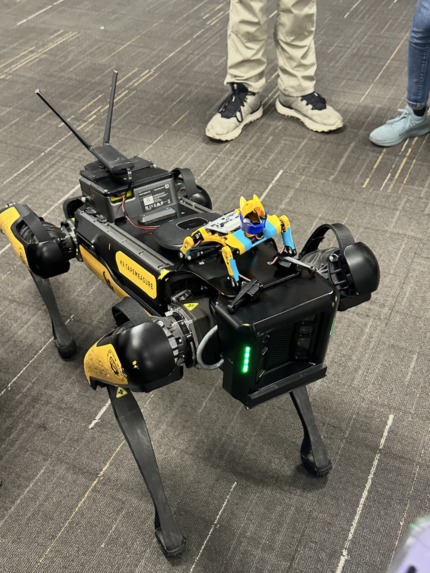
our dog on boston dynamic dog


Inspiration
We were inspired to create Koors after recognizing how many barriers exist for people who rely on service animals from allergies and high costs to limited availability and housing restrictions. We wanted to design a lightweight, accessible alternative that can perform similar assistive tasks without those constraints. Our goal was to combine compassion with technology and make independence more affordable and inclusive.
What it does
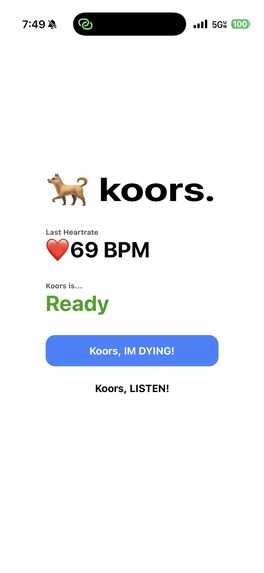
Koors is a robotic service companion that delivers medication automatically when triggered by a health alert from an Apple Watch. If the Watch detects an irregular heartbeat. For example, a resting heart rate of 200 bpm, it sends an HTTP request to dispatch Koors. The robot then navigates toward the user and delivers the needed medicine, bridging wearable health monitoring with real-world assistance.
How we built it
We built Koors using a Raspberry Pi as the central controller, with a Flask backend, React Native mobile interface, Apple HealthKit integration, and BLE beacon navigation. The Apple Watch communicates through a local HTTP request to the Pi, which then triggers movement commands to the robot via serial communication. We also incorporated OpenCV for potential obstacle detection and environmental awareness.
Challenges we ran into
Working with Swift and HealthKit was a major challenge from constant permission issues to data handling restrictions. Which lead us switching over to React Native. None of us had much experience with embedded systems, so connecting hardware components like the Raspberry Pi’s GPIO pins was a learning curve. The hardest problem was serial communication: we learned that Bluetooth and serial shared the same /dev/ttyAMA0 port, causing conflicts when sending motion commands to the robot.
Accomplishments that we're proud of
Our proudest moment came when we successfully triggered Koors to walk toward the user after receiving a real Apple Watch alert. For a team of beginners in both hardware and robotics, getting that first movement, driven entirely by our custom-built software pipeline was surreal. We jumped up and down celebrating as the robot took its first independent steps.
What we learned
We learned an incredible amount in a short time from mobile app development and Raspberry Pi programming to robotics, embedded communication, and BLE integration. Understanding how sensors, software, and mechanical systems interact gave us a deep appreciation for how complex yet rewarding robotics development can be.
What's next for Koors
Next, we plan to give Koors a home mapping system similar to a Roomba. This would let it label obstacles and plan efficient routes without relying solely on camera vision or BLE signals. We’re also exploring integration with local pharmacies and healthcare platforms to make automated, on-demand medical delivery a reality.


Log in or sign up for Devpost to join the conversation.