-
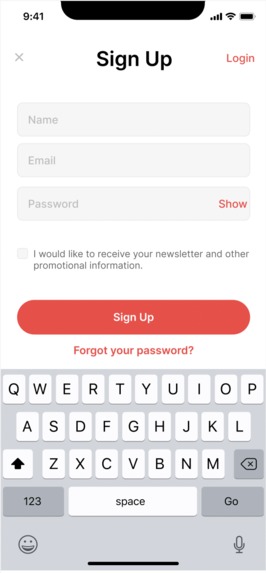
Sign Up (Figma Mockup)
-
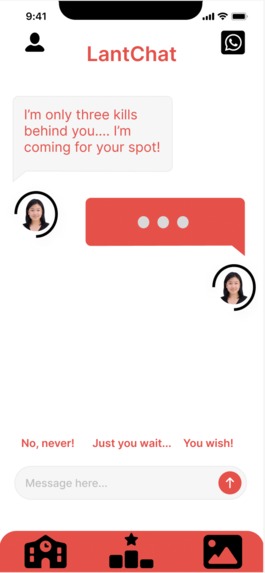
LantChat (Figma Mockup)
-
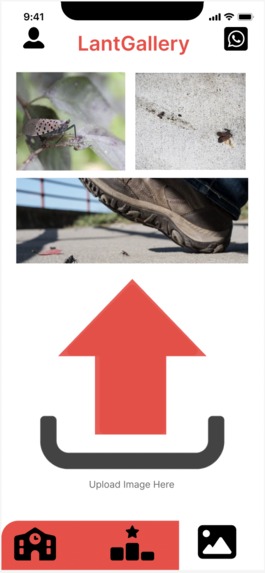
LantGallery (Figma Mockup)
-
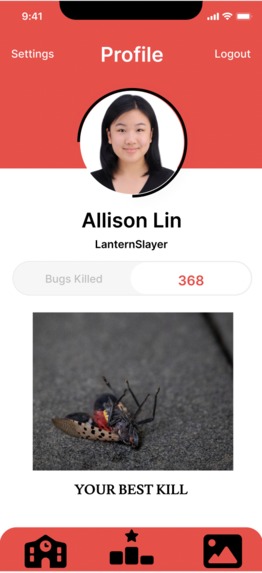
Profile (Figma Mockup)
-
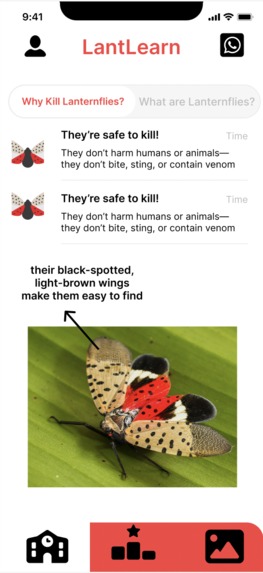
LantLearn (Figma Mockup)
-
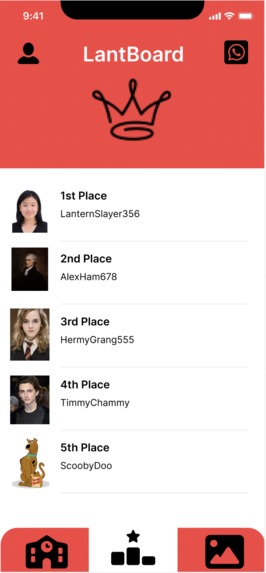
LantBoard (Figma Mockup)
-
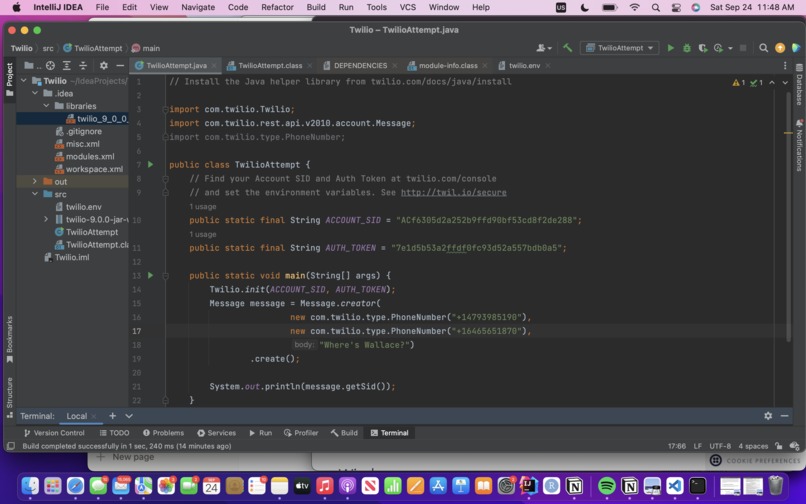
Twilio Attempt Screenshot 1
-
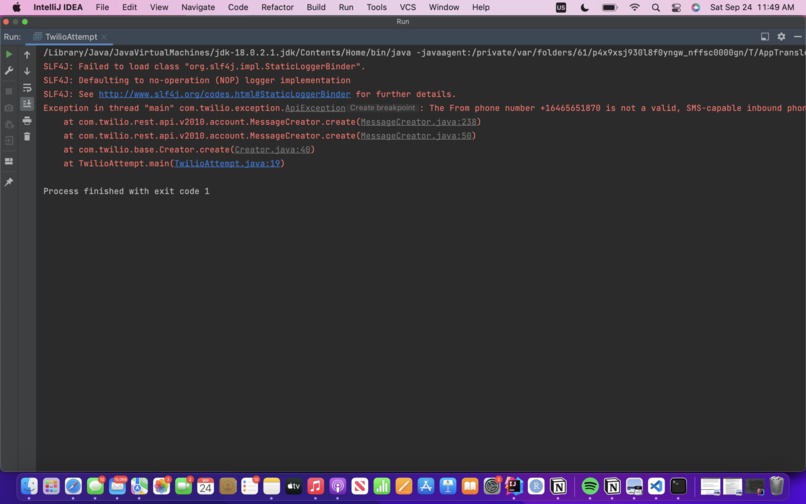
Twilio Attempt Screenshot 3
-
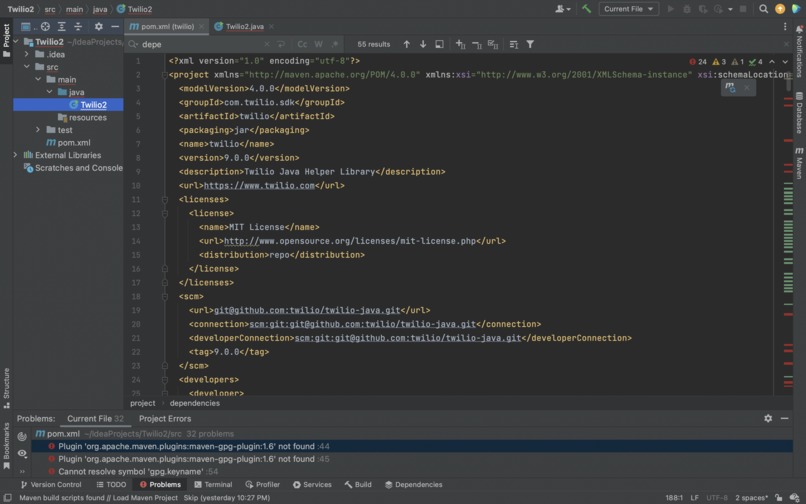
Twilio Attempt Screenshot 2
-
LanternDie Logo
-
LanternDie Thumbnail


Inspiration
We began our ideation on the Flora and Fauna track when Lucy brought up her experiences with overpopulated wild animals in her hometown. This prompted Kyra to recall an ongoing problem — the pesky Lantern Flies found everywhere on the east coast! On Barnard College campus especially, people have made it their mission to get rid of every Lantern Fly they see. Inspired by the recent interest in exterminating this insect, we had the idea to create an app that encourages users to help the community in a fun way as well as create an opportunity to learn more about local ecosystems. The impact of invasive species on ecology and biodiversity is widely recognized. The Spotted Lantern Fly (Lycorma delicatula) is one such species which has profoundly affected ecosystems in mid and southern-latitude regions such as the United States, Canada, Korea, and China. An estimated 12% of vegetation has been outstripped due to the presence of the Lantern Fly in the Eastern United States (e.g. New York) alone. To combat this issue, the US Department of Agriculture has called for public intervention via “squash and kill” tactics. Here we present LanternDie, an interactive platform which promotes and stops the spread of the invasive Spotted Lantern Fly. In a convenient hand-held format, the app Lantern Die! provides users with an educational and entertaining approach for curbing the spread of invasive species and insect pests in general.
What it does
LanternDie is an app which engages user(s) to get involved in sto(m)pping! the spread of Lantern Flies using a multifaceted approach. The app first presents a (1) Photo Upload Registry, (2) LantGallery, (3) LantChat and (4) LantBoard (leaderboard) which encourages the user to take action in their community – stomping, swatting, and squashing the pesky insects. By engaging in friendly competition to see who can accumulate the greatest number of insect kills, users can take an active role in helping the local ecosystem. Moreover, we incorporate an educational feature, (5) LantLearn, which informs user(s) of the impact of invasive species and disrupted ecology in their local communities (e.g. New York, New Jersey). We’ve designed a dynamic user interface which motivates and inspires individuals to become stewards of their local environment, stomping and swatting the insects and promoting a more balanced ecology in the process.
How we built it
Before building the app, we had to conduct research on Lantern Flies in scientific literature. This informed our LantLearn page mock-up and inspired the upload feature, since the government is looking for individuals to report sightings. Once we had a strong idea of the features we wanted, we developed the front end of LanternDie with the app interface design tool, Figma. This wireframe/mock-up shows our thinking behind the several features of LanternDie, including sign-up, photo upload, photo gallery, profile, dashboard and chat pages. Our team carefully crafted the colors, fonts and layout to keep our users engaged. Additionally, instead of coding a full back-end for the app, we showed our problem solving and computational thinking by creating a Java object-based simulation. We created a User class, a UserComparator, a user dataset .csc file and a Main class to test out these methods with the dataset. This can be seen and run through Repl.it. The User class stores all users in a linear database (ArrayList) that is sorted in order of most to least kills. This is the leaderboard that would be shown to users to motivate users. Finally, we created a simple and concise website that explains our project idea to potential users, mentors and perhaps even in the future, investors. To do this, we employed Wix’s website builder, Velo. We were also able to get a hold of the domain lanterndie.tech. Because Wix requires a premium subscription plan in order to connect a personal domain, we are holding off on doing so.
Challenges we ran into
With none of our team members experienced in web development, we initially struggled to link our ideation with an actionable development plan. In response, we combined multiple platforms, including app development, Java, and Velo, to maximize the capabilities of our design. Combining various team members' diverse skills in programming, research communication, and UI/UX design, we filled the gaps in our knowledge with the help of plenty of quick learning – not all of which was straightforward. One team member worked for over half of the weekend to implement Twilio communications with the hopes of creating a system of SMS texts notifying users when they advanced on the leaderboard and when other users advanced to be one point behind them. However, even with the assistance of the mentors, we struggled to implement the Twilio libraries necessary to run the program. In the process, we explored three separate routes to implementation – Maven, .jar files, and Gradle – all of which failed. In the process, we deepened our understanding of the terminal and inter-platform connections, but unfortunately adding Twilio features to LanternDie will continue to be a goal for the team. On another side of development, we had to experiment with several different prototyping
Accomplishments that we're proud of
Biodiversity, flora and fauna are important for maintaining a balanced, stable, and sustainable environment. The absence of native vegetation and wildlife (brought on by invasive species) is an ongoing threat to ecosystems which underpin modern society. We are proud to have developed an app which promotes this concept using an innovative and entertaining platform. From a technical standpoint, we are excited to have dived into ecological research, learned how to design an app wireframe/mock-up, developed Java object-based simulations, and built a website. For half of the team, this was the first hackathon they ever participated in as well as the first year they have been involved with coding. The members with slightly more experience challenged themselves to use Twilio and Velo, making this a truly educational experience for all members. Even though we all come from diverse backgrounds in engineering, CS, and economics; we worked together as a cohesive team. One of our greatest achievements was coming together and harnessing our unique strengths and abilities to make a project we are passionate about!
What we learned
DivHacks has been an insightful experience which taught us not only new technical skills (e.g. Twilio, Wix), but also overarching themes of sustainability and environmental conservation. We also picked up invaluable skills in collaboration and teamwork. Learning how to ideate, pitch, and design the app as a group are three such examples of skills acquired. On a more technical side, we learnt: Velo by Wix, prototyping through Figma, and domain purchases online. Finally, we learned how to have fun, be imaginative, and make a difference in the world using CS and tech. We leave DivHacks feeling inspired and motivated to attend future hacking events and apply ourselves towards real-world problems like the Lantern Fly invasion!
What's next for LanternDie
During the short time frame of this hackathon, we were only able to create a mockup of the front and back end of the app. If we were to continue this project and take it forward, we would have to create a front and back end and develop a mobile app. Regardless, in terms of scalability, the lanternfly crisis is only the beginning. Future possibilities are endless for LanternDie. On the marketing side, we have plans to integrate a LanternDie time everyday. To aid existing government databases in precisely tracking and locating the spread of lanternflies, we want to integrate a geospatial tagging feature in the photo registry. We would also like to adapt the app towards other invasive species like the Gypsy moth. We want to expand the geographic context of the app and extend its use in other countries. Canada, Korea, and China, for example, are confronted with Gypsy moth, Lantern Fly, and long-horned beetle threats.


Log in or sign up for Devpost to join the conversation.