-
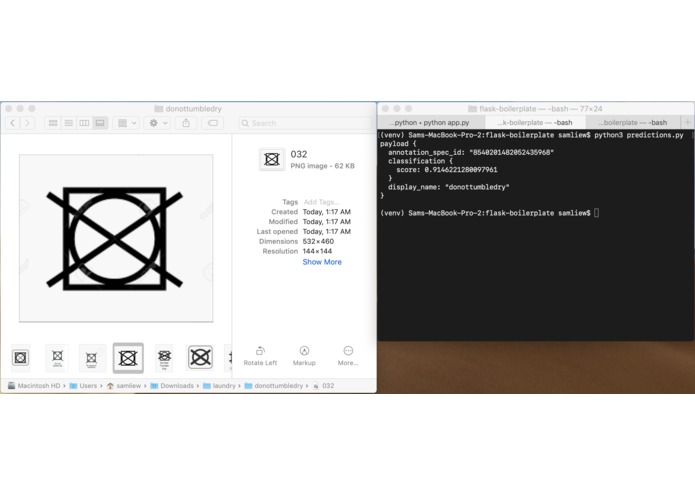
Test of ML model in CLI
-
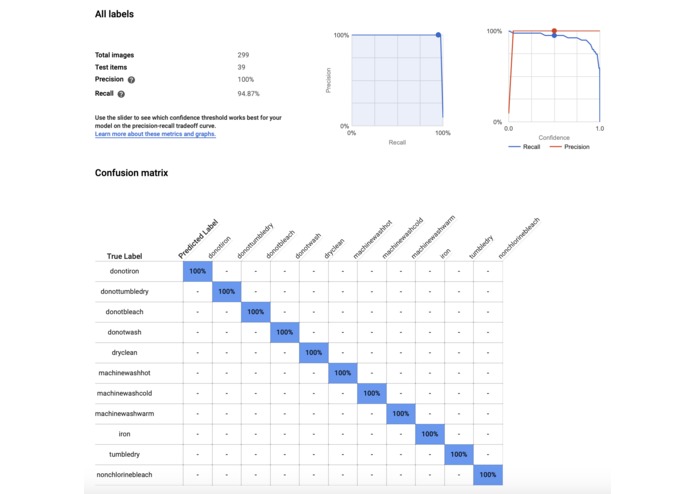
Evaluation of ML model training
-
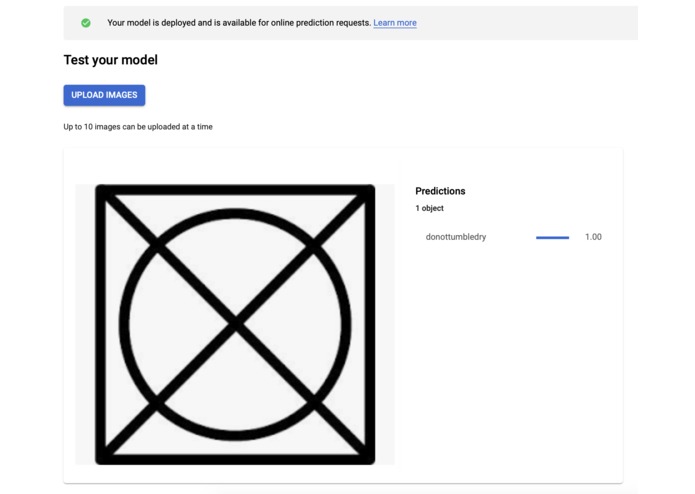
Test of ML model in Web interface
-
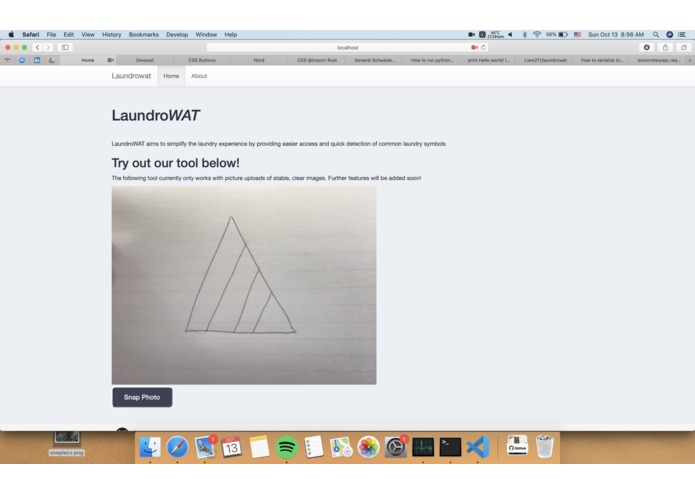
Website preview


Inspiration
A surprisingly large number of people don't know how to properly sort their laundry; I, myself, have had more mishaps with laundry than I'd to admit. While many articles of clothing have laundry instructions in the form of symbols without words, it takes significant effort to learn and decode them. Therefore, we decided to build a program that would assist people in this task.
What it does
Laundro*WAT* is a web-based application that uses a webcam or built in camera to take a picture of a laundry symbol, then by applying a machine learning model on the image, interprets the symbol, and provides more detailed instructions on how that piece of clothing is to be washed.
How we built it
The frontend was developed with Python's Flask framework, along with HTML/CSS and Javascript, with a color palette inspired by Nord. The custom ML model was created on Google Cloud Platform, using the Beta version of the AutoML Vision service. The training data for the model was wholly sourced from Google Images, and basic photo editing tools were used to tailor the data.
Challenges we ran into
As the AutoML Vision service is still in its Beta release, we encountered a significant amount of frustration over its bugs and underdeveloped documentation. At the same time, due to its rapid development over the past few years, solution to our issues from forums and sites such as StackOverflow ere outdated and largely unhelpful.
Accomplishments that we're proud of
We are most proud of creating a consistently working image recognition machine learning model, and successfully integrating it within our web app. Additionally, this is one of our member's first hackathon, and he was able to learn on the fly, and was able to significantly contribute to the final product.
What we learned
We learned a lot more about the machine learning process, and now have a better understanding of the sheer amount of data and computing power needed to effectively train these models. While we are experienced in Python, this was one of our first times using the Flask framework, so we also learned more about Full-stack development and integration between the front-end and back-end of web applications.
What's next for LaundroWAT
In the future, we plan on generating more data sets that are magnitudes larger than what we worked with this weekend, such that we can further increase our model's accuracy, as well as upgrading the model from single-label classification, to multi-label classification, as well as improving the website's functionality and usability.
Built With
- automl
- flask
- google-cloud
- python


Log in or sign up for Devpost to join the conversation.