-
-
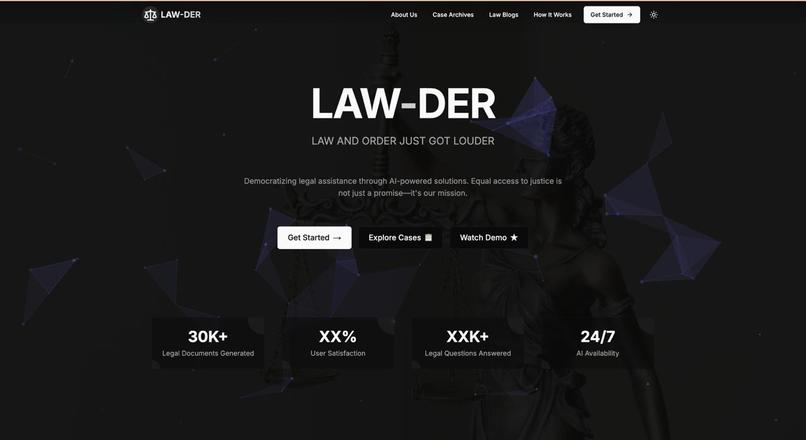
Home Page
-
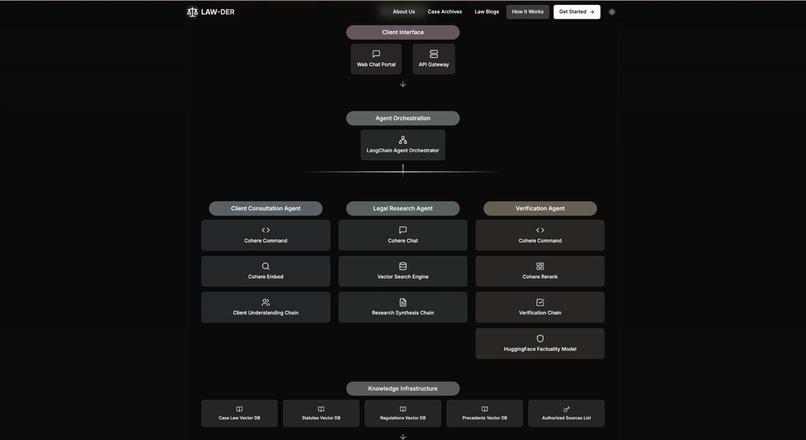
Flow of Execution
-
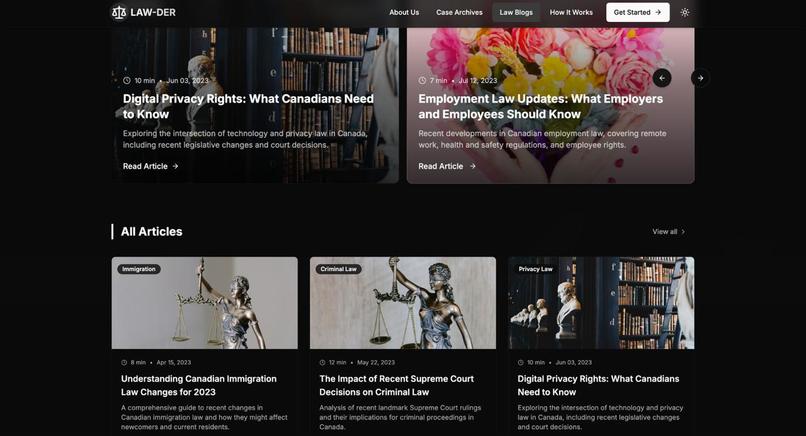
Weekly Blogs
-
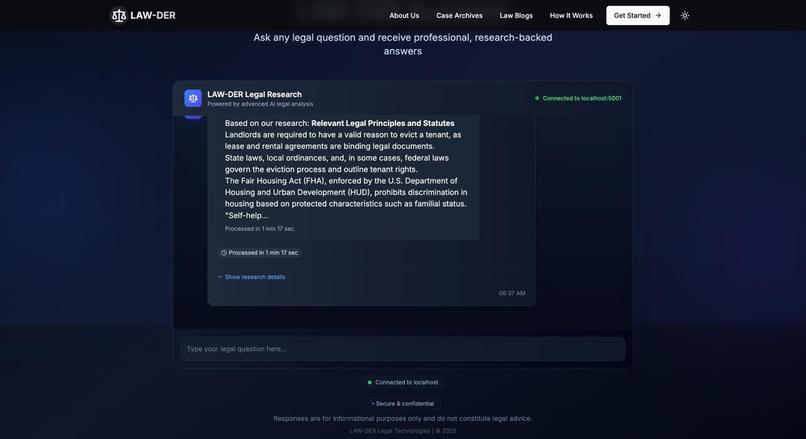
Chat bot


Inspiration
Justice is often daunting—complicated, time-consuming, and often inaccessible, especially to marginalized communities who are unable to afford legal representation. It is hard for many to understand their rights, navigate legal documents, and obtain competent legal counsel. Inspired by the vision of bridging this gap with AI, Law-Der was born. Our AI-powered legal assistant renders legal aid affordable, accessible, and personalized for every individual, bringing justice within reach of millions.
What it does
Law-Der simplifies legal processes and promotes equitable access to legal aid by leveraging AI-driven automation. The system streamlines legal workflows, enhances efficiency, and ensures accuracy in legal practice through:
- AI-Powered Issue Analysis – Users describe their case, and AI recommends legal actions.
- Intelligent Document Manager – AI analyzes legal documents and assists in form-filling.
- Legal Case Archive – A vast, searchable database of past cases and legal precedents.
- Weekly Law Blogs – Educational material on legal advancements.
- Global Lawyer & Law Firm Search – Connecting users to top legal professionals.
- Pro-Bono & Para-Legal Services – Ensuring access to legal aid for those in need.
Additionally, Law-Der simulates a law firm's workflow using AI agents for efficiency, automating:
- Client Consultation – AI-driven intake and case routing.
- Legal Research – AI-powered case law and statute analysis.
- Quality Control – Ensuring accuracy, compliance, and proper sourcing.
- Client Representation – Context-aware legal guidance using knowledge graphs.
By integrating front-office operations, back-office legal work, and AI-enhanced knowledge management, Law-Der revolutionizes the legal industry with smart, accessible, and efficient legal solutions.
Why CoHere?
- Multilingual Support
- Business Solution for Embedding
- Cohere Embed & Vector Database
- Re-Rank for Better Retrieval
How we built it
Our Tech Stack
Frontend
- Next.js 14 for scalability and performance
- React, TypeScript, Tailwind CSS, and Shadcn/ui for a modern, responsive UI
- Framer Motion for smooth animations
Backend
- LLM-powered applications using Cohere Embed, Cohere Command A, Cohere Re-Rank (Multi-Lingual), Chroma DB
- Cloud & caching integration with *Redis
- Flask-based API for backend services and AI interactions
- backed with AWS Buckets
Challenges we ran into
1) Legal Complexity – Keeping AI-generated responses on track with actual real-world legal structures in jurisdictions was the greatest challenge. Since laws were vastly different in all countries, states, and even cities, we had to ensure that our AI was context- sensitive and adaptable. Besides, legal text is dense and rich in detail, so it was critically important to train our AI to interpret legal texts properly without warping critical information. 2) AI Accuracy – Training our AI to provide precise, impartial legal advice and ensuring that our AI Lawyer doesn't produce any hallucinations. To tackle this, we developed three AI Models - A cohere-based AI Lawyer Assistant , one Legal Research Agent and one Verification agent. Because of this, we tackled the problem of the credibility of the information ensuring we took details only from renowned domains. 3) Scalability – Handling enormous libraries of case laws, lawyer directories, and legal documents efficiently. We had four large databases - Case Law Vector DB, Statues Vector DB, Regulations Vector DB and Precedents Vector DB.
Accomplishments that we're proud of
1) Leveraging NLP for Legal Assistance – Using advanced natural language processing to provide accurate and context-aware legal guidance.
2) Promoting Legal Accessibility & Inclusion – Ensuring equitable access to legal aid for underrepresented and marginalized communities.
3) Democratizing Legal Knowledge – Empowering individuals with AI-driven insights, making legal education more accessible and understandable.
4) Enhancing Legal Awareness – Providing users with AI-powered insights to help them understand their rights and navigate legal complexities.
5) Bridging the Justice Gap – Making legal resources and expert assistance accessible to those who may otherwise struggle to afford or find proper legal representation.
What we learned
1) AI’s Impact on Legal Accessibility – Exploring how AI can break barriers in the legal system, making justice more approachable while ensuring regulatory compliance.
2) Responsibility of AI in Law – Developing ethical, transparent, and unbiased AI solutions that provide accurate and fair legal guidance.
3) Inclusion – Creating an intuitive and user-friendly experience tailored to individuals with little to no legal background.
What's next for Law-Der
1) Expanding AI Legal Support – Covering more legal domains and languages. 2) Mobile App Launch – Bringing AI legal assistance to users on the go. 3) Collaborations with Legal Experts – Partnering with law firms to enhance AI accuracy. 4) AI-Powered Legal Education – Developing an interactive learning tool for students and citizens to master legal fundamentals.
Built With
- amazon-web-services
- beautiful-soup
- co:here
- command
- embed
- figma
- flask
- framemotion
- framermotion
- langchain
- next.js
- python
- reactquery
- redis
- rerank
- searapi
- shadcn/ui
- tailwindcss
- typescript


Log in or sign up for Devpost to join the conversation.