-
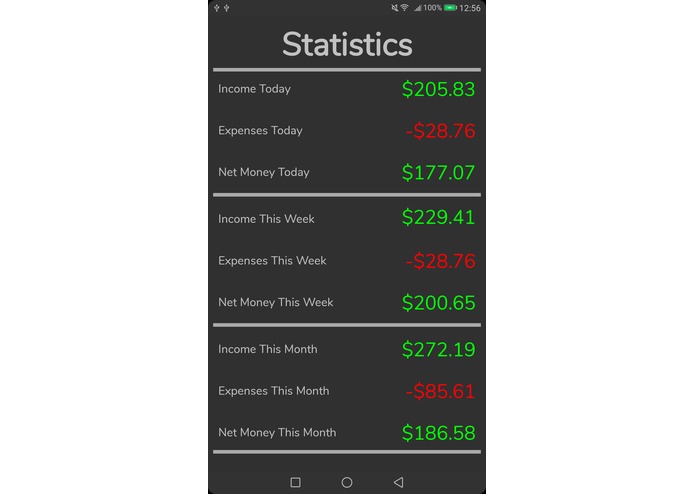
Statistics
-
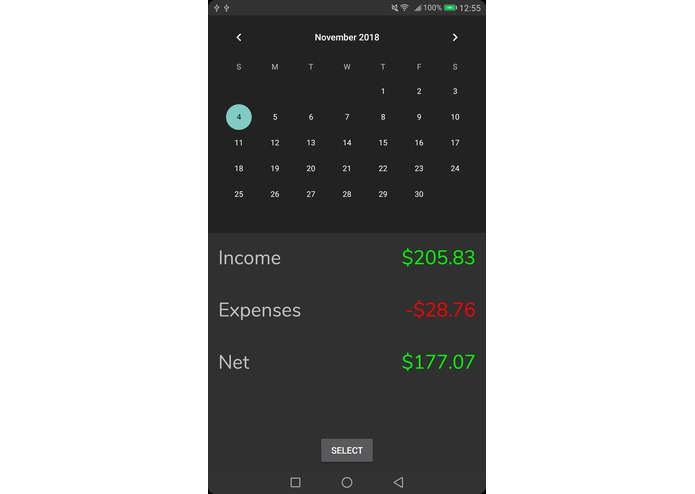
Calendar
-
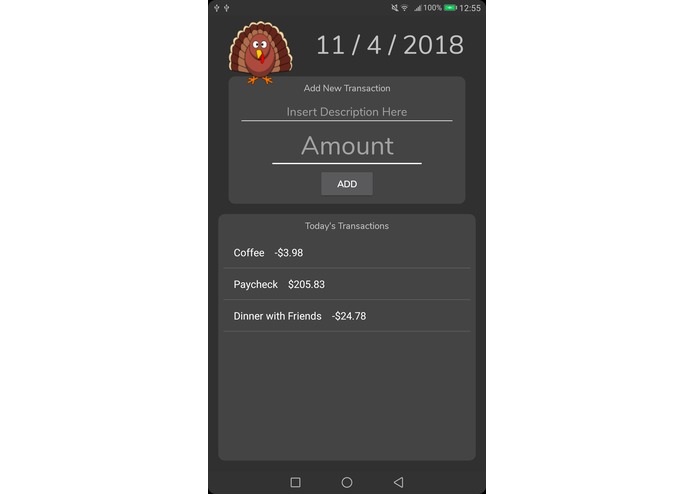
Main Transaction Page


Our Inspiration
College students always seem to have a problem with holding onto their money; whether it's buying daily 5 dollar coffees, or going on weekly Amazon shopping sprees, these spending habits definitely aren't good for us, especially when we are already bogged down by student loans. This Android application aims to help anyone, but especially college students, overcome these bad habits, and learn to save money over time.
What It Does
Every time the user makes a transaction (i.e. buys a burger, gets a paycheck, etc.) they enter it in, with a description of what the transaction was, and the amount of money. This is added to a list of transactions for the day, and is also logged in a calendar. If the user wants to access previous days, that can also be done through the calendar. Over time, statistics are kept of how much money the user was able to save, or how much the user couldn't save, and the user can see personal records too. Daily, weekly, and monthly stats help the user keep track of their progress of spending habits.
How We Built It
There are 3 Fragments, each which holds a different feature of the app. The Fragments must communicate with the data that the calendar holds through HashMaps, so that the data can be passed within Fragments, as well as eventually stored to the phone's storage so that the stats can be accessed again upon reopening the app. The xml also closely works with the java files to make the UI intuitive and nice-looking.
Challenges We Ran Into
As we have learned with previous Android applications, it can be very difficult to pass data between activities/fragments, especially when using different data structures to accommodate for key-value pairs. It was also difficult to make the app intuitive but also functional and beautiful, as Android doesn't come by default aesthetically pleasing.
Accomplishments That We're Proud Of
Oftentimes with hackathon projects, the end result can be very unfinished, in that it may work in most scenarios, but can be buggy when used over time as more and more aspects of the app are unveiled. We had to test a lot of possible scenarios for the app to encounter in real-life use, and doing this allowed our app to be very polished and basically ready for the app store, in terms of smoothness of functionality and UI.
What We Learned
Working as a team for any kind of Android application is very difficult. The API and files are not kept and saved in a way that is easy for group work on several machines, and we spent hours simply trying to salvage our work that we worked on separately when we brought it all together. In the future, we would probably aim to work on one machine all together, even though it may seem slower at first, at least for Android projects.
What's Next For Let's Get This Bread
More features, better statistics, a better looking, more intuitive UI, and possibly Internet integration or the ability to export your stats/data as a .csv file.


Log in or sign up for Devpost to join the conversation.