-
-
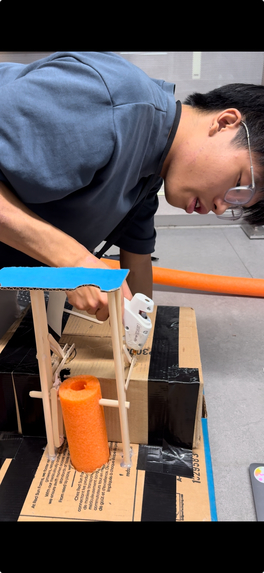
darren liu working hard at 4am

Inspiration
Within large buildings, we have seen many defibrillator machines, but as lifeguards, we were alarmed that there were no instructions on how to perform CPR. AED machines do not resuscitate without properly administered CPR, so it is of the upmost importance that there is also help for CPR.
What it does
Life Jacket is a small, compact CPR device which, when placed on an individual's chest, and begins administering CPR chest compressions while simultaneously calling emergency services utilizing Twilio's API.
These features make it so that people who live alone with heart problems can always have CPR administered to them even if no one is around, and that emergency services are alerted and can arrive quickly.
How we built it
We constructed the frame of our project with scrapped cardboard and wooden dowels found at the event. With glue and duct tape, we put together a piston that turns torque into linear movement with a servo attached to an Arduino Uno. As for the software, we generated the audio instructions using ChatGPT's TTS Api. We connected the arduino to python code to also make a Twillio Call which imitates calling the service centres.
Challenges we ran into
We came here with nothing other than an arduino starter kit. We had to scavenge for cardboard parts and make use of pringles cans for legs. Converting the radial movement of the servo into a linear movement for the piston was a challenge designing and executing with the little materials we had.
Accomplishments that we're proud of
Creating a socially good project that can hope to see a future for the elderly in our community. There was nothing else that can beat the pride of helping the people we love most.
What we learned
We learned design principles and the mechanics of torque. We also learned how to use Twilio API and send calls with custom voice messages.
What's next for Life Jacket
Life Jacket still holds much potential in the real world to grow beyond any typical defibrillator. With the incorporation of AI, turning our audio instructions into a full blown assistive AI will be our next step. This AI can help lower and redirect traffic from overworked emergency call centres. The design can also be made modular and adjustable so that it can fit any body size and produce enough force to properly perform CPR.


Log in or sign up for Devpost to join the conversation.